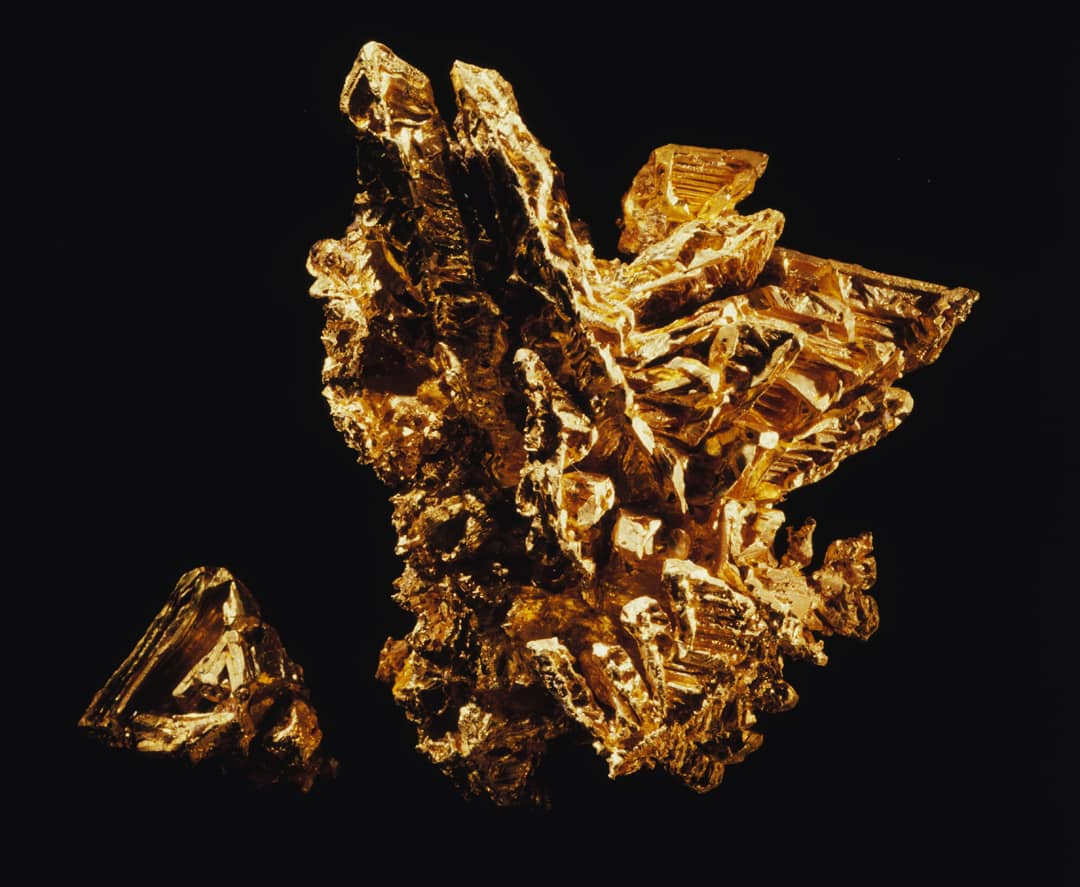
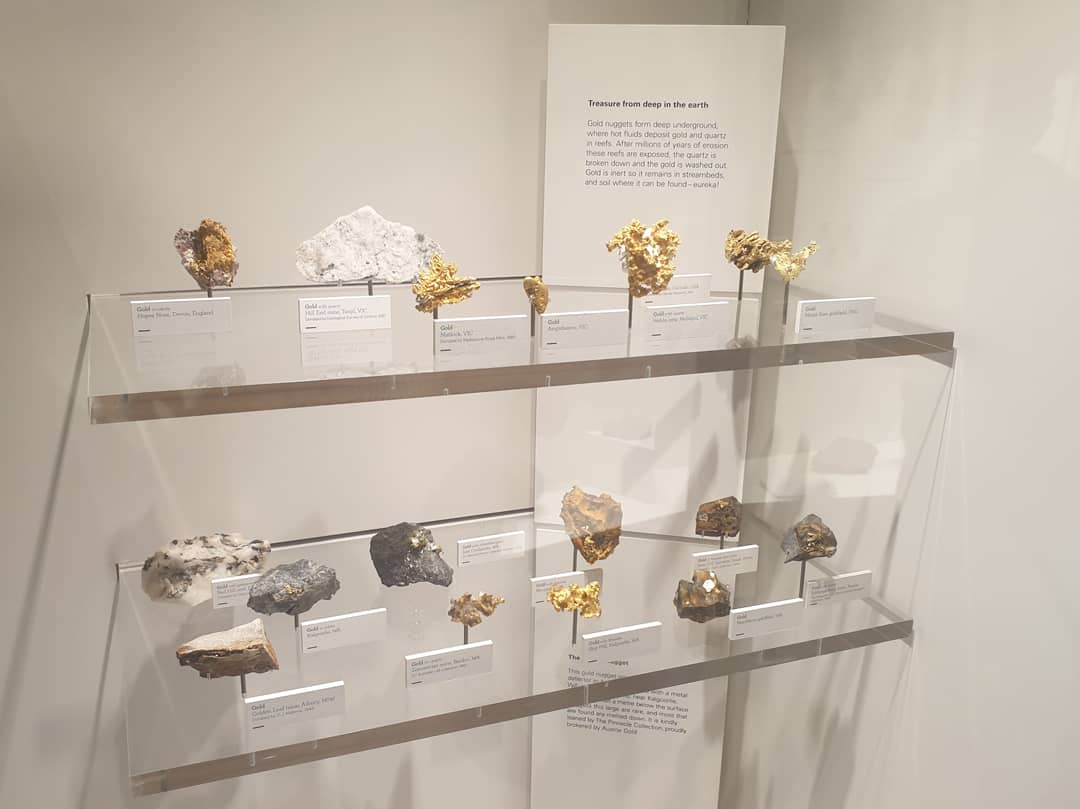
This collection comprises over 2,700 specimens of gold in a variety of forms, including gold nuggets, crystals, wire, ‘mustard gold’, and gold ores. It strongly represents the goldfields of Victoria, Western Australia, South Africa and New Zealand, and includes specimens from 40 countries across seven continents. It also contains 182 replicas of Victorian gold nuggets that were historically destroyed. These replicas, with associated historical registers, are now the only records of characteristics of many of the largest gold nuggets ever documented.
The collection has its origins with the gold rushes in the colony of Victoria (part of Australia from 1901) in the second half of the 19th century, during which over 61 million ounces of gold were mined. From 1853, public collections were built in Victoria to document, study, and educate the public on Victoria’s mineral wealth.
These early collections (of the Geological Survey of Victoria, National Museum of Victoria, University of Melbourne, and Industrial and Technological Museum) have been amalgamated under Museums Victoria and form the foundation of the Gold Collection. Important collections assembled by Matthew Smyth3 and Edward Dunn (Murchison medalist, author ‘Geology of Gold’ 1929) have supplemented this, as have hundreds of smaller acquisitions over 170 years.
Geo-collection value
The collection contains an exceptional breadth of gold specimens, the best of which are world-class examples of their kind 5. The range of habits, forms, and associations with other minerals, many of which are distinctive of localities, holds natural heritage value that would be difficult to replace.
The collection provides scientific value through research access, which in recent years has included studies on mechanisms of gold deposit formation1 and the biogeochemistry of microbe-gold interaction2. Similar specimens can otherwise be difficult or impossible for researchers to access due to expense, exhaustion or closure of mines, and changes in land use.
The historical and cultural value of the collection stems from systematic collecting and thorough documentation during 19th century gold rushes. Historical documents link gold specimens and replicas to people and places in Victoria, other parts of Australia, New Zealand and South Africa. These are relevant to the scientific and social history of these places, and demonstrate global trade and migration spurred by the search for and discovery of gold. Specimens and documentation are also a record of the impact of gold rushes on the First Peoples of these regions, the spread of migrant gold-seekers, and associated dispossession.
Display of gold specimens in Dynamic Earth Gallery, Melbourne Museum, Victoria, Australia.
Reference
Voisey, C. R., Hunter, N. J., Tomkins, A. G., Brugger, J., Liu, W., Liu, Y., & Luzin, V. (2024). Gold nugget formation from earthquake-induced piezoelectricity in quartz. Nature Geoscience, 17(9), 920-925.
Rea, M. A., Shuster, J., Hoffmann, V. E., Schade, M., Bissett, A., & Reith, F. (2019). Does the primary deposit affect the biogeochemical transformation of placer gold and associated biofilms?. Gondwana Research, 73, 77-95.
Henry, D. A., & Witcomb, A. (2023). Matthew McVicker Smyth and the ICI collection of gold at Museums Victoria. Australian Journal of Mineralogy, 24 (1): 16.