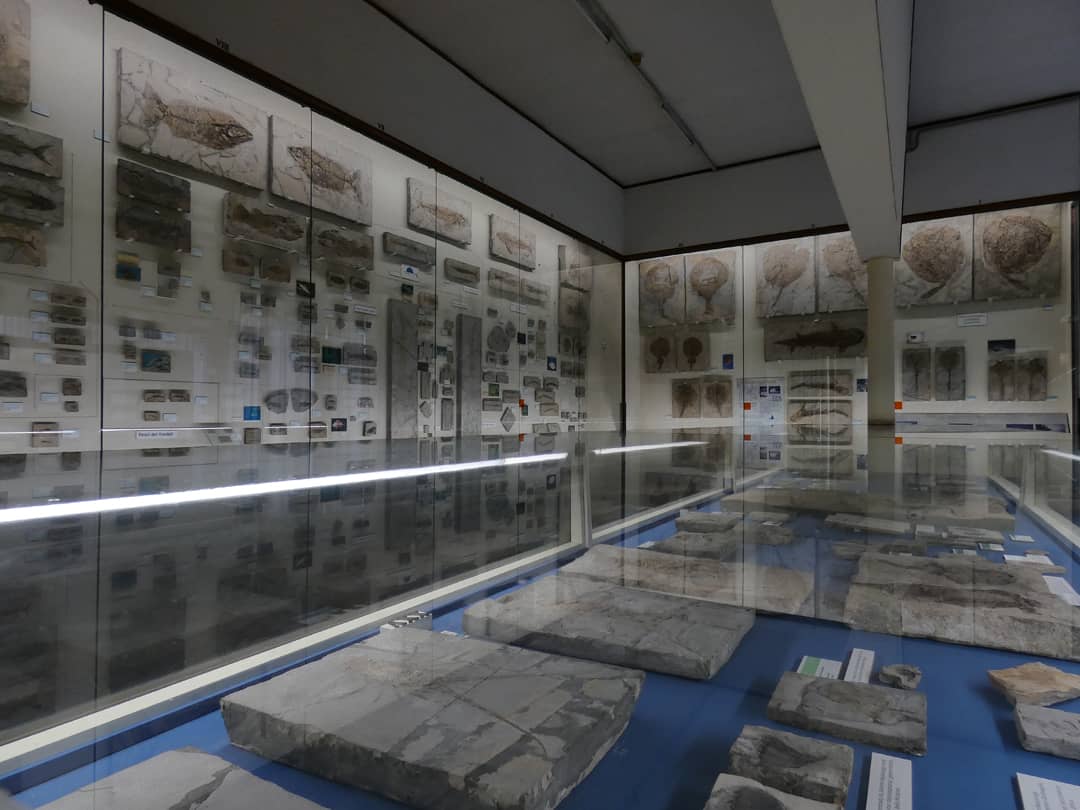
Exhibit of Bolca paleontological collection at the Natural History Museum of Verona.
The fossils of Bolca: a heritage of Eocene biodiversity.
Geo-collection description
The Natural History museum of Verona houses the most substantial paleontological collection from the Bolca deposits, which amount to over 10000 specimens, considering only the two main sites of Pesciara and Monte Postale. The collection is mainly composed of fossil fish that are inextricably linked in the collective memory to the name of Bolca. Plant remains (algae, marine and terrestrial plants) are also abundantly documented. Fossil of other animals, both vertebrates and “minor fauna,” can be found there.
In particular, the Pesciara has returned some, although rare, specimens of reptiles and bird feathers, as well as jellyfish and an arachnid (scorpion).
Insects, crustaceans, mollusks (bivalves, gastropods and, less common, cephalopods) bryozoans, brachiopods and annelids, on the other hand, came from both deposits (Papazzoni et al., 2014; Friedman & Carnevale, 2016; Zorzin et al., 2021).
The collection is the result of historical contributions (e.g. Gazola, Massalongo) and excavation campaigns carried out with scientific criteria since the second half of the twentieth century and still ongoing.
Geo-collection value
The Bolca paleontological deposit, including the sites of Pesciara and Monte Postale, is one of the most famous Fossil-Lagerstätten in Italy and worldwide. The age of the two deposits is attributed to Ypresian (Early Eocene), approximately between 50 and 49 million years ago.
Since the earliest reports, dated back to the second half of sixteenth century, the fossils of Bolca have been the focus of intense debates aimed to explain the presence of animals and plants within rocks. A very rich collection of publications, spanning almost five centuries of history (Mattioli, 1550), testifies the scientific interest and human curiosity about these fascinating legacies, emphasizing, among other things, the prominent role that Bolca fossils have played in the history of paleontology (Papazzoni et al., 2014; Romano & Carnevale, 2023). The exceptional state of preservation and rich variety of specimens make the collection of extraordinary value for phylogenetic studies and paleoecological, paleobiogeographical, paleoclimatic reconstruction. Furthermore the ichthyofaunal diversity, comprising 259 taxa, make Bolca a case study as biodiversity hotspot for Eocene (Papazzoni et al., 2014).
The collection is open to be studied by scientists, students and accessible to the public by permanent and temporary exhibitions. The Eocene marine deposits of Bolca are going to be presented for recognition of UNESCO World Heritage List.
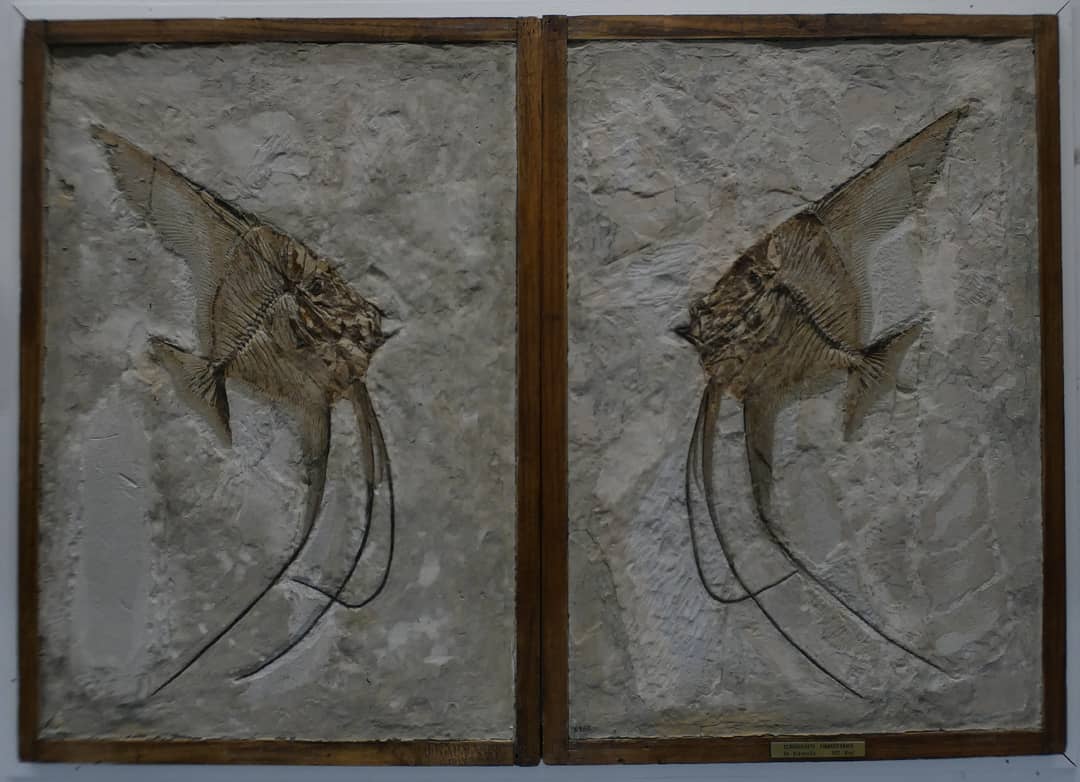
Ceratoichthys pinnatiformis (Blainville 1818).
Reference
Friedman M., Carnevale G., 2016. The Bolca Lagerstätten: shallow marine life in the Eocene. Journal of the Geological Society, 165, 569-579.
Mattioli P.A., 1550. Il Dioscoride dell’eccellente dottor medico M.P.And. Matthioli da Siena; con li suoi discorsi da esso la terza volta illustrati et copiosamente ampliati. Venezia, Valgrisi V., 701.
Papazzoni C.A, Giusberti L., Carnevale G., Roghi G., Bassi D., Zorzin R., 2014. The Bolca Fossil-Lagerstätten: a window into the Eocene World. Supplemento al Bollettino della Società Paleontologica Italiana, 53, 1, 110 pp.
Romano M., Carnevale G., 2023. The early studies on the Eocene Bolca Fossil-Lagerstätte (Italy): a historical overview. Bollettino della Società Paleontologica Italiana, 62 (2), 105-142.
Zorzin R., Bianchi S.A., Confente G., Frisone V., Giusberti L., Guerra R., Martinelli N., Pallozzi B., Roghi G., Saggioro F., Saracino M., Sommaruga M., Stradoni T., Zampieri D., (a cura di R. Zorzin), 2021. Il Patrimonio Geologico della Val d’Alpone e dell’alta Valle del Chiampo. Cierre Edizioni, Sommacampagna, pp. 232.