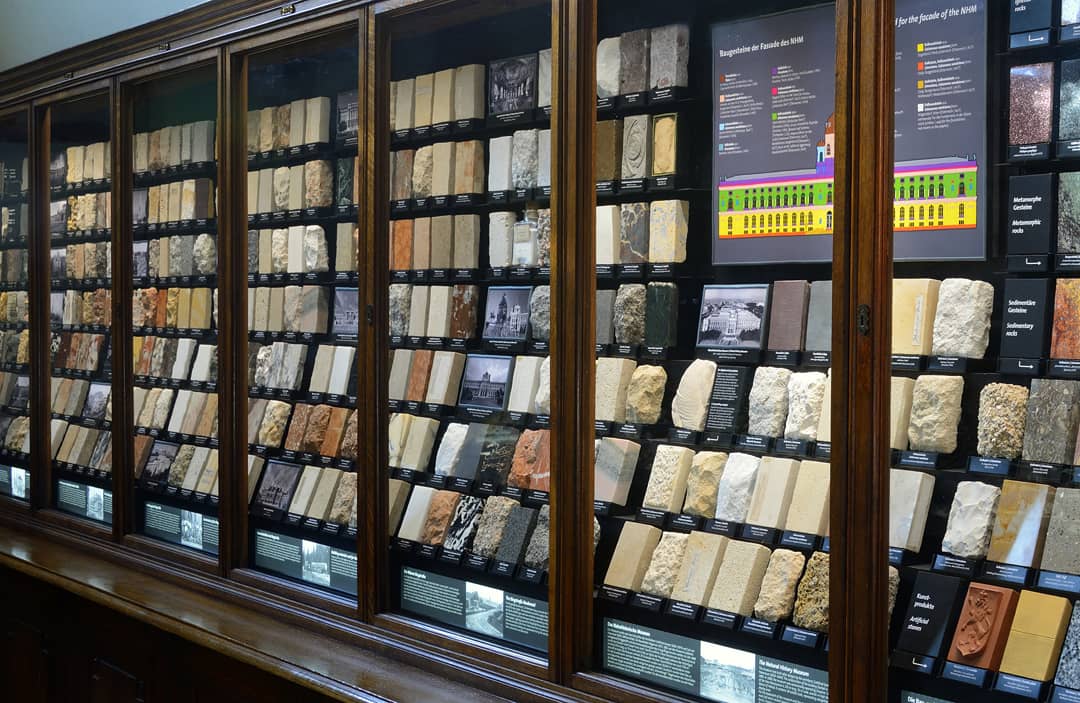
The building and decorative stone collection on display in Hall 1 of the Natural History Museum Vienna. Photo credit: K. Kracher, NHM Vienna.
One of the largest and oldest building and decorative stone archives in the world.
Geo-collection description
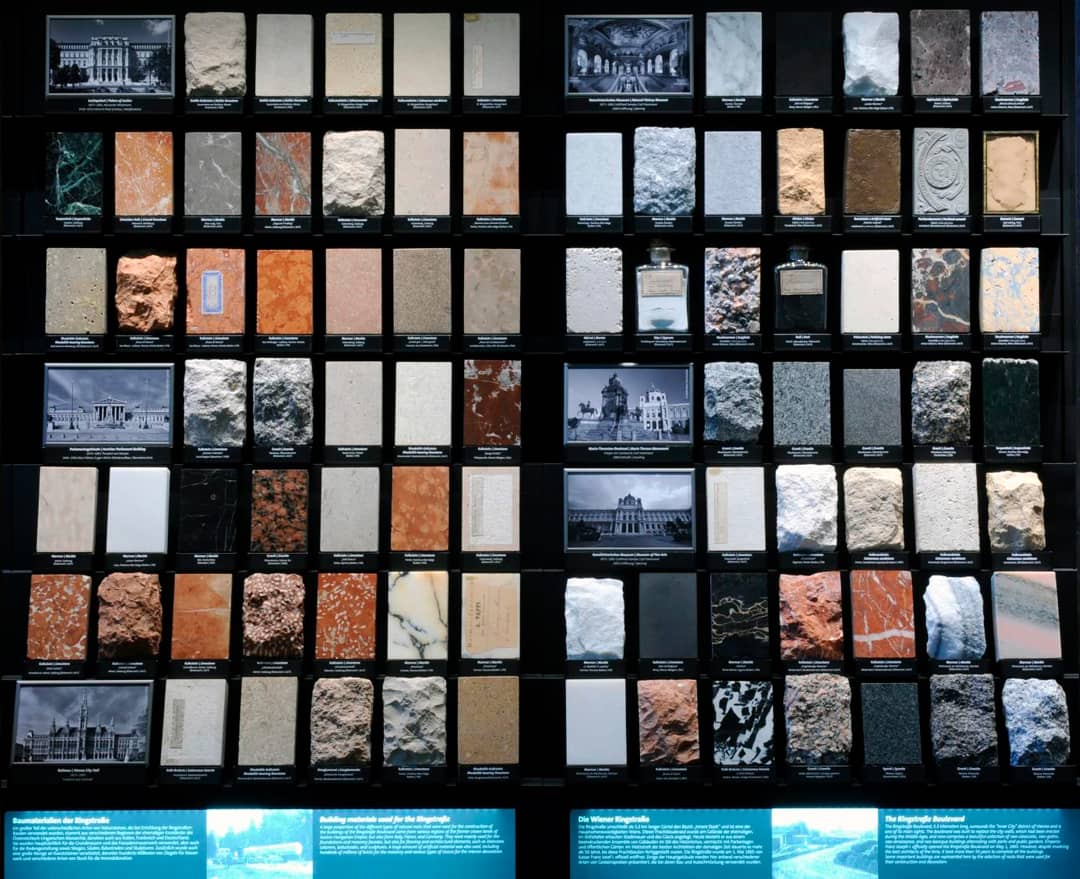
The collection mostly consists of natural rocks (formatted and one side polished), but also contains a few handmade products, such as scagliola (‘Stuckmarmor’), bricks, and roofing shingles. The specimens represent those used in monuments and buildings in Austria and, to a minor extent, in the rest of the world. The collection was initiated by Felix Karrer (1825-1903), a volunteer at the NHM Vienna, following the donation of a stone catalogue from the construction society “Union-Baugesellschaft” in 1878 and realizing the idea of Eduard Suess (1831-1914), who wished a geologically organized decorative stone collection. The oldest specimens of the collections are inherited from that of the Ambras Castle near Innsbruck (16th century), but the collection is constantly “updated” with the rocks used for building new monuments or with replaced plates after renovation of public buildings in the city of Vienna.
Geo-collection value
Scientific value: The collection is organized after geological classification, finding place, and inventory number. Labels and inventory books report information on the original quarry, place of usage, donor or seller, and year of acquisition in the collection. It is unique in its completeness of rock sources in the former Austro-Hungarian empire. For this information, the collection is constantly consulted by architects, art historians, and restaurateurs.
Historical value: Initiated by F. Karrer (1825-1903) but the collection contains specimens from the much older Ambras collection (16th century) up to the stones currently used for decoration of railway stations in Vienna, the collection has documented centuries and continues doing so. Cultural and educational value: The collection is seen as stony database of historical buildings, but also as tool for introducing the general public to geology, as the specimens are classified according to their geological origin, subdivided into magmatic, metamorphic, and sedimentary rocks. Representative samples are on exhibition in Hall 1 of the NHM Vienna; this exhibition was fully renovated in 2015 for the 100th years anniversary of the opening of the famous Ringstraße in the center of Vienna. Dedicated guided tours are regularly offered.
Detail of two showcases in Hall 1. Photo credit: A. Schumacher, NHM Vienna.
Reference
Karrer, F. (1892): Führer durch die Baumaterial-Sammlung des K.K. Naturhistorischen Hofmuseum [Guide through the building materals collection of the K.K. Naturhistorisches Hofmuseum]. R. Lechners k. k. Hof- und Univ.-Buchhandlung, Vienna, Austria, 302 pp.
Fischer, M., Moschner, I., Schönmann, R. (1976): Das Naturhistorische Museum in Wien und seine Geschichte [The Natural History Museum in Vienna and its history]. Annalen des Naturhistorischen Museums Wien, 80, 1-24.
Jovanović-Kruspel, S. (Ed.) (2015): Natural History Museum Vienna – A Guide to the Collections. Verlag des Naturhistorischen Museums, Wien, 256 pp.
Koeberl, C., Brandstätter, F., Harzhauser, M. & Riedl-Dorn, C. (2018): History and importance of the geoscience collections at the Natural History Museum Vienna. Geological Society of America Special Paper, 535, 131-161.