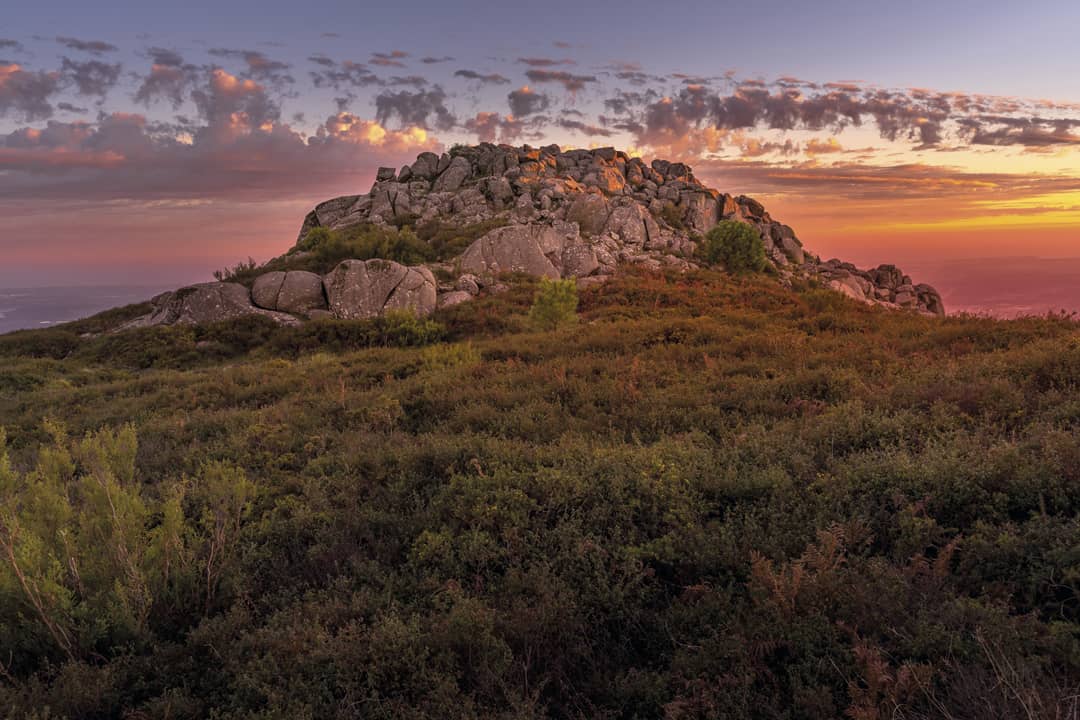
Panoramic view of the an outcrop of Monchique Alkaline Complex at the top of Fóia hill, Algarve, Portugal (Photo: Bernardo Costa Carneiro).
Geological Period
Cretaceous (Late Cretaceous)
Main geological interest
Igneous and Metamorphic petrology
Tectonics
Location
Monchique, Algarve, Portugal
37°18’53” N, 8°35’46” W
Panoramic view of the an outcrop of Monchique Alkaline Complex at the top of Fóia hill, Algarve, Portugal (Photo: Bernardo Costa Carneiro).
An iconic Cretaceous magmatic occurrence, critical to understanding how the Atlantic Ocean formed, with unique rock types.
The Monchique Alkaline Complex stands out for its spectacular magmatic features and exceptional diversity of alkaline igneous rocks, making it a pivotal site for studying this unique magmatic suite. The rare rock types of the complex, such as monchiquite and foyaite, provide crucial insights into mantle-crust interactions during the Late Cretaceous. Its geochemical influence extends beyond petrology, affecting the mineralization of local thermal waters, which are the highest in pH in Iberia. These waters, rich in sodium-bicarbonate, are not only scientifically valuable but also integral to balneotherapy and bottled mineral water industries, further enhancing the sites global relevance.
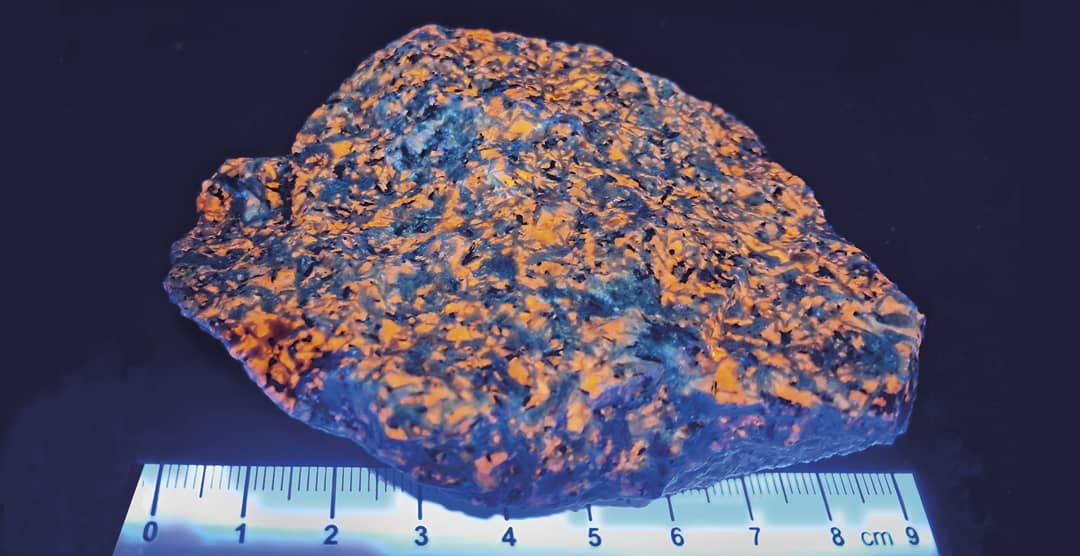
Image of a Foyaite under longwave UV light, displaying the spectacular fluorescence orange colours of sodalite.
Geological description
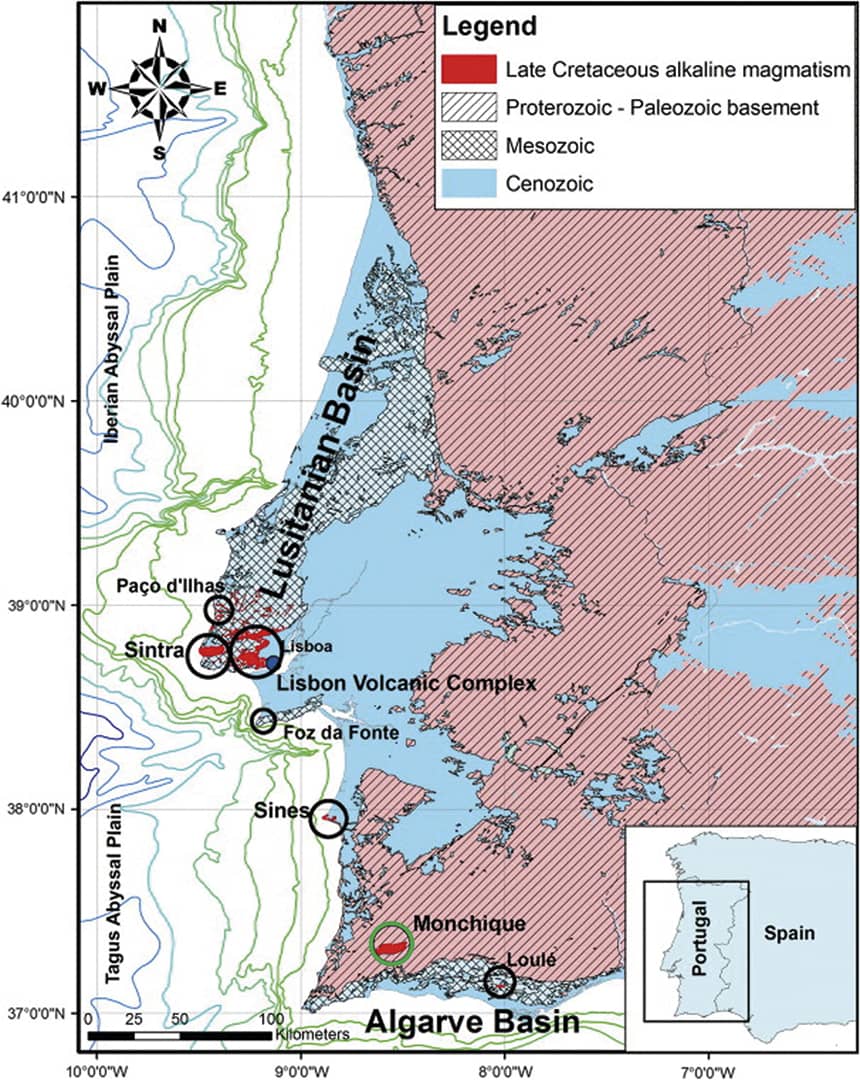
Late Cretaceous alkaline magmatism in Portugal (see map) is critical for understanding the opening of the central-north segment of the Atlantic Ocean (Miranda et al., 2009). The origin of Sintra, Sines and Monchique massifs, aligned along a NNW-SSE direction, have been intensely debated in Portuguese Geology (e.g.: Ribeiro et al., 1979; Bernard-Griffiths et al., 1997; Geldmacher et al., 2006).
The Monchique Alkaline Complex, located in Western Algarve (South Portugal), is the youngest and most spectacular of these magmatic complexes and is composed of two concentric nepheline syenite plutons, lamphrophyre dykes, and minor mafic-ultramafic outcrops (Rock, 1982; Gonzalez-Clavijo and Valadares, 2003). It was emplaced ~72 Ma ago (Miranda et al., 2009) within Carboniferous metapelite and quartzite.
The full spectrum of alkaline magmatism can be found, making the Monchique Alkaline Complex a key site to understand this magmatic suite, including rock types that were locally described, such as Monchiquite (feldspar-absent alkaline lamprophyre with amphibole, Ti-rich augite and olivine as predominant mafic minerals) and Foyaite (K-feldspar-nepheline syenite with trachytic texture; see photo above).
NNE–SSW-oriented faults in the complex control the emergence of the thermal waters at Caldas de Monchique, displaying temperatures of 31 °C, very high alkaline pH (9.5) and sulfurous hydro-geochemical nature.
Scientific research and tradition
This iconic magmatic occurrence has been the focus of dozens of research works covering both its petrological and hydrogeochemical features. Its alignement with the two other Cretaceous igneous massifs has been a critical topic of discussion in Portuguese geology, and the thermo-mineral waters of the region display long-known medicinal properties.
Geological setting of the Cretaceous alkaline magmatism in Iberia. The Monchique Alkaline Complex is highlighted in green.
Reference
Bernard-Griffiths, J. et al. (1997) “Continental Lithospheric Contribution to Alkaline Magmatism: Isotopic (Nd, Sr, Pb) and Geochemical (REE) Evidence from Serra de Monchique and Mount Ormonde Complexes,” Journal of Petrology, 38(1), pp. 115–132. Available at: https://doi.org/10.1093/petroj/38.1.115.
Geldmacher, J. et al. (2006) “Origin and geochemical evolution of the Madeira-Tore Rise (eastern North Atlantic),” Journal of Geophysical Research: Solid Earth, 111(B9). Available at: https://doi.org/10.1029/2005JB003931.
Gonzalez-Clavijo, E. and Valadares, V. (2003) “O Maciço Alcalino de Monchique (SW Portugal): estrutura e modelo de instalação na crosta superior,” Comunicações do Instituto Geológico e Mineiro, 90, pp. 43–64.
Miranda, R. et al. (2009) “Age constraints on the Late Cretaceous alkaline magmatism on the West Iberian Margin,” Cretaceous Research, 30(3), pp. 575–586. Available at: https://doi.org/10.1016/j.cretres.2008.11.002.
Ribeiro, A. et al. (1979) Introduction à la géologie générale du Portugal. Serviços geológicos de Portugal.
Rock, N.M.S. (1982) “The Late Cretaceous Alkaline Igneous Province in the Iberian Peninsula, and its tectonic significance,” Lithos, 15(2), pp. 111–131. Available at: https://doi.org/10.1016/0024-4937(82)90004-4.
Author(s)
Artur Abreu Sá
University of Trás-os-Montes e Alto Douro and Pole of the Geosciences Centre, Quinta de Prados, 5000-801 Vila Real, Portugal
Telmo Bento dos Santos
Instituto Dom Luiz (IDL), Faculdade de Ciências, Universidade de Lisboa, Campo Grande, 1749–016 Lisboa, Portugal
Maria do Rosário Carvalho
Instituto Dom Luiz (IDL), Faculdade de Ciências, Universidade de Lisboa, Campo Grande, 1749–016 Lisboa, Portugal
Tiago Catita
Instituto Dom Luiz (IDL), Faculdade de Ciências, Universidade de Lisboa, Campo Grande, 1749–016 Lisboa, Portugal