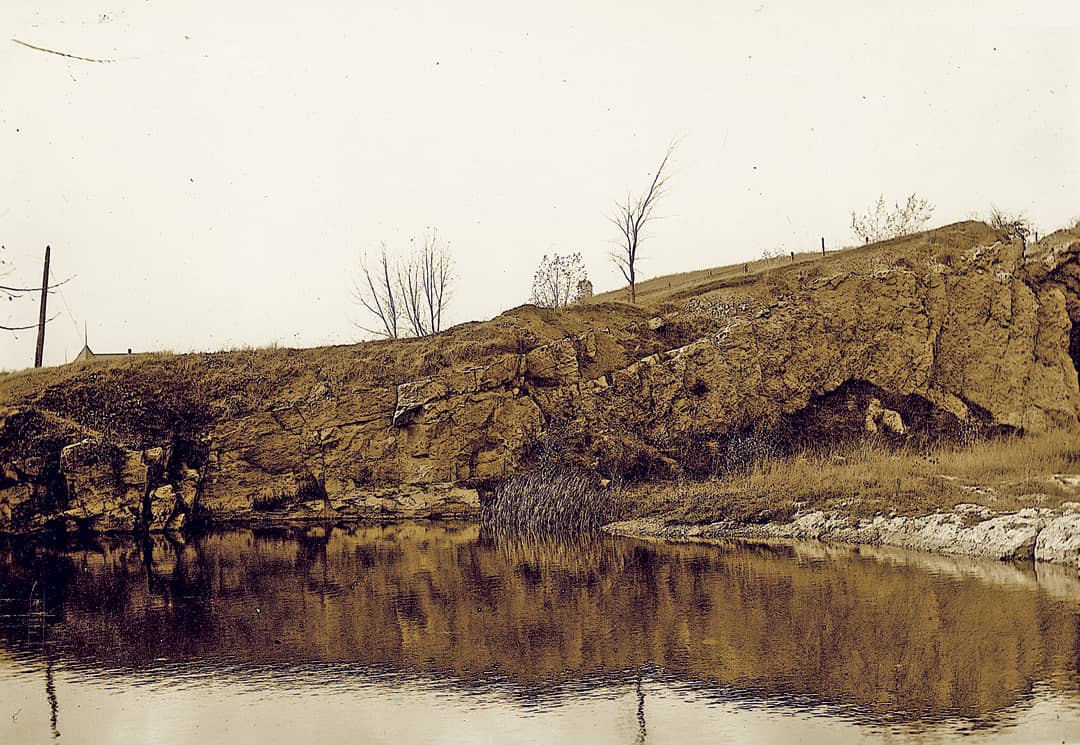
The Schoonmaker Reef (1898), showing the depositional transition from the massive reef mound on the right into the well-bedded sea floor strata on the left. Reef thickness on the right side of photograph is approximately 9 meters. (Photo: Alden USGS).
Geological Period
Silurian
Main geological interest
History of geosciences
Stratigraphy and sedimentology
Location
Wisconsin, United States of America.
43°2’49” N, 87°59’36” W
The Schoonmaker Reef (1898), showing the depositional transition from the massive reef mound on the right into the well-bedded sea floor strata on the left. Reef thickness on the right side of photograph is approximately 9 meters. (Photo: Alden USGS).
The first (1862) fossil coral reef defined by depositional and environmental criteria.
Study of the Schoonmaker Reef was crucial in establishing criteria for recognizing ancient coral reefs. During the early 1800s, the abundance of corals was used as the primary feature of modern reefs. As a result, reports of ancient reefs were erroneously based only on an abundance of corals, ignoring mounding or other depositional and environmental features of true coral reefs. Using a combination of these features, James Hall (1862), Thomas Chamberlin (1877), Amadeus Grabau (1903), and Robert Shrock (1939) established Schoonmaker as the first identified and textbook example of a Paleozoic coral reef based on depositional and ecological features.
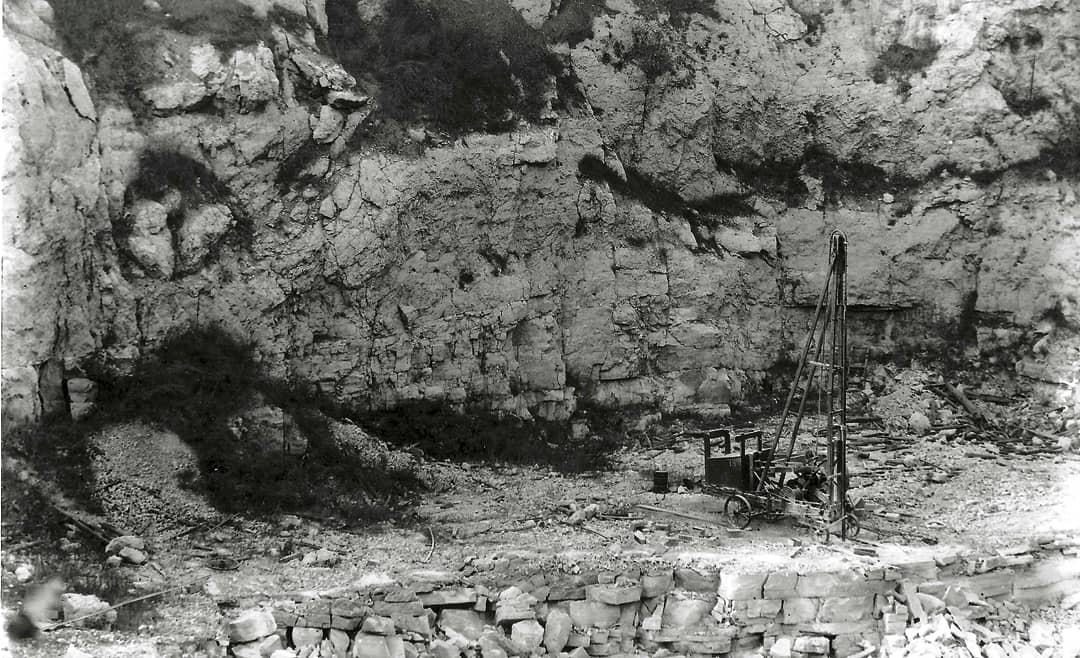
The north-west corner of the Schoonmaker quarry, showing massive reef core rock overlying well-beaded non-reef strata circa 1920. (Photo: Milwaukee Public Museum).
Geological description
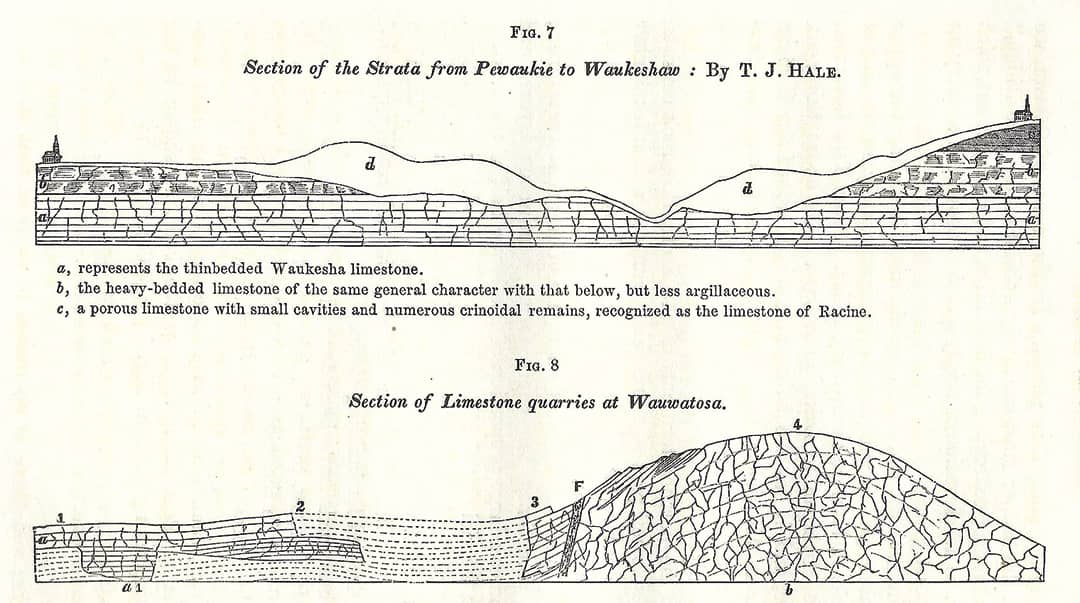
Pleistocene glacial sediments deeply bury the bedrock surface of the Milwaukee, Wisconsin region. However, at a few locations along the walls of the Menomonee River Valley, massive Silurian carbonate mounds project up into these sediments, which contrast with well-bedded carbonates found at lower elevations on the valley floor. It was initially thought that these different rock types were simply successive formations. By the early 1860s, however, stone quarrying had revealed important relationships between these carbonates. At the Schoonmaker Quarry in Wauwatosa, a gradational transition was exposed where weakly defined upper mound rubbly strata dipped downward and graded into fine-grained, well-bedded, horizontal strata. The paleontology of these rocks followed this transect, where a high diversity of attached benthos, including corals, in the upper mound was replaced by a lower diversity biota of mobile organisms, including large cephalopods, in the surrounding fine-grained horizontal strata. This transitional pattern suggested that these higher mounds were not merely erosional remnants of an overlying and younger formation, but were contemporaneous with the lower, surrounding horizontal beds. The changes in sedimentology of this transition resulted from the erosion of a biologically constructed reef mound growing at a faster rate than the surrounding sea floor environments.
Scientific research and tradition
The Schoonmaker Reef has been a primary site for research on Silurian reefs since the 1860s. In the early 20th century, it was a textbook example of an early Paleozoic reef and is still used to establish criteria for defining other Paleozoic coral reefs. It is now a geological science park.
Hall’s 1862 figure 8 showing the reef-to-sea-floor transition at the Schoonmaker Reef in Wauwatosa. Photo 1 represents the area between points 3 and 4.
Reference
Chamberlin, T.C. (1877) “Upper Silurian,” Geology of Wisconsin. Survey of 1873-1879. Madison: Published under the direction of the chief geologist, by the commissioners of public printing, pp. 327–394. Available at: http://archive.org/details/cu31924003974148.
Hall, J. (1862) “Physical geography and general geology,” in J. Hall and J. D. Whitney, Report of the Geological Survey of the State of Wisconsin. Madison: Authority of the legislature of Wisconsin, pp. 1–72.
Mikulic, D.G. and Kluessendorf, J. (1998) Wauwatosa’s ancient reef & amateur naturalist: Dedication of the Schoonmaker Reef and Fisk Holbrook Day Home as National Historic Landmarks. Wauwatosa: Wauwatosa Historical Society. p. 16.
Mikulic, D.G. and Kluessendorf, J. (2024) “Geoheritage and geoconservation in the American Midwest: Silurian reefs of the Milwaukee–Chicago region,” in R.M. Clary, E.J. Pyle, and W.M. Andrews (eds.) Geology’s Significant Sites and their Contributions to Geoheritage. Geological Society of London, Available at: https://doi.org/10.1144/SP543-2023-2.
Shrock, R.R. (1939) “Wisconsin Silurian Bioherms (Organic Reefs),” GSA Bulletin, 50(4), pp. 529–562. Available at: https://doi.org/10.1130/GSAB-50-529.