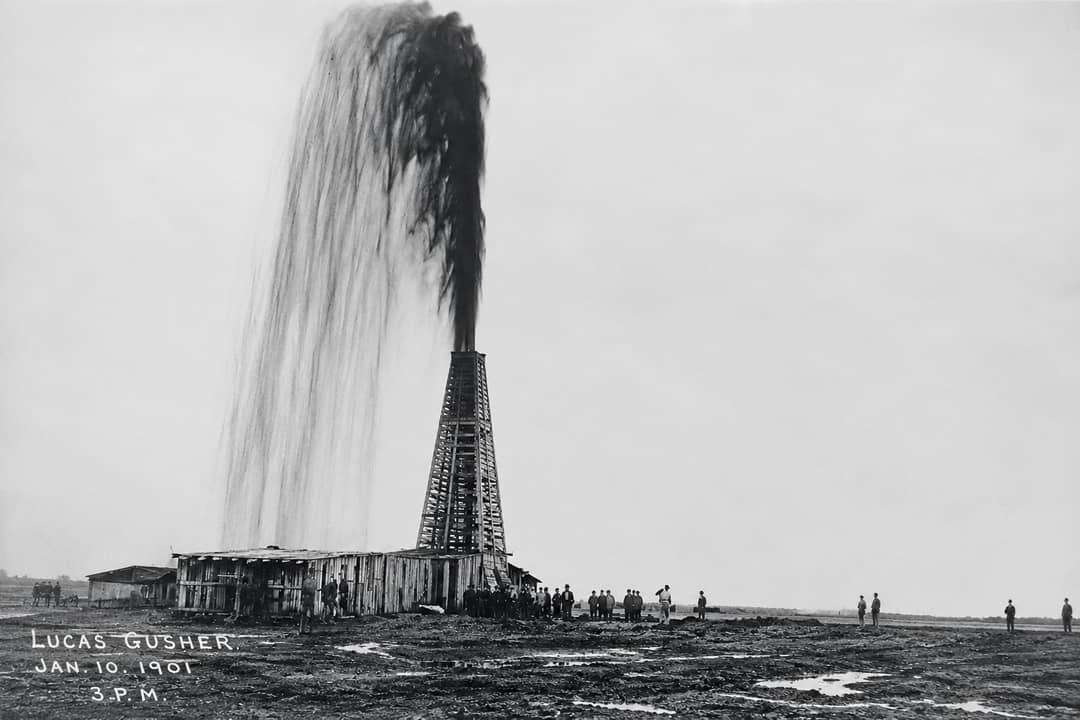
The Lucas Gusher which exploded on January 10, 1901 unleashed the liquid petroleum age, and moved oil production from the East to Texas.
Geological Period
Jurassic
(Middle Jurassic)
Main geological interest
History of geosciences
Stratigraphy and sedimentology
Location
Beaumont, Texas, United States of America
30°0’58” N, 94°4’24” W
The Lucas Gusher which exploded on January 10, 1901 unleashed the liquid petroleum age, and moved oil production from the East to Texas.
The discovery that validated salt dome structures as key geological controls for massive oil accumulations.
On January 10, 1901, Spindletop began spewing oil, quickly producing 100,000 barrels a day, exceeding the production in the rest of the world. While there had been a petroleum industry in Baku and the eastern U.S. for 50 years, previous wells produced only a small volume of oil.
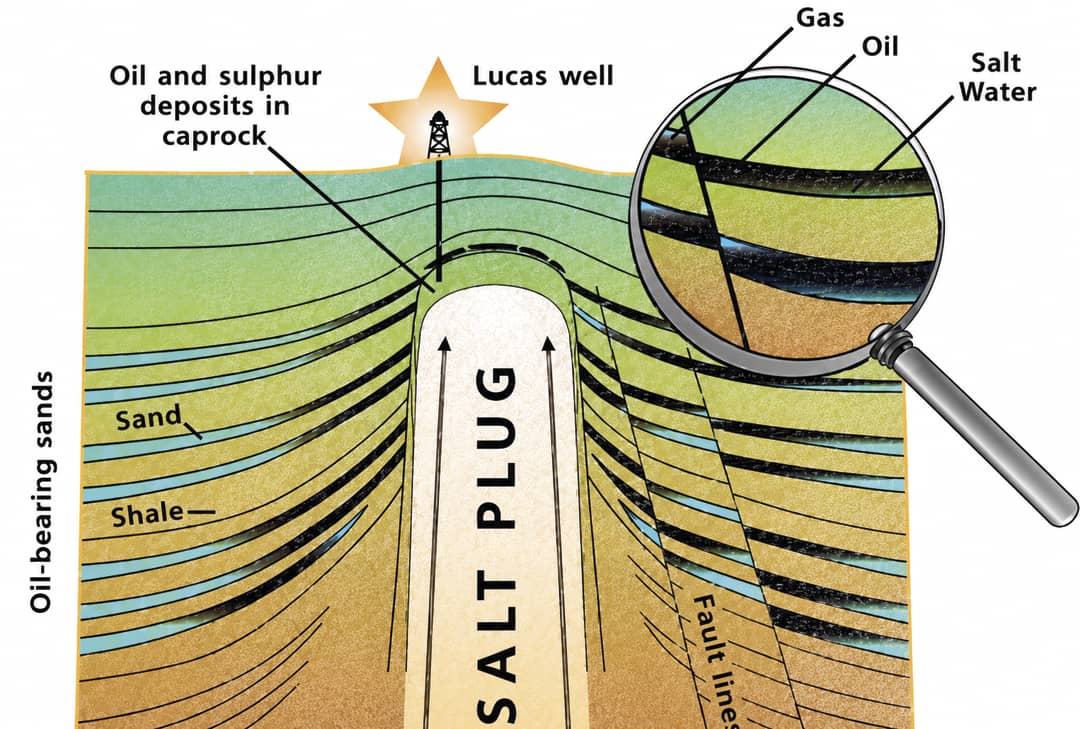
The discovery also validated the petroleum potential of salt domes. Spindletop proved that salt dome structures could trap large accumulations of hydrocarbons, establishing them as one of the most important concepts in petroleum geology.
Spindletop marked the beginning of the age of abundant petroleum. Oil rapidly became the dominant fuel for transportation, manufacturing, electric power generation, and military operations, fundamentally reshaping the global economy throughout the twentieth century.
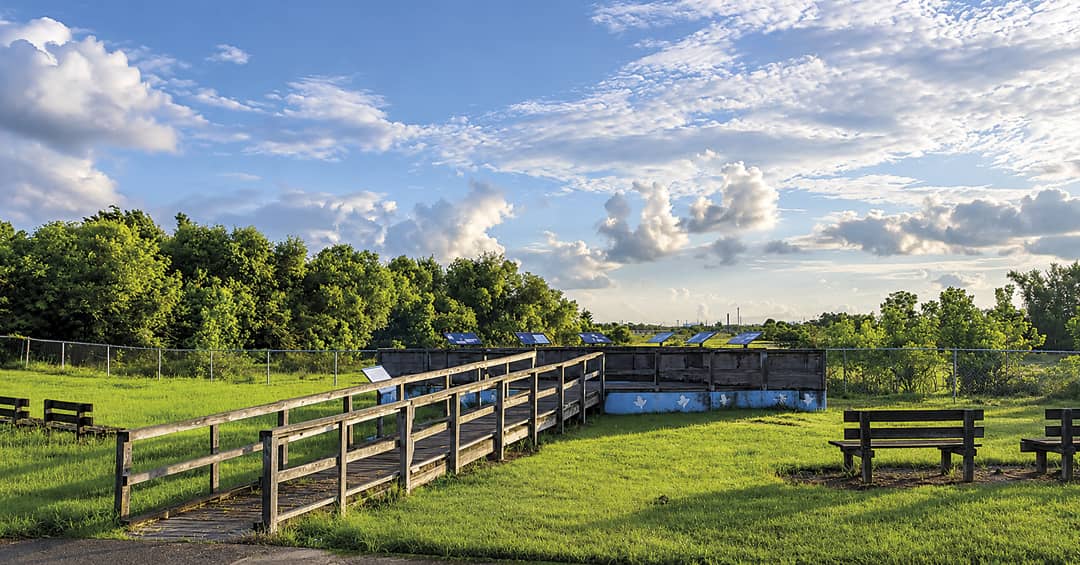
On April 12, 2001, the Spindletop Park was opened to allow a faraway glimpse of the original site of the Lucas Gusher, the surface location that marks the historic oil field at depth.
Geological description
The Spindletop Oil field was the first, and most famous, of the Gulf Coast oil fields. It established the salt dome as a petroleum trap. Spindletop had a diameter of about one mile and an anhydrite and gypsum cap. Most of the oil was produced from porous cavernous limestone at the top of the cap. Few fields of its size, just 265 acres, have produced as much, 30,000,000 barrels in the first three years.
Spindletop was formed when a column of Louann Salt moved upward through overlying sediments due to its low density and plastic behavior under pressure. The diapiric movement created a dome-shaped uplift, which deformed and fractured the surrounding strata. The crest and flanks of the dome created a prime location for oil traps.
The highly porous and permeable primary reservoir at Spindletop provided ideal conditions for oil storage and flow. The oil was found at a depth of about 1,020 feet (310 meters). The evaporite cap rock served as an effective seal, trapping the oil in the reservoir beneath and preventing it from migrating upward or escaping.
Significant, deeper oil production was later established in Oligocene Frio sands on the flank and under a salt overhang.
Scientific research and tradition
Since the days of the indigenous people, it was recognized there was oil in Southeast Texas. Especially obsessed was entrepreneur Pattillo Higgins, who drilled the Lucas Gusher despite the Texas state geologist who said that there was no oil at Spindletop.
The Lucas Gusher proved salt domes’ relationship to the vast reservoirs of oil along the Gulf Coast.
DeGolyer, E. (1945) “Anthony F. Lucas and Spindletop,” Southwest Review, 31(1), pp. 83–87.
Linsley, J.W., Rienstra, E.W. and Stiles, J.A. (2008) Giant under the Hill: A History of the Spindletop Oil Discovery at Beaumont, Texas, In 1901. Austin, Texas: Texas State Historical Association, 2002. Available at: http://archive.org/details/giantunderhillhi0000joan.
McKinley, F.B. and Riley, G. (2006) Black Gold to Bluegrass: From the Oil Fields of Texas to Spindletop Farm of Kentucky. Austin: Eakin Press.
Spencer, J. et al. (2021) “Spindletop Salt Dome Oil History and Geoscience 120 Years After First Oil Discovered Near Beaumont Texas January 10, 1901, to January 10, 2021,” 63(5), pp. 8–11.
Yergin, D. (1991) The Prize: The Epic Quest for Oil, Money & Power. New York, N.Y: Simon and Schuster.