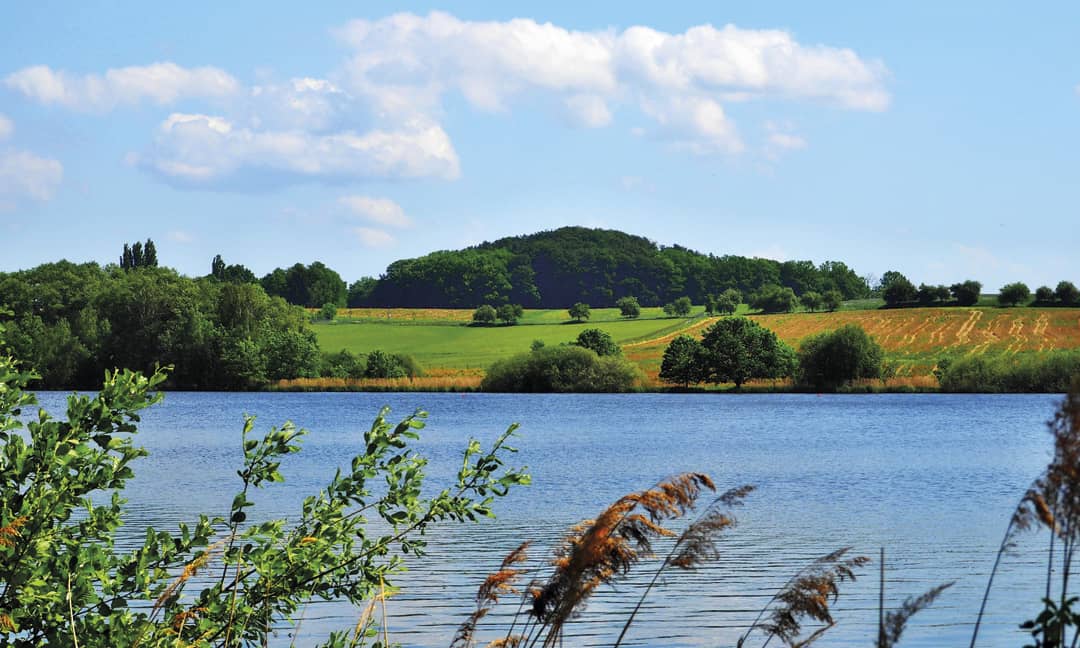
The inconspicuous hill represents an important locality where a dispute about the origin of rocks was resolved. (Photo: Jan Buriánek)
Geological Period
Quaternary (Pleistocene)
Main geological interest
History of geosciences
Volcanology
Location
Egeria National Geopark, Czech Republic
50°6’01” N, 12°20’20” E
The inconspicuous hill represents an important locality where a dispute about the origin of rocks was resolved. (Photo: Jan Buriánek)
A scoria cone where the first scientific excavation discovered a basaltic neck, resolving the Neptunist–Plutonist controversy over rock origins.
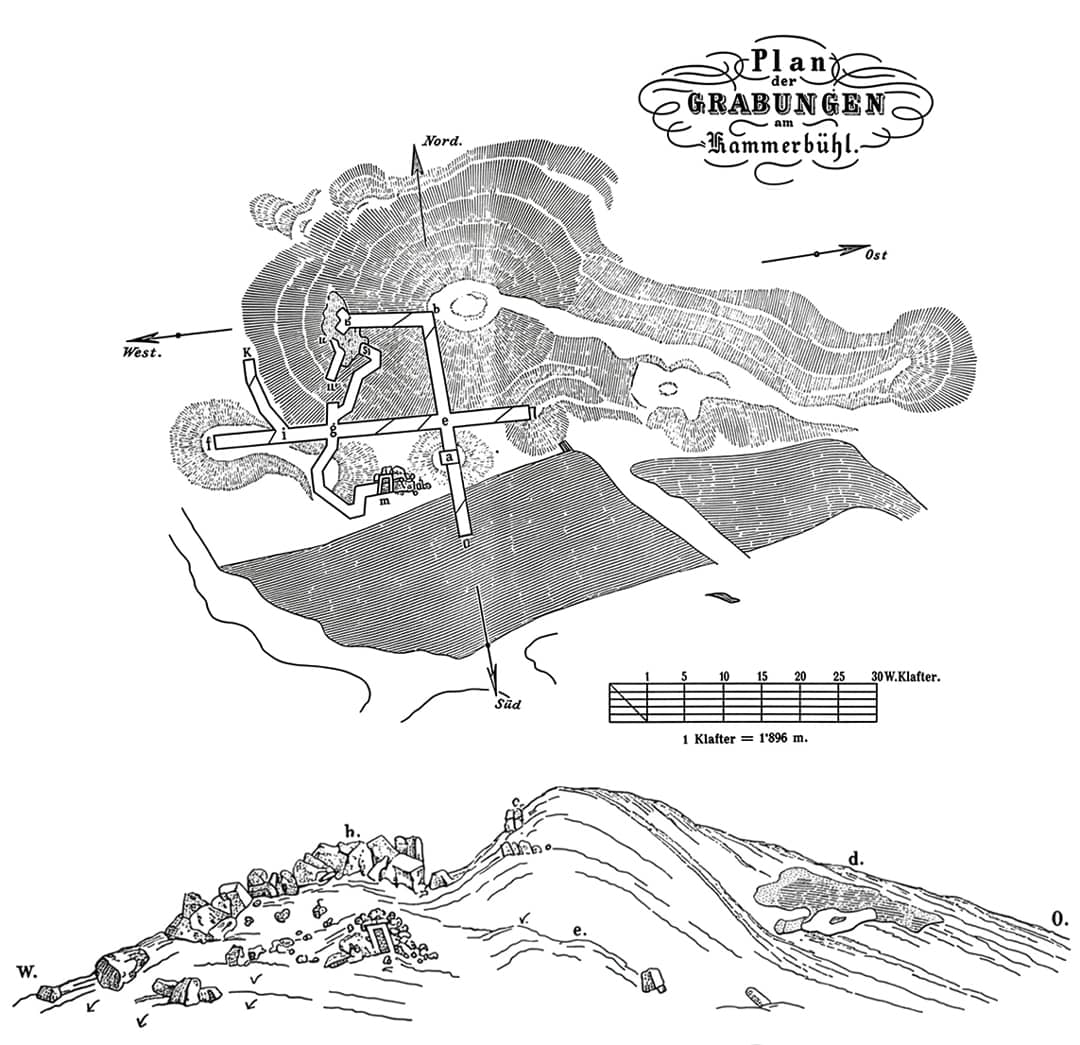
The site is a global milestone in the history of geosciences, having played a crucial role in the controversy between Neptunists and Plutonists over the origin of rocks. It hosted the first large-scale field experiment in geological history (1834–1837), where exploratory adits were excavated solely to determine if volcanoes were fed by burning coal or magmatic conduits. The 225-meter tunnel system exposed the basaltic neck and thermally affected sediments, definitively proving its magmatic origin. This first excavation undertaken exclusively for scientific purposes has been recently reopened, providing unique public access to the evidence that effectively ended a decades-long scientific dispute.
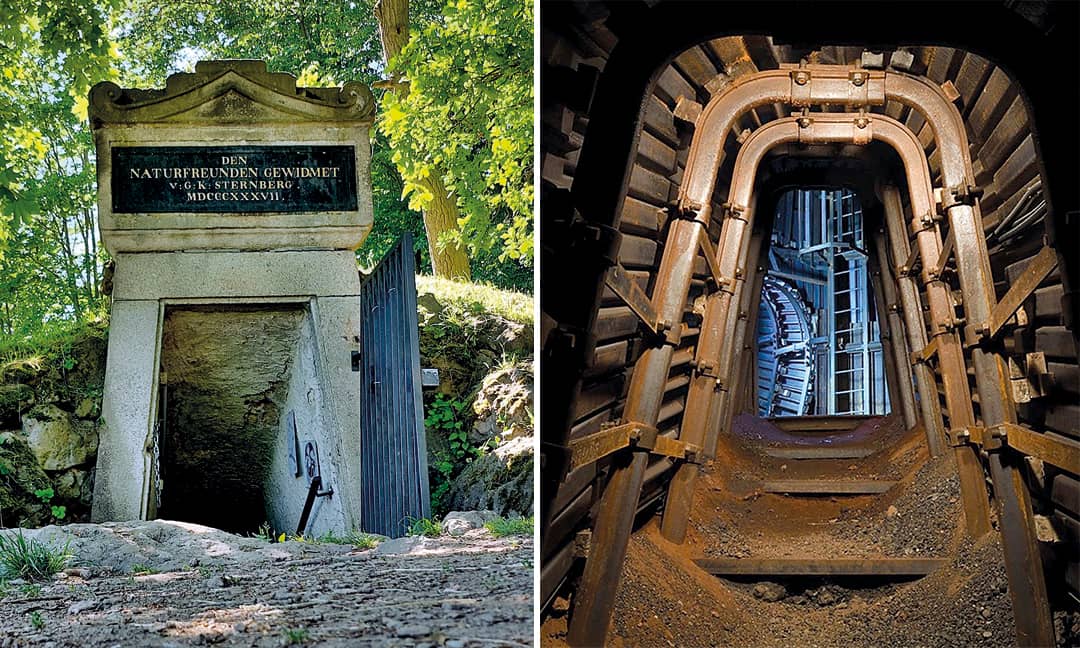
Left: Entrance to the exploration tunnel, which confirmed the inlet vent and thus the volcanic origin of Komorní hůrka. (Photo: Jan Buriánek). Right: The current appearance of the adit. (Photo: Petr Zajícek).
Geological description
Komorní hůrka is a Pleistocene (approx. 0.3 Ma) scoria cone composed of melilite-bearing olivine nephelinite, produced by very low degree partial melting of possibly carbonate metasomatized mantle in within-plate settings. It is located on the western margin of the NNW–SSE trending Cheb–Domažlice Graben (CDG) at its intersection with older Ohře (Eger) Rift. The volcano erupted through Neogene claystones and siltstones of the Cheb Basin. Its small size (ca. 200 m across) provides an exceptionally clear window into structure of a scoria cone. The eruption evolved from an initial phreatomagmatic phase (driven by magma-water interaction) that soon shifted towards the Strombolian style, producing mainly volcanic scoriae. The distribution of pyroclastic deposits is asymmetric (elongated to the east) due to the prevailing strong west-winds in poorly vegetated landscape of Middle Pleistocene. Ground geophysical surveys have identified the central magma conduit and the geometry of the lava flow. Komorní hůrka is situated in an area with frequent earthquakes known about since medieval times. While the Pleistocene volcanoes are arranged along the western margin of the CDG, the contemporary seismic swarms at the eastern margin of the CDG are associated with the ascent of Mantle-derived CO2-rich fluids (Mantle origin evidenced by isotopic signature).
Scientific research and tradition
Scientific tradition since the 18th century involves figures like von Born, Šternberk, Berzelius and Goethe. It hosted the first scientific excavation (1834–1837) investigating the hill’s structure. Modern research employs geophysics to map volcanic structures, while recently reopened adits and outcrops provide a unique educational geosite for historical and seismic studies.
Historical drawing of the hill profile and adit diagram.
Reference
Goethe, J.W. (1809) “Der Kammerbühl bei Eger ein Vulcan.,” Taschenbuch für die gesammte Mineralogie, 3–4(1–24), pp. 365–369.
Gottsmann, J. and Tobschall, H. (1997) “Petrographic and geochemical studies on the Komorní Hůrka scoria cone, Cheb basin, Czech Republic” Challenges to Chemical Geology, Abstracts. In: Journal of the Czech Geological Society, 42(3), pp. 54–0.
Hradecký, P. (1994) “Volcanology of Železná and Komorní hůrka in Western Bohemia” Bulletin of the Czech Geological Survey, 69(2), pp. 89–92.
Rapprich, V. et al. (2019) “A Crucial Site in the Argument Between Neptunists and Plutonists: Reopening of the Historical Adit in the Komorní hůrka (Kammerbühl) Volcano After 180 Years,” Geoheritage, 11(2), pp. 347–358. Available at: https://doi.org/10.1007/s12371-018-0286-z.
Wagner, G.A. et al. (2002) “Dating of the Quaternary volcanoes Komorní Hůrka (Kammerbühl) and Železná Hůrka (Eisenbühl), Czech Republic, by TL, ESR, alpha-recoil and fission track chronometry,” Zeitschrift fuer Geologische Wissenschaften, 30(3), pp. 191–199.
Author(s)
Markéta Vajskebrová.
Czech Geological Survey
Vladislav Rapprich.
Czech Geological Survey
Petr Rojík.
Muzeum Sokolov
Luboš Stárka.
Nature Conservation Agency of the Czech Republic
Milan Brož.
Institute of Geophysics of the Czech Academy of Sciences
Tomáš Fischer.
Charles University, Faculty of Science