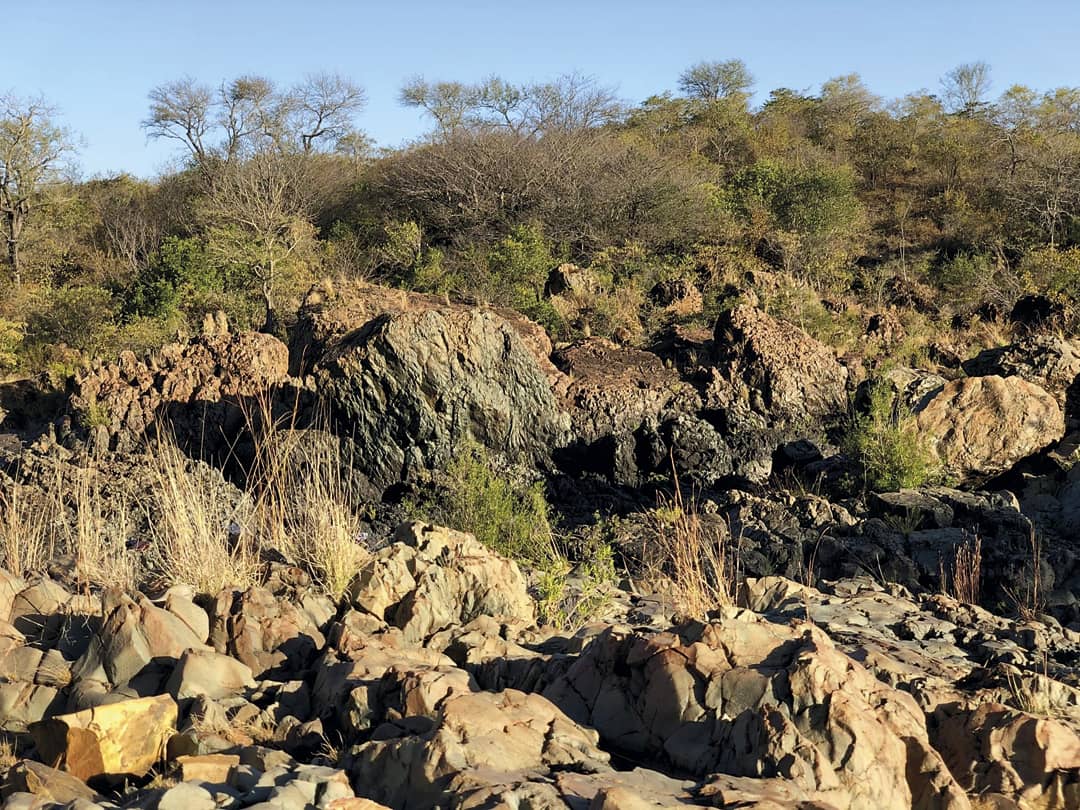
Regional geological landscape of the Belingwe Greenstone Belt showing Archean ultramafic and volcanic lithologies exposed along the river system. (Photo: Nomasiko Mpofu).
Geological Period
Meso-archean Era to Neo-archean Era
Main geological interest
Stratigraphy and sedimentology
Location
South-central Zimbabwe, primarily in the Mberengwa District, Zimbabwe
20°36’00” S, 30°0’00” E
Regional geological landscape of the Belingwe Greenstone Belt showing Archean ultramafic and volcanic lithologies exposed along the river system. (Photo: Nomasiko Mpofu).
A window to the Archean Earth with an extraordinary combination of early crust, early life, pristine komatiites and a monumental basal unconformity.
The Belingwe Greenstone Belt uniquely preserves key elements of Earth’s early history: some of the oldest fossil evidence of life, pristine ultramafic lavas formed in a hotter mantle, and a foundational unconformity critical for stratigraphic correlations. It is a natural laboratory that continues to underpin research in geobiology, geochemistry, and tectonics. Recognition as an Geological Heritage Site would ensure the conservation of this irreplaceable record, promote international scientific collaboration, and support sustainable development through geoeducation and geotourism. Its global relevance places it in the same league as other designated sites like Barberton (South Africa) and Nuvvuagittuq (Canada).
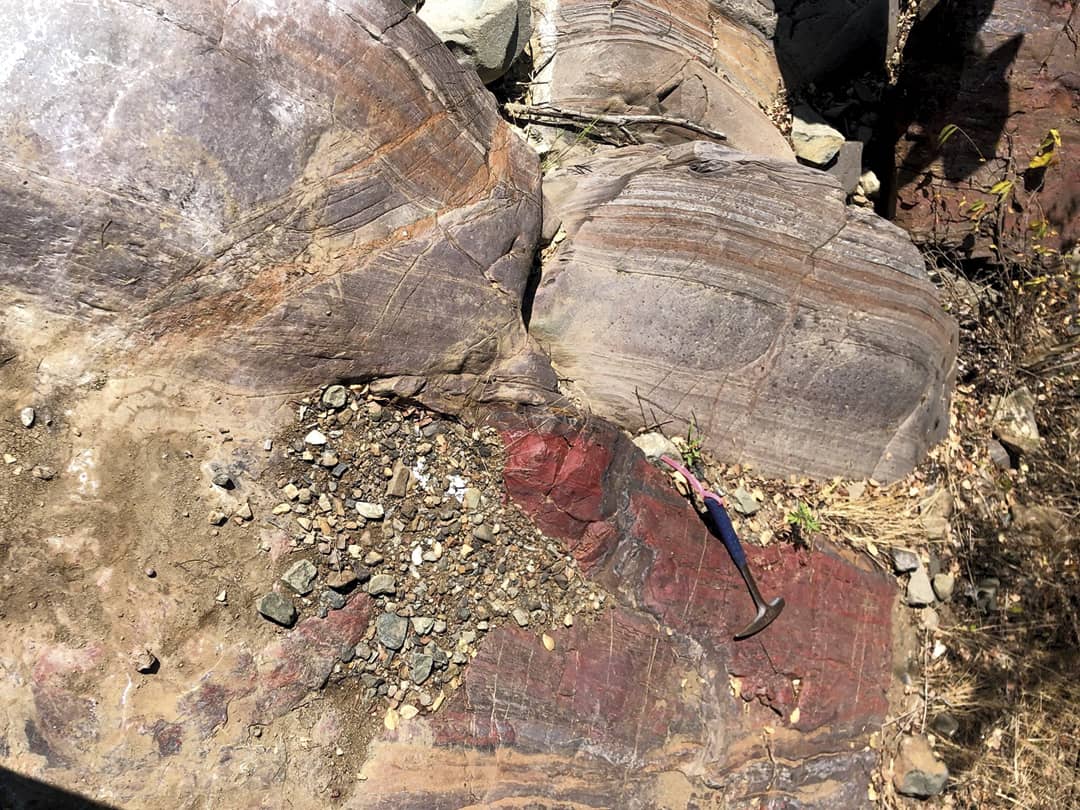
Manjeri Formation banded iron formation (BIF) overlying Archaean Shabani–Tokwe Gneiss basement across the Manjeri unconformity, with a thin basal gravel lag recording pre-Ngezi erosion. (Photo: Nomasiko Mpofu).
Geological description
The Earth’s early crust and life began in the Archaean. Good exposures of Archaean rocks are scarce, which has led to different interpretations on the evolution of the young Earth. The Belingwe Greenstone Belt (BGB) located in south-central Zimbabwe within the Archean Zimbabwe Craton, is one of the most scientifically studied Archean terrains. It has well-preserved rock exposures that are lowly metamorphosed and lowly strained, with structures that have contributed immensely to the debate on early earth processes.
The BGB has two broad greenstone sequences, the Ngezi (2.9 Ga) and the Mtshingwe (2.7 Ga) groups, bordered by 3.5 and 2.9 Ga gneisses, and intruded by 2.6 Ga granitoids.
While some researchers interpret greenstone belts as remnants of oceanic crust thrusted onto continents, others infer primary deposition onto continental rifts. A well-exposed unconformity between the BGB horizons and basement gneisses, which has been declared a National Monument, is fundamental to the advancement of this debate, and the elucidation of Archean stratigraphy.
Ubiquitous komatiites in the BGB provide evidence for high-temperature early mantle conditions while the exceptionally preserved stromatolites offer evidence for the beginning of life on Earth, and photosynthetic processes that contributed to the planet’s oxygenation.
Scientific research and tradition
The Belingwe Greenstone Belt has been a cornerstone of Archean geological research for decades, extensively studied for its well-preserved stromatolites, komatiites, and unconformities. It has served as a global reference site for early Earth processes, crustal evolution, and the origins of life and the atmosphere.
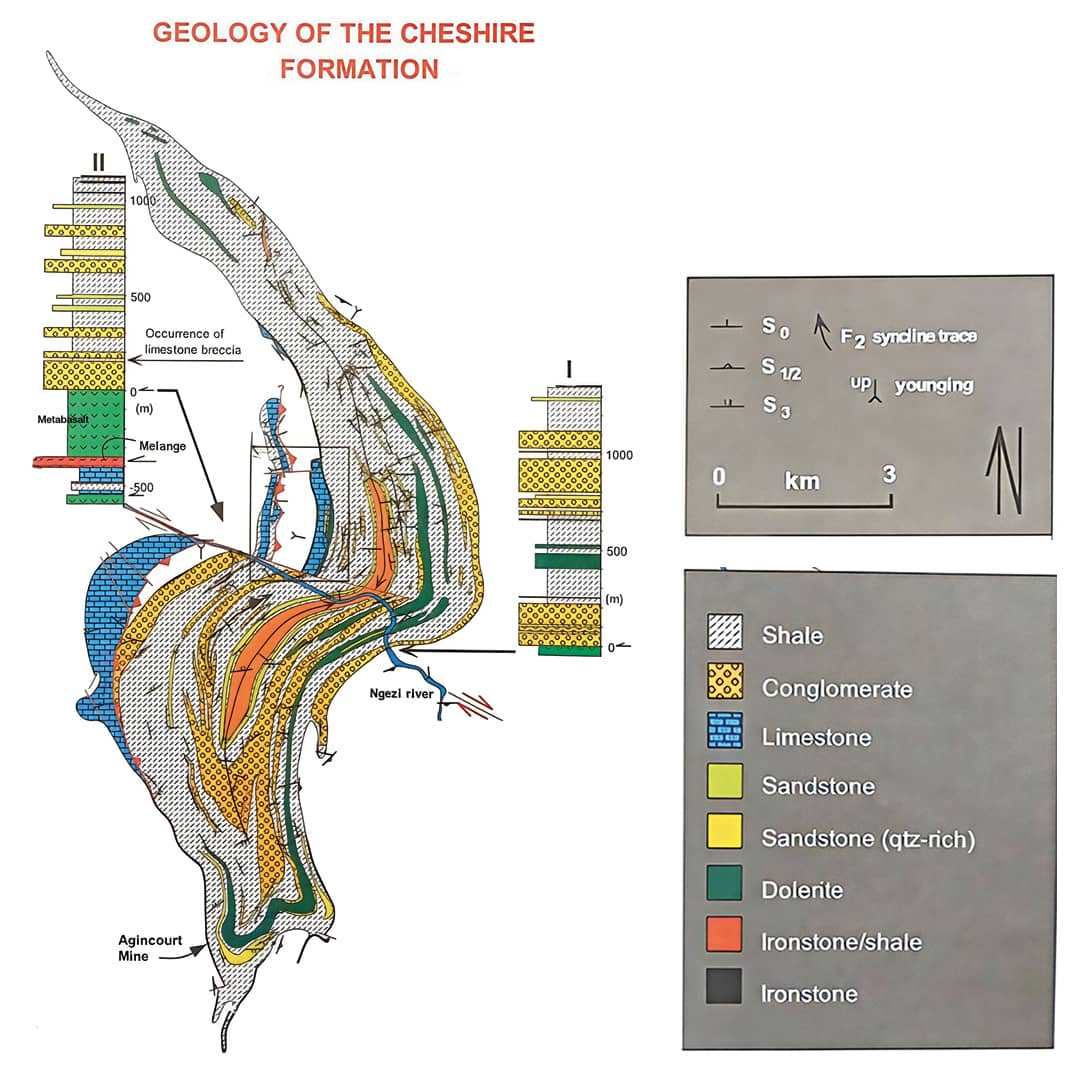
Localized geological map of the Cheshire Formation and associated stromatolitic sedimentary succession within the Belingwe Greenstone Belt, Zimbabwe. Adapted from Hofmann et al. (2001).
Reference
Abell, P.I. et al. (1985) “Archaean stromatolites from the Ngesi Group, Belingwe greenstone belt, Zimbabwe; preservation and stable isotopes — preliminary results,” Precambrian Research, 27(4), pp. 357–383. Available at: https://doi.org/10.1016/0301-9268(85)90094-4.
Bickle, M.J., Martin, A. and Nisbet, E.G. (1975) “Basaltic and peridotitic komatiites and stromatolites above a basal unconformity in the Belingwe greenstone belt, Rhodesia,” Earth and Planetary Science Letters, 27(2), pp. 155–162. Available at: https://doi.org/10.1016/0012-821X(75)90024-2.
Hofmann, A., Dirks, P.H.G.M. and Jelsma, H.A. (2001) “Late Archaean foreland basin deposits, Belingwe greenstone belt, Zimbabwe,” Sedimentary Geology, 141–142, pp. 131–168. Available at: https://doi.org/10.1016/S0037-0738(01)00072-0.
Mugumbate, F. (2024) “The value of the Belingwe Greenstone Belt, Zimbabwe, as a national geoheritage site,” in R.M. Clary, E.J. Pyle, and W.M. Andrews (eds.) Geology’s Significant Sites and their Contributions to Geoheritage. Geological Society of London, p. 0. Available at: https://doi.org/10.1144/SP543-2022-244.