End-Permian Mass Extinction at the Opal Creek Section
Canada
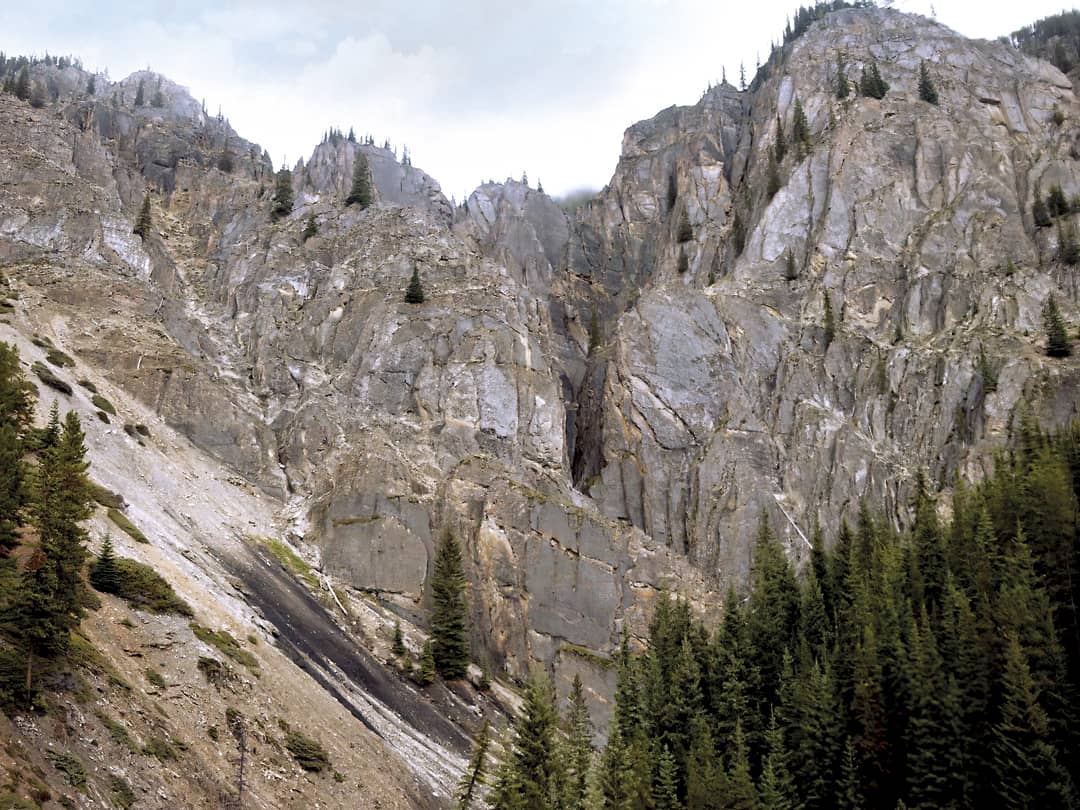
Opal Creek section with vertical resistant beds of Pennsylvanian and Permian units and black recessive unit is uppermost Permian and Lower Triassic Sulphur Mountain Formation.
Geological Period
Permian (Cisuralian) to Triassic (Early Triassic) boundary
Main geological interest
Stratigraphy and sedimentology
Paleontology
Location
Kananaskis Country, Alberta, Canada
50°40’32” N, 115°4’48” W
Opal Creek section with vertical resistant beds of Pennsylvanian and Permian units and black recessive unit is uppermost Permian and Lower Triassic Sulphur Mountain Formation.
North America’s most detailed biostratigraphically constrained geochemical record of the greatest Phanerozoic Mass Extinction.
IUGS GHS 018 (Meishan, China) represents the world’s most intensively studied Permian-Triassic boundary section documenting the greatest Phanerozoic mass extinction record for the Tethys Ocean. However, there are few detailed records of the Permian-Triassic boundary (PTB) preserved from the Panthalassic Ocean, which covered ~70% of Earth’s surface. The Opal Creek section is among the few filling that gap, preserving a succession that spans the End-Permian mass extinction (EPME) and PTB. Conodont biostratigraphic and geochemical studies reveal harsh oceanographic conditions prior to the EPME when a demosponge community became extinct; most marine biota were extinct from the region much earlier in contrast to the Meishan record.
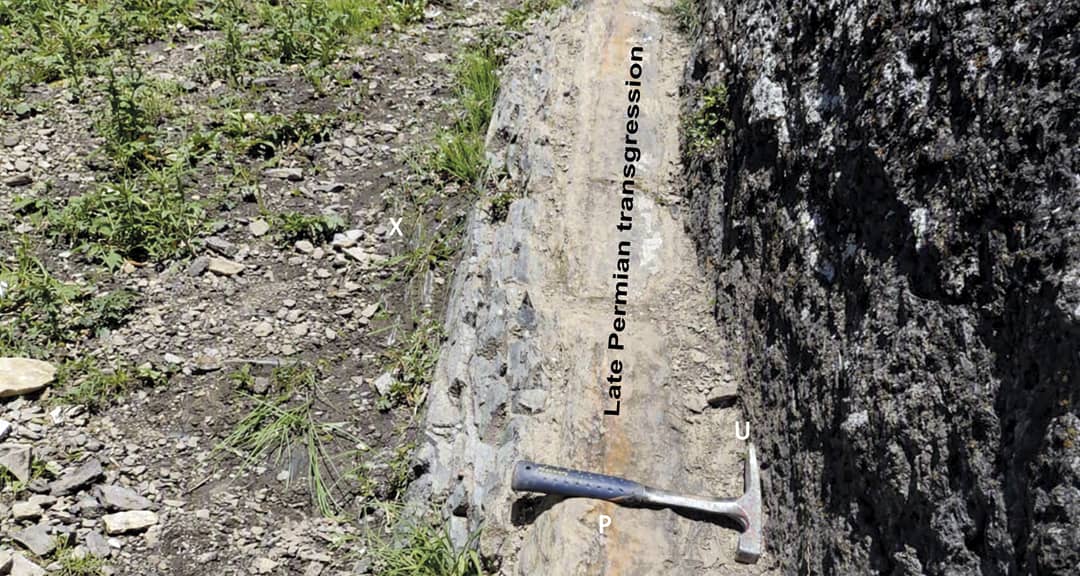
Contact closeup: hammer (30 cm); unconformable base (U) of transgressive Sulphur Mountain Formation. Pyrite layers (P) visible; demonsponge extinction (X) about 10 cm above blue-grey siltstone.
Geological description
The Opal Range in the Front Ranges of the southern Canadian Rocky Mountains forms sawtooth profiles of nearly vertical sedimentary layers. The Opal Creek section is noteworthy because it includes numerous unconformities within a thin Permian succession (Johnston Canyon and Ranger Canyon formations) overlain by thick uppermost Permian to Lower Triassic Sulphur Mountain Formation (Henderson, 1997). The Permian records an active cold-water coastal upwelling zone that supported high productivity. The Sulphur Mountain Formation is dominantly an outer shelf to upper slope succession of shaly siltstone at the base shallowing into shoreface at the top. The section provides a detailed record of the PTB interval and End-Permian mass extinction EPME on the eastern Panthalassic Ocean margin. Detailed isotopic and trace element studies have focussed on the shaly siltstone in the lower ~30 metres (Schoepfer et al., 2013; Zhang et al., 2017). These studies indicate a distinct euxinic episode preceded the local extinction of a demosponse community, which is associated with abrupt cessation of coastal upwelling. This pattern is comparable to sections in northeast British Columbia (Schoepfer and Henderson, 2022) and the Canadian Arctic (Algeo et al., 2012; Beauchamp et al., 2009) in terms of facies succession and extinction signature.
Scientific research and tradition
Located in Kananaskis Country, the section is located in protected public land use region in Alberta. The section was first demonstrated as an important PTB site in 1997. The geochemistry was first studied as post-doctoral research by Shane Schoepfer and subsequenctly many international scientists have visited and sampled the site.
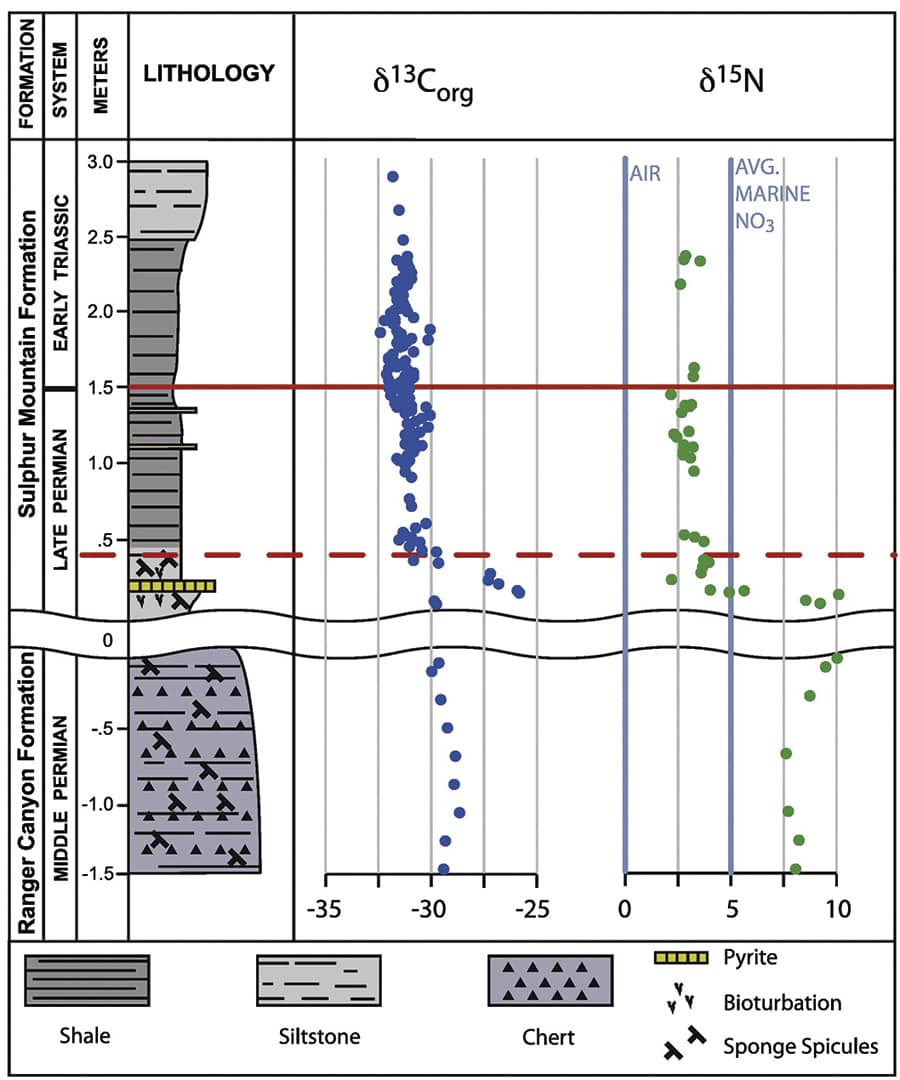
Carbon and nitrogen isotopic geochemistry and lithology of basal Opal Creek section; EPME at dashed red line (modified from Schoepfer et al., 2013, fig. 4).
Reference
Algeo, T. et al. (2012) “Evidence for a diachronous Late Permian marine crisis from the Canadian Arctic region,” GSA Bulletin, 124(9–10), pp. 1424–1448. Available at: https://doi.org/10.1130/B30505.1.
Beauchamp, B. et al. (2009) “Late Permian Sedimentation in the Sverdrup Basin, Canadian Arctic: The Lindström and Black Stripe Formations,” Bulletin of Canadian Petroleum Geology, 57(2), pp. 167–191. Available at: https://doi.org/10.2113/gscpgbull.57.2.167.
Henderson, C.M. (1997) “Uppermost Permian conodonts and the Permian-Triassic boundary in the Western Canada Sedimentary Basin,” Bulletin of Canadian Petroleum Geology, 45(4), pp. 693–707. Available at: https://doi.org/10.35767/gscpgbull.45.4.693.
Schoepfer, S.D. et al. (2013) “Termination of a continent-margin upwelling system at the Permian–Triassic boundary, Opal Creek, Alberta, Canada” Global and Planetary Change, 105, pp. 21–35. Available at: https://doi.org/10.1016/j.gloplacha.2012.07.005.
Schoepfer, S.D. and Henderson, C.M. (2022) “Paleogeographic Implications of Open-Marine Anoxia in the Permian–Triassic Slide Mountain Ocean,” in C.M. Henderson, W.S. Snyder, and S.M. Ritter (eds.) Late Paleozoic and Early Mesozoic Tectonostratigraphy and Biostratigraphy of Western Pangea. SEPM Society for Sedimentary Geology. Available at: https://doi.org/10.2110/sepmsp.113.10.
Zhang, G. et al. (2017) “Redox chemistry changes in the Panthalassic Ocean linked to the end-Permian mass extinction and delayed Early Triassic biotic recovery,” Proceedings of the National Academy of Sciences of the United States of America, 114(8), pp. 1806–1810.
Author(s)
Charles Henderson.
Department of Earth, Energy, and Environment, University of Calgary, Calgary, Alberta, Canada
Shane Schoepfer.
Department of Geoscience and Natural Resources, Western Carolina University, Cullowhee, North Carolina, USA