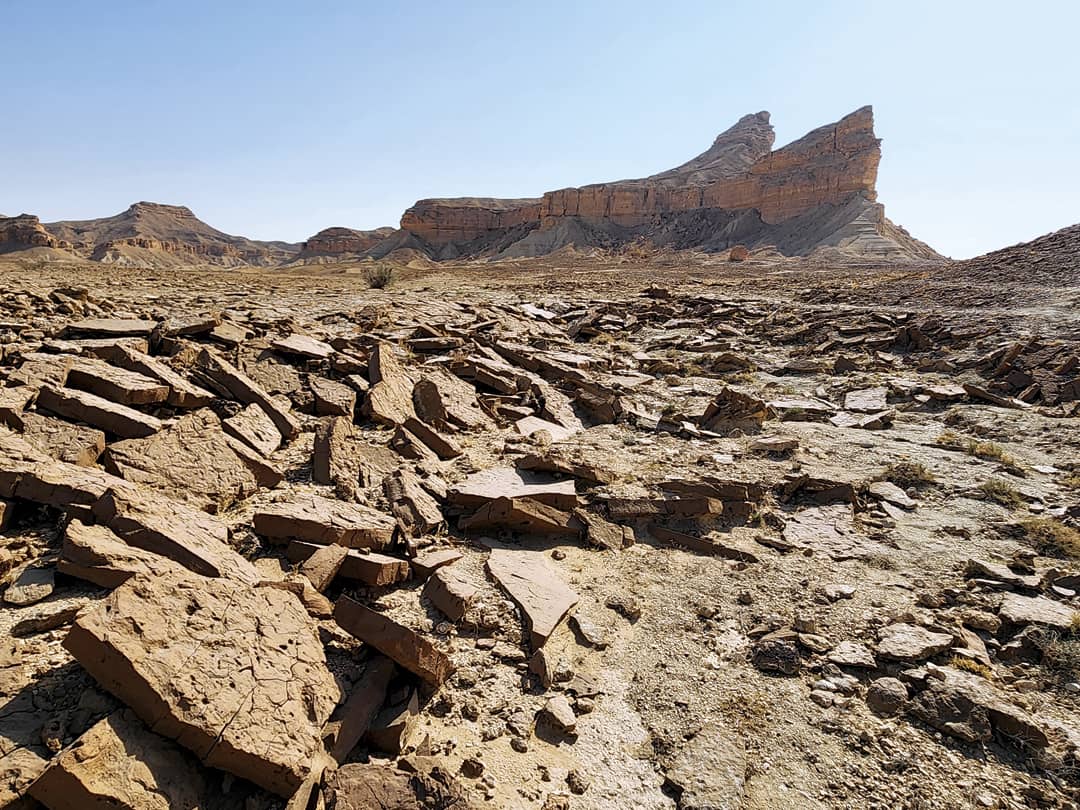
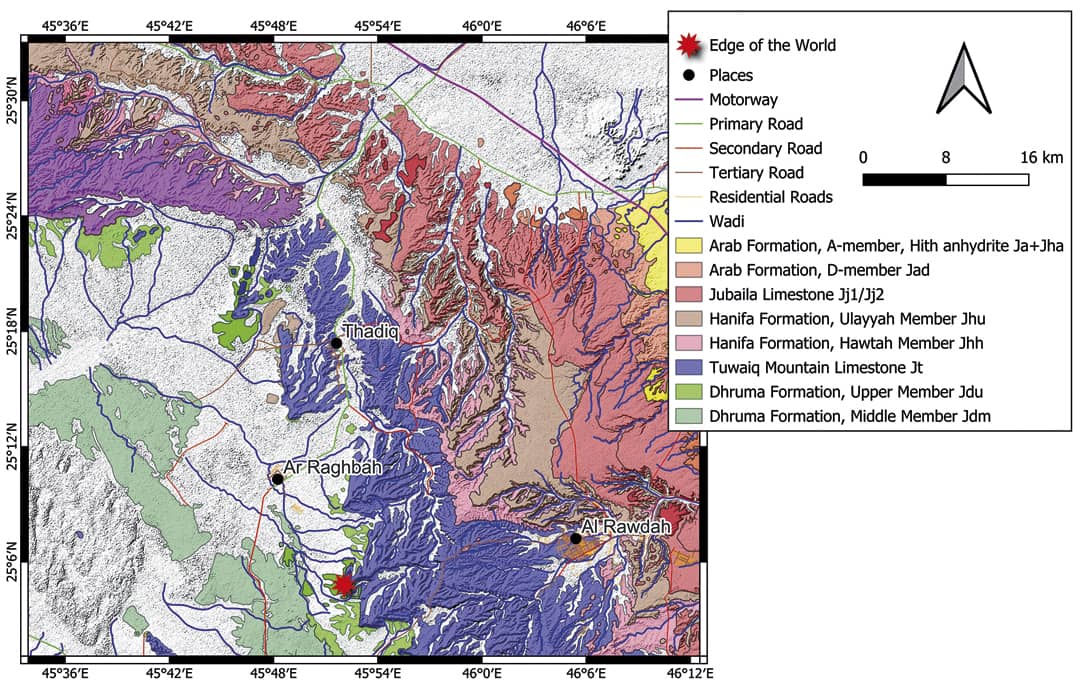
Hard, erosion resistant limestone succession of the Thuwaq Limestone Formation overlain the Dhurma Formation softer, limy mud-dominated successions creating perfect conditions for differential erosion.
Jurassic (Early Jurassic) to Cretaceous (Early Cretaceous)
Stratigraphy and sedimentology
Geomorphology and active geological processes
Arabian Peninsula, Saudi Arabia
24°56’56” N, 45°59’18” E
Hard, erosion resistant limestone succession of the Thuwaq Limestone Formation overlain the Dhurma Formation softer, limy mud-dominated successions creating perfect conditions for differential erosion.
The Khasm Al-Hussan Mountain, referred to as the “Edge of the World,” represents a geomorphological landmark formed through the region’s alternating stratifications of hard limestones and mudstones in an intraplate tectonic context. This geological configuration has given rise to diverse landforms including cuestas, plateaus, and buttes. The escarpment extends for several hundred kilometers, highlighting a sophisticated carbonate system that serves as a prominent petroleum reservoir globally. The escarpments exhibit one of the finest Mesozoic carbonate platforms, generating a unique rock assemblage acted as the Earth’s largest oil source and trap system contributing to the petroleum heritage of modern era.
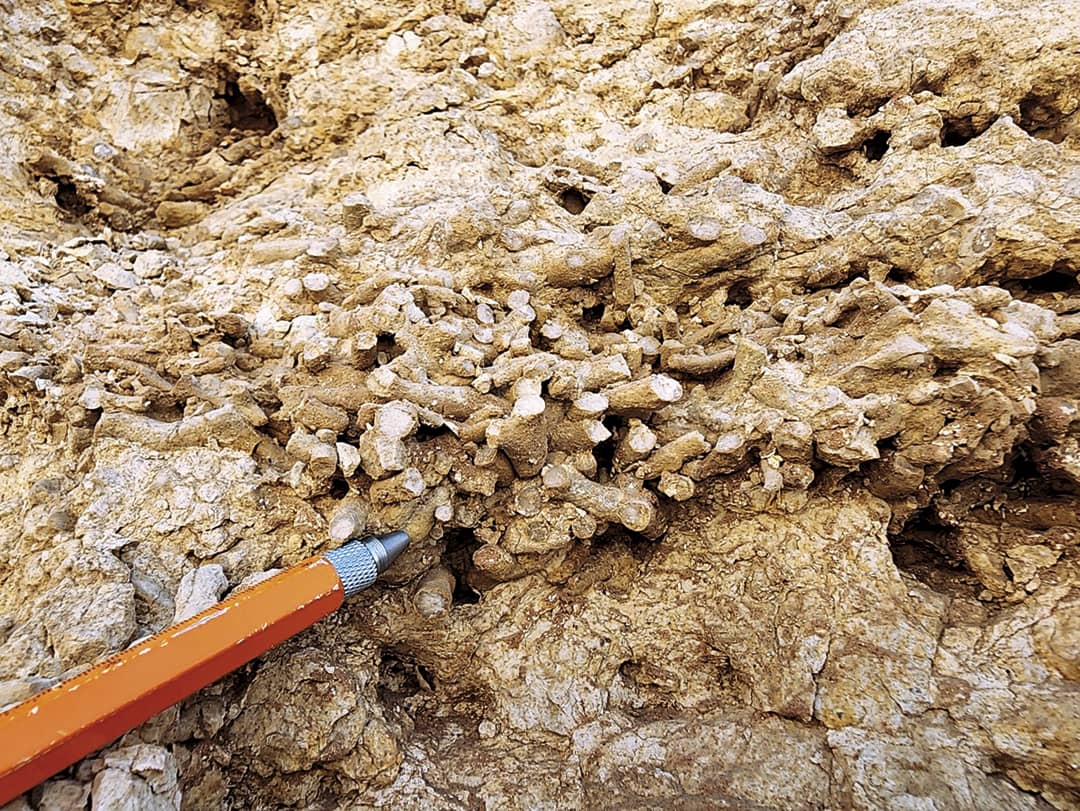
During the Mesozoic era, the Arabian–African Plate had a passive margin with a continental shelf 2000 kilometers wide. From the Jurassic to Lower Cretaceous times, most of the Arabian Plate was submerged under the Neotethys Ocean, forming a widespread shallow-marine shelf ideal for coral reef development. The Tuwaiq Mountain Formation, 50–160 m thick, consists of a lower muddy carbonate unit and an upper stromatoporoid and lagoonal carbonate lithofacies. It was deposited on a carbonate platform across the intra-shelf basin, resulting in black organic Tuwaiq Limestone in the base and yellowish brown Tuwaiq Limestone in the mountain ranges. The Arabian Plate was bordered by the Arabian Shield in the south and west and the Neotethys Ocean in the north. Structural heights and differential subsidence divided the passive margin into temporary intra-shelf basins, with shoal grainstones at the top and organic-rich mudstones at the lows. The region had a full range of ramp facies from shallow grainstone to deep-water storm deposits. During the Jurassic, the Arabian Plate was subtropical to tropical, with high organic productivity indicated by laminated algal sediments contributed significantly to petroleum formation, and subsequent migration to traps forming the largest oil and gas reservoirs on Earth.
The Jurassic limestones exposed at the Khasm Al-Hussan Mountain are subject of intensive sedimentological and petroleum geological researches over 50 years as they are considered to be the main petroleum sources of the Arabian Peninsula reserves. The mountain rich paleontological heritage is a crucial scientific source of regional stratigraphy research.
Al-Awwad, S.F. and Collins, L.B. (2013) “Carbonate-platform scale correlation of stacked high-frequency sequences in the Arab-D reservoir, Saudi Arabia,” Sedimentary Geology, 294, pp. 205–218. Available at: https://doi.org/10.1016/j.sedgeo.2013.05.015.
Al-Husseini, M. (2009) “Update to Late Triassic – Jurassic stratigraphy of Saudi Arabia for the Middle East Geologic Time Scale,” GeoArabia, 14(2), pp. 145–186. Available at: https://doi.org/10.2113/geoarabia1402145.
El-Sorogy, A.S., Al-Kahtany, K.M. and El-Asmar, H.M. (2014) “Marine benthic invertebrates of the upper Jurassic Tuwaiq Mountain Limestone, Khashm Al-Qaddiyah, central Saudi Arabia,” Journal of African Earth Sciences, 97, pp. 161–172. Available at: https://doi.org/10.1016/j.jafrearsci.2014.04.004.
EL-Sorogy, A.S., Almadani, S.A. and Al-Dabbagh, M.E. (2016) “Microfacies and diagenesis of the reefal limestone, Callovian Tuwaiq Mountain Limestone Formation, central Saudi Arabia,” Journal of African Earth Sciences, 115, pp. 63–70. Available at: https://doi.org/10.1016/j.jafrearsci.2015.12.013.
Gutiérrez, F. et al. (2025) “The geomorphology of monoclinal scarps associated with interstratal-dissolution fronts in evaporite formations, illustrated with the Upper Jurassic Arab and Hith formations in Ar Riyadh and Central Saudi Arabia,” Earth-Science Reviews, 261, p. 105032. Available at: https://doi.org/10.1016/j.earscirev.2024.105032.
Youssef, M. and El-Sorogy, A.S. (2015) “Paleoecology of benthic foraminifera in coral reefs recorded in the Jurassic Tuwaiq Mountain Formation of the Khashm Al-Qaddiyah area, Central Saudi Arabia,” Journal of Earth Science, 26(2), pp. 224–235. Available at: https://doi.org/10.1007/s12583-015-0529-8.
Károly Németh.
Saudi Geological Survey, Kingdom of Saudi Arabia
Hussam Al-Turki.
North Riyadh UNESCO Global Geopark
Mohammed Rashad Moufti.
Saudi Geological Survey, Kingdom of Saudi Arabia