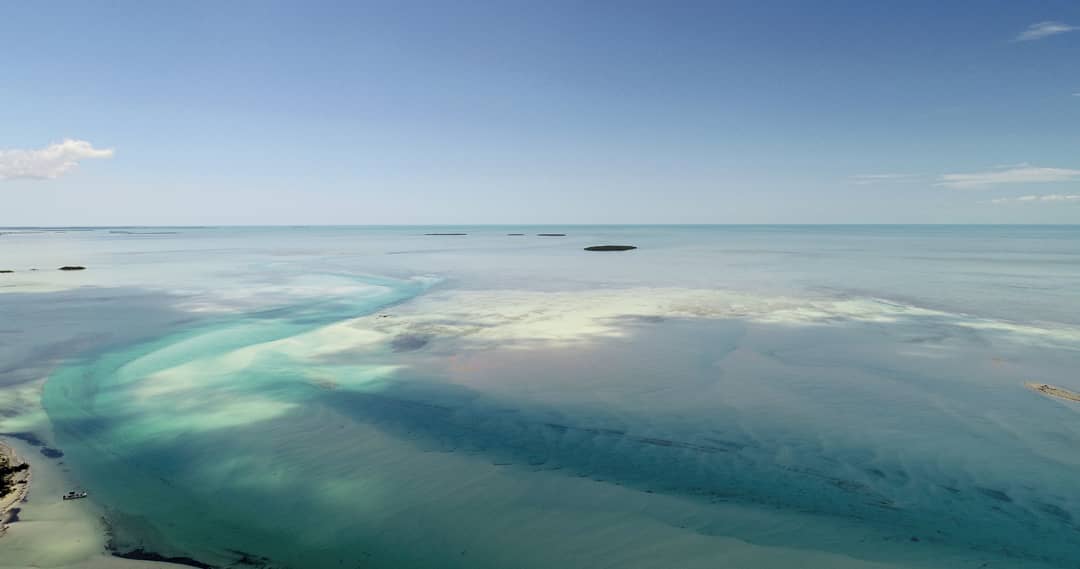
Oblique drone view of the active ooid shoals and tidal channel in the northeastern portion of the Joulters ooid sand body. Please see the boat in the lower left corner of the image for scale.
Geological Period
Quaternary (Holocene)
Main geological interest
Stratigraphy and sedimentology
Mineralogy
Location
The Bahamas Northern Atlantic, Bahamas
25°7’42” N, 78°7’49” W
Oblique drone view of the active ooid shoals and tidal channel in the northeastern portion of the Joulters ooid sand body. Please see the boat in the lower left corner of the image for scale.
An outstanding reference site for carbonate sedimentology for more than 100 years.
The Joulter sandbody is an accessible modern analog offering valuable insights into processes of ooid formation, sedimentation, and accumulation. Likewise, the Andros tidal flats serve as a significant modern example of humid tidal flat environments. Their well-preserved features make them important sites for comparative sedimentological studies, providing a direct reference for interpreting analogous successions in ancient strata, as well studies of sea level, paleoclimatology, and paleoceanography. Together, these locations offer key insights into carbonate depositional environments and their geological evolution, making a highly valuable IUGS geological heritage site.
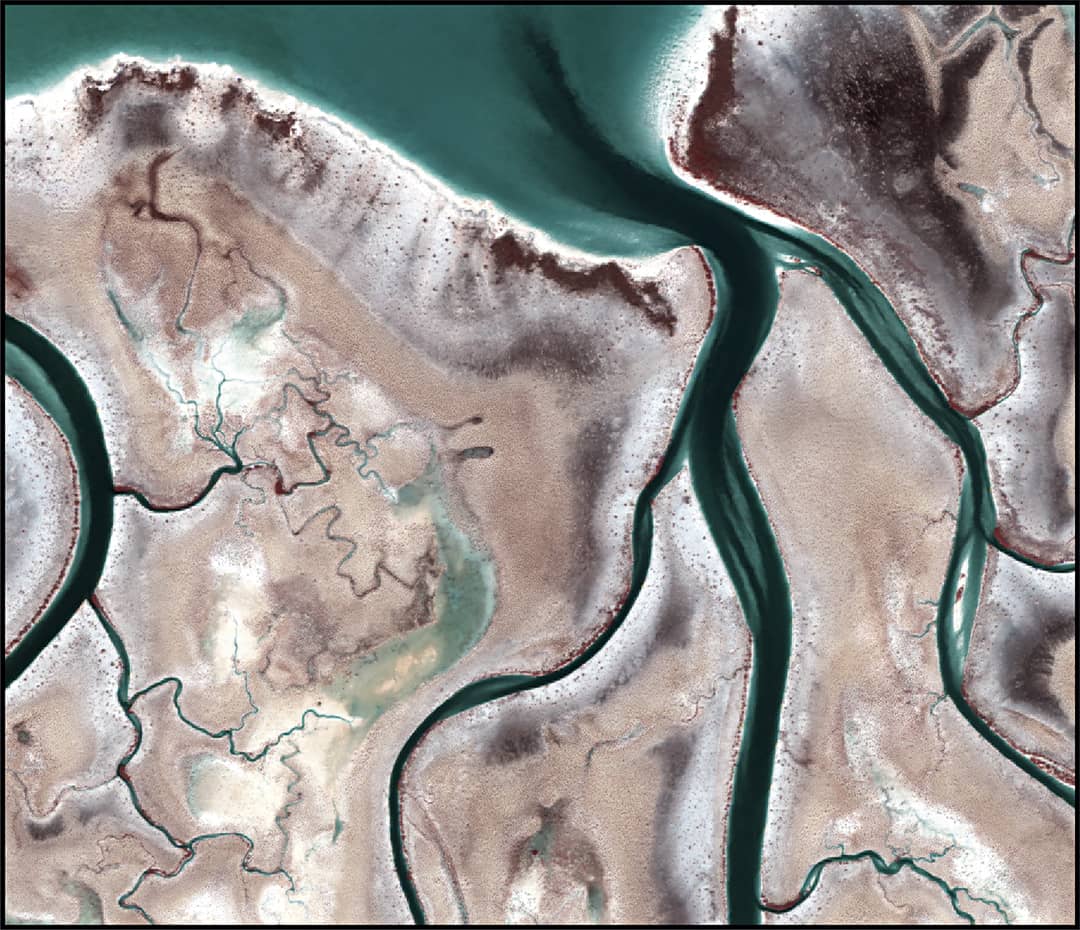
Aerial image of the Triple Goose Creek portion of the Andros tidal flats showing channels, levees and ponds as the main geomorphological features in this environment.
Geological description
Andros Island is the largest island in the Bahamas, located immediately west of the Tongue of the Ocean embayment on Great Bahama Bank. On Northern Andros are two archetypal Holocene carbonate environments which have been described as textbook examples and studied for decades. They allow direct linkage of physical, chemical and biological processes controlling carbonate formation with resulting sediment accumulation.
1) The Joulters ooid sand body is a shallow marine deposit characterized by high-energy environments dominated by tides, waves, longshore currents and storms. This type of environment combines the ideal condition for ooids to precipitate and accumulate in an area exceeding 400 km2. The sand body formed during the last 5,000 years includes an extensive sandflat, mobile sandbars, tidal channels and small islands constructed by beach ridges (Harris, 2025).
2) The Andros tidal flats, and in particular the Triple Goose Creek locality, are located along the northwestern edge of Andros. The site has long intrigued carbonate sedimentologists as one of the more remarkable Holocene examples of a peritidal carbonate environment featuring well-developed supratidal as well as channelized intertidal zones (Shinn, 1983; Rankey and Morgan, 2002; Maloof and Grotzinger, 2012; Wu et al., 2021).
Scientific research and tradition
Northern Andros has been the focus of numerous classic studies on ooid shoals and tidal flat systems (e.g., Halley et al., 1983; Shinn, 1983), serving as a key reference for interpreting similar depositional environments in the geological record and guiding the analysis of ancient carbonate deposits worldwide.
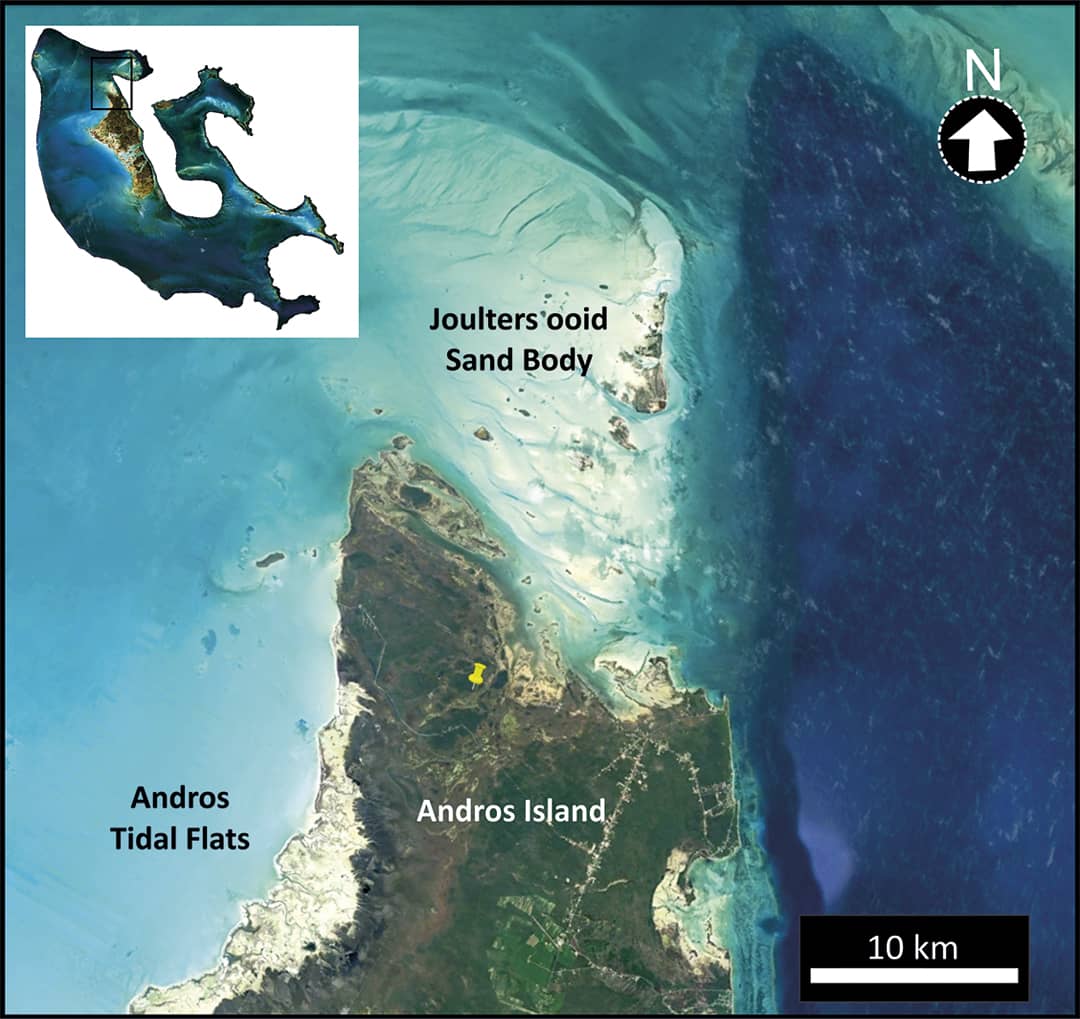
Satellite image (Google Earth) showing Northern Andros Island and location of the two main proposed localities as geological heritage sites.
Reference
Halley, R.B., Harris, P.M. and Hine, A.C. (1983) “Bank Margin Environment,” in P.A. Scholle, D.G. Bebout, and C.H. Moore (eds.) Carbonate Depositional Environments. American Association of Petroleum Geologists. Available at: https://doi.org/10.1306/M33429C16.
Harris, P. (Mitch) (2025) “Fifty years of research on the Joulters ooid sandbody—Impact on carbonate sedimentology and diagenesis and lessons learned from an invaluable analogue,” Carbonate Depositional Environments: Past and Future Questions – A Tribute to the Career of E.A. Shinn. The Depositional Record. Edited by L.R. Kump, M. Ingalls, and A. Hine, 11(5), pp. 1399–1432. Available at: https://doi.org/10.1002/dep2.70004.
Maloof, A.C. and Grotzinger, J.P. (2012) “The Holocene shallowing-upward parasequence of north-west Andros Island, Bahamas,” Sedimentology, 59(4), pp. 1375–1407. Available at: https://doi.org/10.1111/j.1365-3091.2011.01313.x.
Shinn, E.A. (1983) “Tidal Flat Environment,” in P.A. Scholle, D.G. Bebout, and C.H. Moore (eds.) Carbonate Depositional Environments. American Association of Petroleum Geologists. Available at: https://doi.org/10.1306/M33429C8.
Wu, M. et al. (2021) “Sea-level, storms, and sedimentation – Controls on the architecture of the Andros tidal flats (Great Bahama Bank),” Sedimentary Geology, 420, p. 105932. Available at: https://doi.org/10.1016/j.sedgeo.2021.105932.