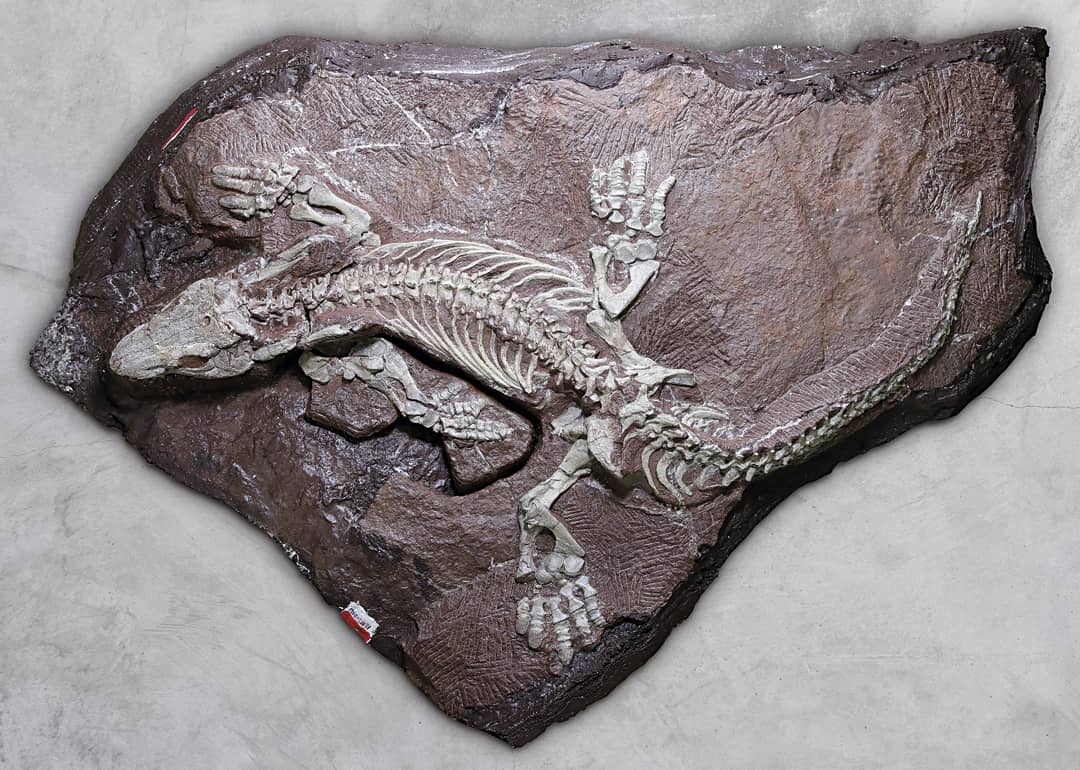
‘Orobates pabsti’ skeleton found in the Bromacker quarries. (Photo: David Berman).
Geological Period
Permian (Cisuralian)
Main geological interest
Paleontology
Location
Bromacker Quarries, Georgenthal Municipality, Germany
50°48’35” N, 10°37’09” E
‘Orobates pabsti’ skeleton found in the Bromacker quarries. (Photo: David Berman).
A terrestrial Lagerstätte unique in the world for abundance and quality of tetrapod tracks and preservation of associated vertebrate skeletons.
The special significance of the Bromacker Lagerstätte is the unique preservation of terrestrial ecosystems of a highland. The abundance and quality of the fossil tracks and their importance for the evolutionary history of terrestrial vertebrates make this locality an unique window to the Early Permian worldwide. This locality shows in detail the origin of the modern food pyramid of continental ecosystem (Berman et al., 2023) rarely known by research in similar Lagerstätten. The Bromacker Lagerstätte is recongized as a “National Geotope in Germany“ and is a core geosite of the UNESCO Global Geopark Thuringia Inselsberg-Drei Gleichen.
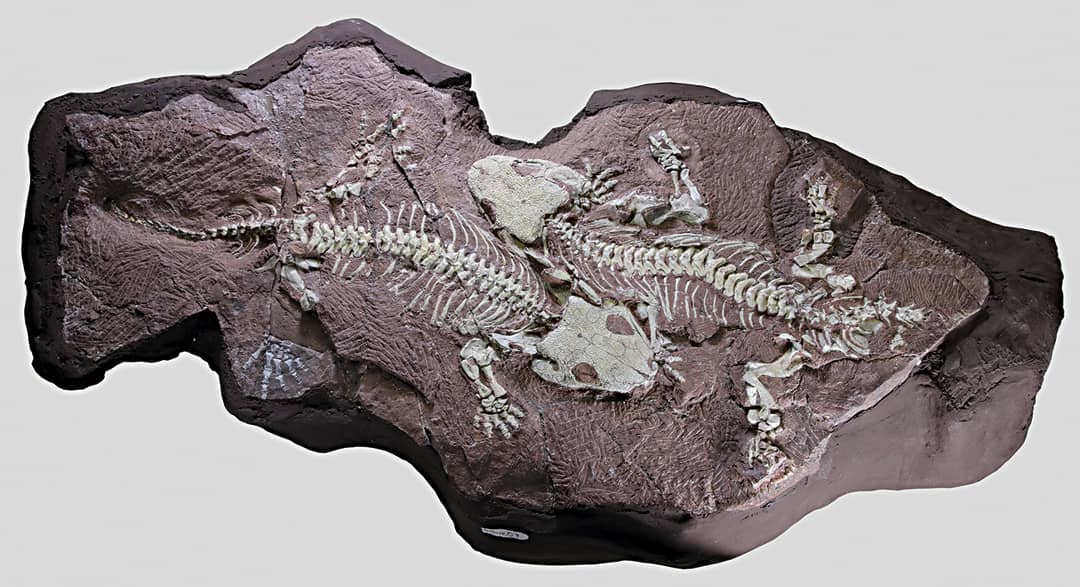
The so-called Tambach Lovers, two nearly completely preserved adult skeletons of ‘Seymouria sanjuanensis’ discovered at Bromacker in 1997 (Berman et al., 2000). (Photo: David Berman).
Geological description
The Bromacker Lagerstätte lies within the Lower Permian Tambach Basin of the Thuringian Forest. This is the type locality of the Tambach Sandstone, a 50–100 meter thick, middle member of an informal tripartite division of the Tambach Formation. It forms the base of the Upper Rotliegend Group in this area and composed a unit of conglomerate, sandstone, and mudstone that is 200-400 meters thick. The vertebrate tracks and skeletons occur mainly in a 10-meter-thick stratigraphic interval of the Tambach Sandstone. Eberth et al. (2000) interpreted the deposition of the Bromacker sediments and its associated fossil assemblage as representing an extremely rare Permian upland paleoenvironment. It represents also one of the first differentiated terrestrial ecosystems with a large number of early tetrapods such as Dimetrodon teutonis, Orobates pabsti and Seymouria sanjuanensis frequently associated with their tracks (Voigt et al., 2007), allowing for reconstruction of the locomotion of Orobates pabsti (Nyakatura et al., 2019). Moreover, desiccation cracks, plant remains, invertebrate trace fossils, raindrop marks, jellyfish and vertebrate skin impressions are commonly preserved on the sandstone slabs (Eberth et al., 2000) enable a detailed paleoecological reconstruction (Berman et al., 2000) as well as phylogeny and taxonomy (Ponstein et al., 2024).
Scientific research and tradition
Already known as a fossiiferousl site during the 1800s, a systematic exploration of the layers of the Bromacker locality started during the 1970s, and it soon become known worldwide for its unique tetrapod skeletons and tracks record. Since 2020, the project “BROMACKER” continues the excavations and research with a special focus on science communication.
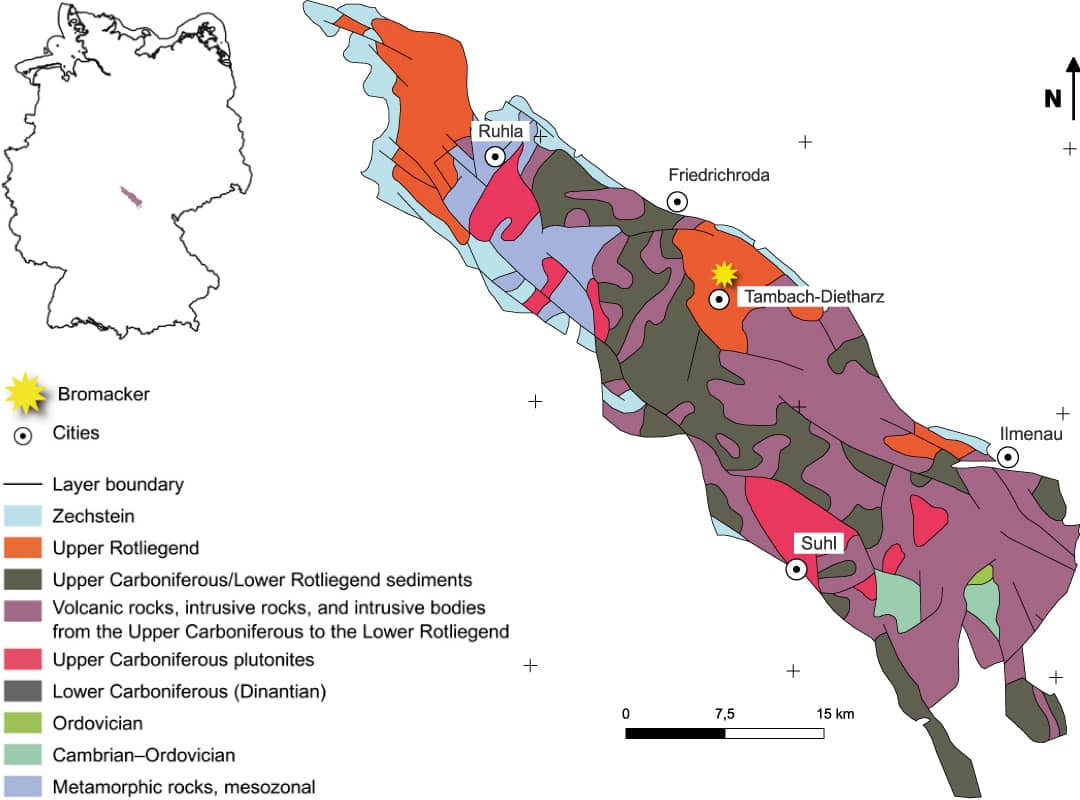
Location of the Bromacker locality (yellow star) within the Thuringian Forest in Germany, modified from Ponstein et al., 2024.
Reference
Berman, D.S. et al. (2000) “Redescription of Seymouria sanjuanensis (Seymouriamorpha) from the Lower Permian of Germany based on complete, mature specimens with a discussion of paleoecology of the Bromacker locality assemblage,” Journal of Vertebrate Paleontology, 20(2), pp. 253–268. Available at: https://doi.org/10.1671/0272-4634(2000)020%255B0253:ROSSSF%255D2.0.CO;2.
Berman, D.S. et al. (2023) “Origin of the Modern Terrestrial Vertebrate Food Chain,” Annals of Carnegie Museum, 88, p. 302. Available at: https://doi.org/10.2992/007.088.0302.
Eberth, D.A. et al. (2000) “Lower Permian Terrestrial Paleoenvironments and Vertebrate Paleoecology of the Tambach Basin (Thuringia, Central Germany): The Upland Holy Grail,” PALAIOS, 15(4), pp. 293–313. Available at: https://doi.org/10.1669/0883-1351(2000)015%253C0293:LPTPAV%253E2.0.CO;2.
Nyakatura, J.A. et al. (2019) “Reverse-engineering the locomotion of a stem amniote,” Nature, 565(7739), pp. 351–355. Available at: https://doi.org/10.1038/s41586-018-0851-2.
Ponstein, J., MacDougall, M.J. and Fröbisch, J. (2024) “A comprehensive phylogeny and revised taxonomy of Diadectomorpha with a discussion on the origin of tetrapod herbivory,” Royal Society Open Science, 11(6), p. 231566. Available at: https://doi.org/10.1098/rsos.231566.
Voigt, S., Berman, D.S. and Henrici, A.C. (2007) “First well-established track-trackmaker association of paleozoic tetrapods based on Ichniotherium trackways and diadectid skeletons from the Lower Permian of Germany,” Journal of Vertebrate Paleontology, 27(3), pp. 553–570. Available at: https://doi.org/10.1671/0272-4634(2007)27%255B553:FWTAOP%255D2.0.CO;2.
Author(s)
Mauro Alivernini.
Management Office of UNESCO Global Geopark Thuringia Inselsberg-Drei Gleichen
Sylvia Reyer-Rohde.
Management Office of UNESCO Global Geopark Thuringia Inselsberg-Drei Gleichen
Peter Frenzel.
Geological Institute, Friedrich-Schiller-University Jena