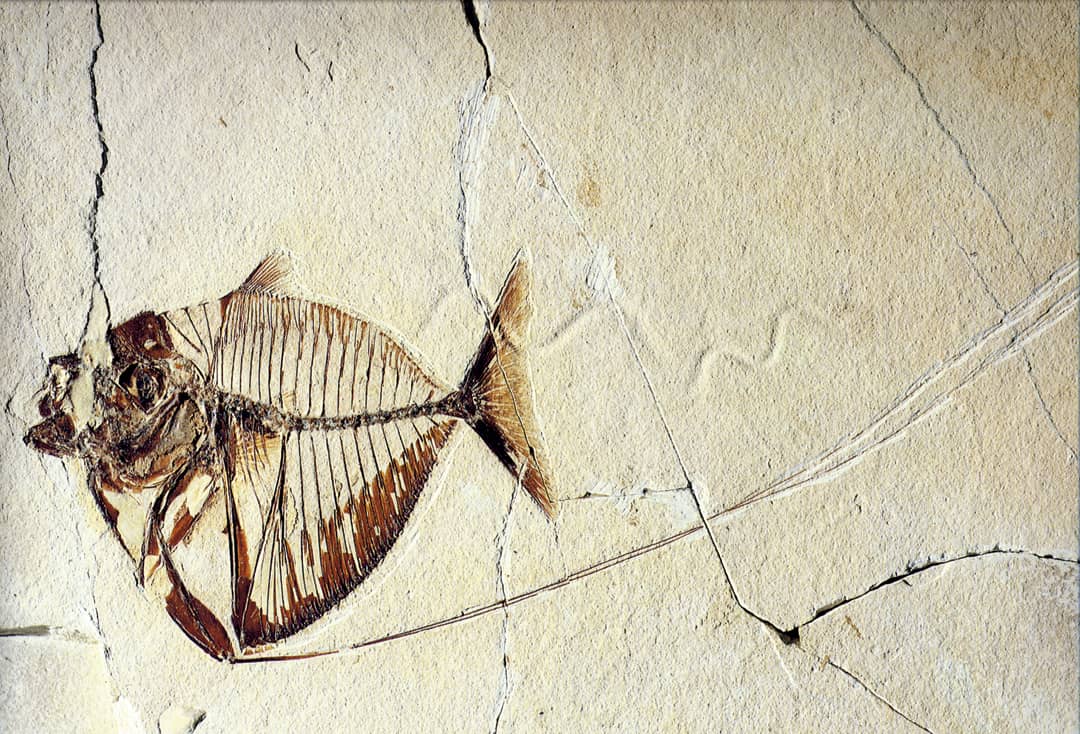
The moonfish ‘Mene rhombea’ from the Monte Postale site, Bolca Lagerstätte. (Photo: Museo Civico di Storia Naturale, Verona).
Geological Period
Paleogene (Eocene)
Main geological interest
Paleontology
History of geosciences
Location
Veneto, Italy
45°36’01” N, 11°13’20” E
The moonfish ‘Mene rhombea’ from the Monte Postale site, Bolca Lagerstätte. (Photo: Museo Civico di Storia Naturale, Verona).
A unique and spectacular snapshot of tropical shallow marine life in the early Cenozoic of Tethys.
The rich fossil sites of the Bolca Lagerstätte provide an extremely detailed picture of marine life in a tropical, shallow setting located in the western portion of the Tethys during the Eocene, aproximately 50 million years ago (Papazzoni et al., 2014). Known since the XVI century for their exquisite preservation and attractive appearance of its fossils (Romano and Carnevale, 2023), the laminated limestone of Bolca have yielded about 600 species of fishes, marine and terrestrial invertebrates, and plants, documenting reef-associated ecosystems in an ancient biodiversity hotspot.
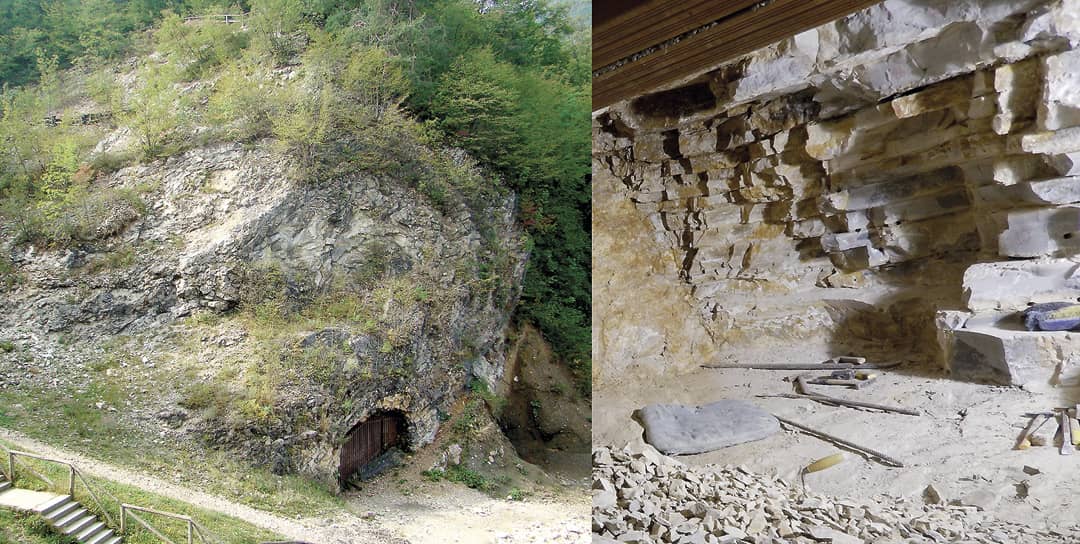
View of the Pesciara site (left) and its fossiliferous laminated limestone (right).
Geological description
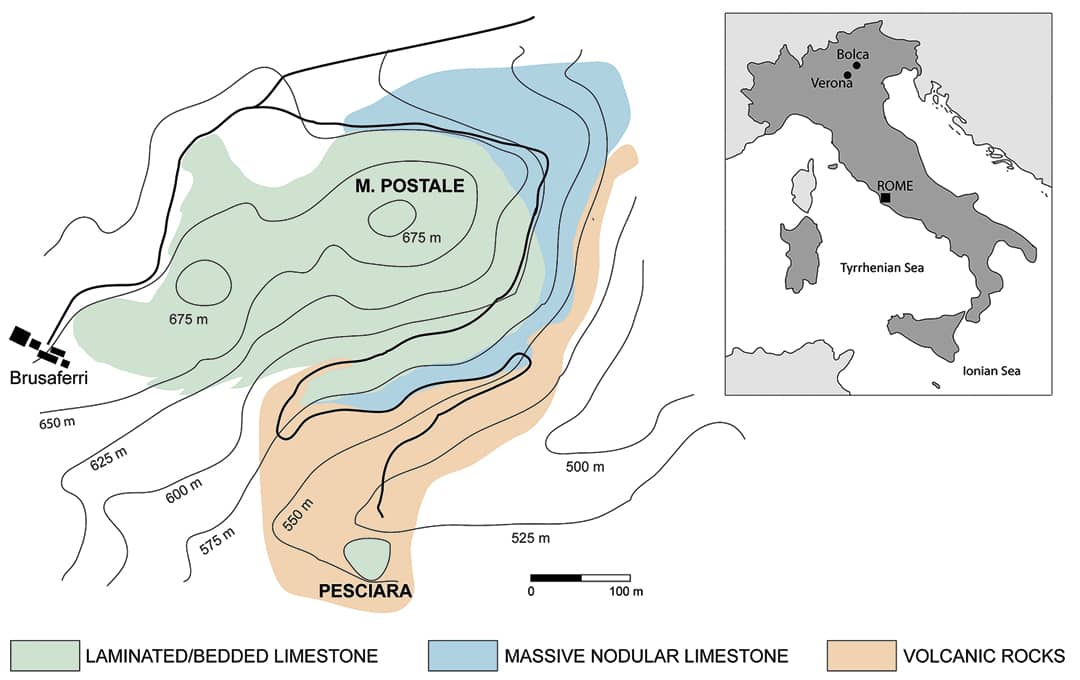
The Bolca Lagerstätte comprises two main productive sites, Pesciara and Monte Postale, located near the village of Bolca, in the eastern part of Monti Lessini (northeastern Italy). The carbonate succession at these two sites is commonly referred to as ‘Calcari Nummulitici’ and includes finely laminated limestone with exceptionally preserved fishes, plants and soft-bodied invertebrates. This fossiliferous limestone was deposited in the late Ypresian, between 50.5 and 48.5 Ma (Papazzoni et al., 2017), in a peri-reefal system not far from the coast characterized by depressed areas with restricted bottom circulation (Marramà et al., 2016). Soft tissues and traces of the original pigmentation are commonly preserved, especially in the fossils collected from Pesciara. Overall, the Bolca fossil assemblage documents mature tropical ecosystems following a 15 myr interval of evolutionary recovery after the K-Pg mass extinction. The fossil fishes are particularly relevant for their remarkable diversity (more than 260 species), documenting the massive early Cenozoic diversification of percomorphs, the dominant group of marine teleosts, and the assembly of modern coral reef fish assemblages (Friedman and Carnevale, 2018).
Scientific research and tradition
The first documented report of a fossil from Bolca dates back to 1550, and the first illustration appeared in 1622. More than four centuries of extensive exploration of the Bolca sites resulted in the discovery of hundreds of thousands spectacular fossils. Research on these fossils is still in progress.
Sketch geological map of the area surrounding the village of Bolca showing the location of the Pesciara and Monte Postale sites.
Reference
Friedman, M. and Carnevale, G. (2018) “The Bolca Lagerstätten: shallow marine life in the Eocene,” Journal of the Geological Society, 175(4), pp. 569–579. Available at: https://doi.org/10.1144/jgs2017-164.
Marramà, G. et al. (2016) “Controlled excavations in the Pesciara and Monte Postale sites provide new insights about the palaeoecology and taphonomy of the fish assemblages of the Eocene Bolca Konservat-Lagerstätte, Italy,” Palaeogeography, Palaeoclimatology, Palaeoecology, 454, pp. 228–245. Available at: https://doi.org/10.1016/j.palaeo.2016.04.021.
Papazzoni, C. et al. (eds.) (2014) The Bolca Fossil-Lagerstatten: A window into the Eocene World. Modena: S.P.I. (Rendiconti della Società Paleontologica Italiana, 4).
Papazzoni, C.A. et al. (2017) “Integrating Shallow Benthic and Calcareous Nannofossil Zones: the Lower Eocene of the Monte Postale Section (northern Italy),” Palaios, 32, pp. 6–17. Available at: https://doi.org/10.2110/palo.2016.014.
Romano, M. and Carnevale, G. (2023) “The early studies on the Eocene Bolca Fossil-Lagerstätte (Italy): an historical overview,” Bollettino della Societa Paleontologica Italiana, 62, pp. 1–63. Available at: https://doi.org/10.4435/BSPI.2023.05.
Author(s)
Giorgio Carnevale.
Università degli Studi di Torino
Roberto Zorzin.
Museo Civico di Storia Naturale di Verona
Giuseppe Marramà.
Università degli Studi di Torino
Luca Giusberti.
Università degli Studi di Padova
Guido Roghi.
CNR, Istituto di Geoscienze e Georisorse, Padova
Stefano Dominici.
Università degli Studi di Firenze
Cesare Andrea Papazzoni.
Università degli Studi di Modena e Reggio Emilia