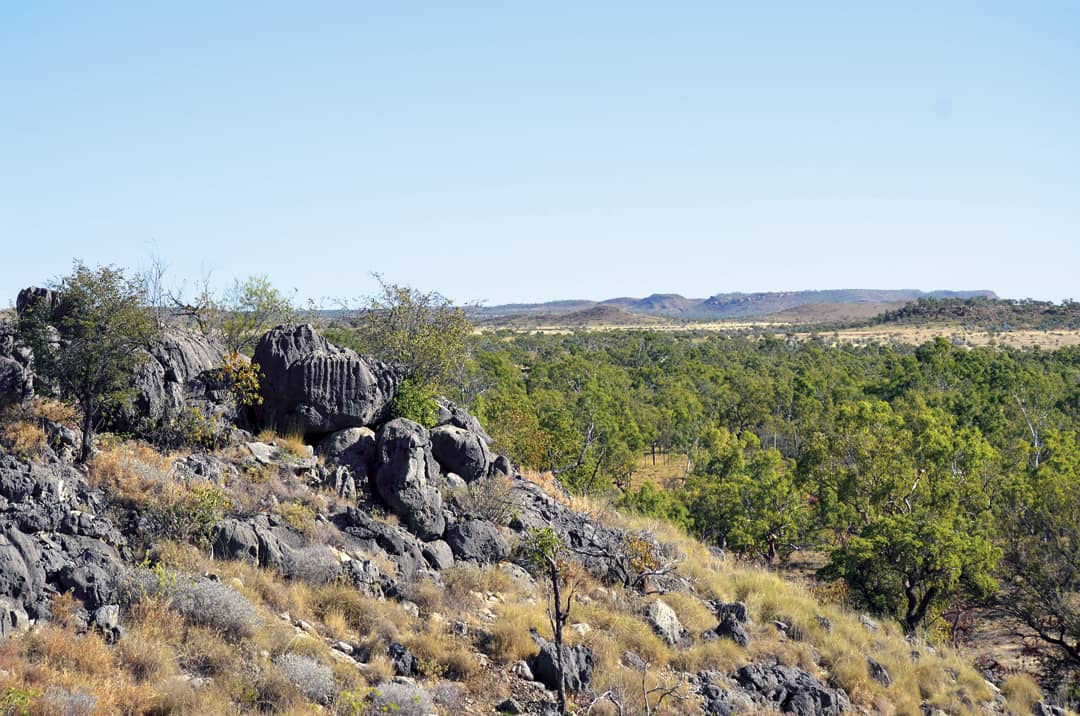
Limestone bluff in the Riversleigh World Heritage Area, looking north-west across Boodjamulla National Park, Waanyi Country, Queensland (photo: K. Black).
Geological Period
Paleogene (Oligocene) to Quaternary (Pleistocene)
Main geological interest
Paleontology
Geomorphology and active geological processes
Location
Northwestern Queensland, Australia
19°4’59” S, 138°43’01” E
Limestone bluff in the Riversleigh World Heritage Area, looking north-west across Boodjamulla National Park, Waanyi Country, Queensland (photo: K. Black).
A rich, globally unique record of Australian mammal and other vertebrate evolution spanning the last 25 million years.
The Riversleigh World Heritage Area contains an unrivalled fossil record of highly diverse Australian mammals. More than 200 new vertebrate, invertebrate and plant species have been discovered, many unique to the heritage area. They include an Order of mammals that may have ties to South American groups. Some of these species occur in poorly-dated deposits elsewhere in Australia facilitating biocorrelation. Preservation of the Miocene fossils is superb. They include articulated skeletons, uncrushed delicate skulls of tiny bats and even intact arthropods. Mineralisation is extraordinary; soft tissues, cells and even nuclei are preserved. Ongoing research has involved more than 100 colleagues in 44 institutions in 12 countries.
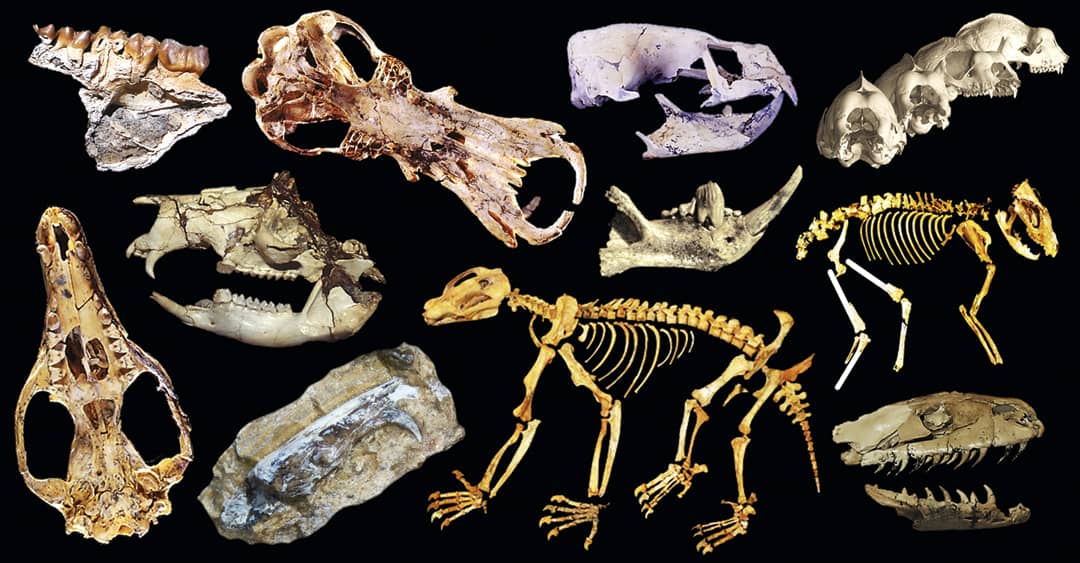
Exceptionally well-preserved skeletons, skulls and dentaries of uniquely-Australian, highly diverse Oligocene and Neogene animals have been found at Riversleigh.
Geological description
In the complex Riversleigh World Heritage Area highly fossiliferous Upper Oligocene to Holocene strata overlie Cambrian carbonate and Proterozoic siliciclastic marine strata. Cenozoic limestone composed of freshwater lacustrine and paleokarst deposits accumulated in cave pools that facilitated uniquely fine preservation of fossils. There are more than 300 distinct fossil sites and local faunas. Five depositional phases and faunal intervals are recognised that span the Late Oligocene, Early, Middle and Late Miocene and Early and Late Pleistocene. The Miocene to Pleistocene deposits have been radiometrically-dated using U-Pb ratios in fossil speleothems, providing the only securely-dated sequence of mid to late Cenozoic mammal-bearing fossil deposits on the Australian continent. These deposits have produced the richest Cenozoic sequence of fossil vertebrate faunas in Australia. Although about half of Riversleigh’s deposits are within the heritage area, additional extensive deposits recently discovered, such as the ‘New Riversleigh’ area, are revealing faunas representing additional time intervals such as the latest Late Miocene. All previously known groups of Australian marsupials have an extraordinarily rich record at Riversleigh (e.g. 18 new kinds of pseudocheirid ringtail possums) in addition to four family-level groups (e.g., malleodectids and yingabalanarids) that are only known from Riversleigh.
Scientific research and tradition
Spanning the last 25 million years, Riversleigh’s fossil record documents a period of dramatic transformation for the Australian continent, revealing the evolution of its unique wildlife during cycles of natural climate change that reshaped the continent’s vast, ancient rainforests into the open forests, woodlands and grasslands of today.
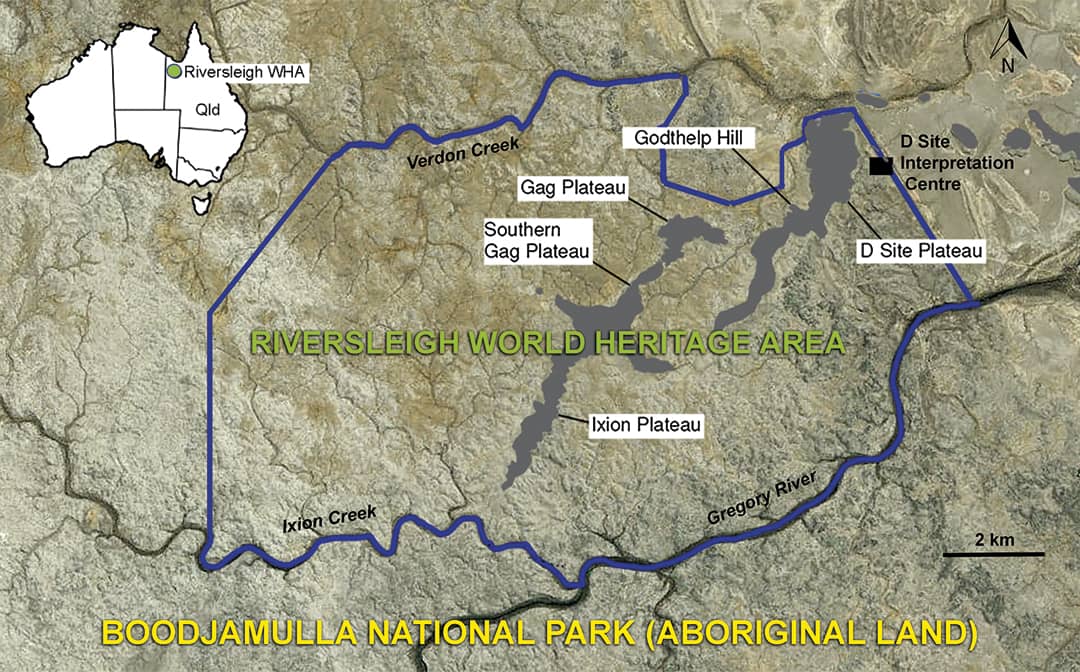
Location map showing fossil-rich limestone plateaux (grey) in the Riversleigh World Heritage Area, Boodjamulla National Park (Waanyi Country), Queensland.
Reference
Archer, M. et al. (2023) Prehistoric Australasia: Visions of Evolution and Extinction. Csiro Publishing.
Archer, M., Hand, S.J. and Godthelp, H. (2000) Australia’s Lost World: Prehistoric Animals of Riversleigh. (2nd edition). USA: Indiana University Press.
Arena, D.A. et al. (2016) “Mammalian lineages and the biostratigraphy and biochronology of Cenozoic faunas from the Riversleigh World Heritage Area, Australia,” Lethaia, 49(1), pp. 43–60. Available at: https://doi.org/10.1111/let.12131.
Black, K.H. et al. (2012) “The Rise of Australian Marsupials: A Synopsis of Biostratigraphic, Phylogenetic, Palaeoecologic and Palaeobiogeographic Understanding,” in J.A. Talent (ed.) Earth and Life: Global Biodiversity, Extinction Intervals and Biogeographic Perturbations Through Time. Dordrecht: Springer Netherlands, pp. 983–1078. Available at: https://doi.org/10.1007/978-90-481-3428-1_35.
Matzke-Karasz, R. et al. (2014) “Subcellular preservation in giant ostracod sperm from an early Miocene cave deposit in Australia,” Proceedings of the Royal Society B: Biological Sciences, 281(1786), p. 20140394. Available at: https://doi.org/10.1098/rspb.2014.0394.
Woodhead, J. et al. (2016) “Developing a radiometrically-dated chronologic sequence for Neogene biotic change in Australia, from the Riversleigh World Heritage Area of Queensland,” Gondwana Research, 29(1), pp. 153–167. Available at: https://doi.org/10.1016/j.gr.2014.10.004.
Author(s)
Michael Archer.
University of New South Wales, Sydney
Suzanne Hand.
University of New South Wales, Sydney
Troy Myers.
University of New South Wales, Sydney
Anna Gillespie.
University of New South Wales, Sydney
Rick Arena.
University of New South Wales, Sydney
Phil Creaser.
University of New South Wales, Sydney
Ian Graham.
University of New South Wales, Sydney
Kenny Travouillon.
Western Australian Museum, Perth