Triassic Dabie Ultrahigh-pressure Metamorphic Belt
China
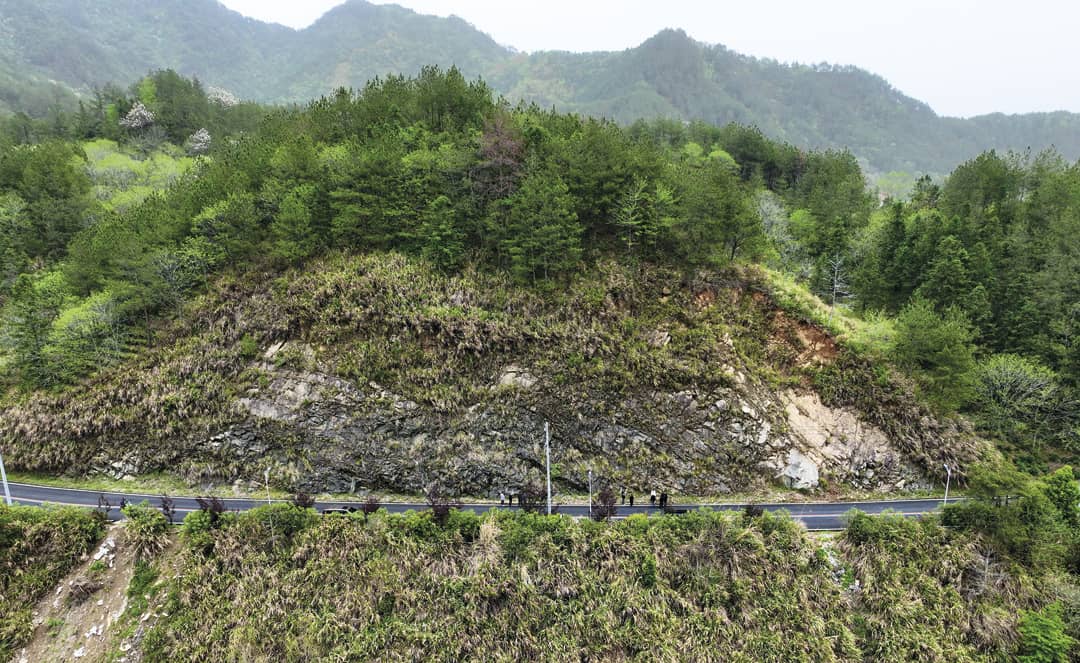
Bixiling eclogite, the largest ultrahigh-pressure eclogite block in the Dabie‑Sulu orogenic belt and the second largest globally.
Geological Period
Triassic (Early Triassic) to Jurassic (Early Jurassic)
Main geological interest
Igneous and Metamorphic petrology
Tectonics
Location
Qianshan City, Anhui Province, China
30°38’04” N, 116°24’39” E
Bixiling eclogite, the largest ultrahigh-pressure eclogite block in the Dabie‑Sulu orogenic belt and the second largest globally.
The Earth’s largest, most extensive, and well-preserved ultrahigh-pressure metamorphic belt.
The Dabie metamorphic belt is internationally renowned for preserving the world’s most complete assemblages of ultrahigh‑pressure rocks formed during continental deep subduction (Cong & Liou, 1995), including the Bixiling eclogite–peridotite block within gneiss and the Hanchangchong eclogite‑facies rocks enclosed in marble. This exceptional record makes the region a unique natural laboratory for studying subduction, exhumation, and deep fluid–rock interactions, providing key evidence for advancing plate‑tectonic theory. Its scientific importance has stimulated broad international collaboration across multiple disciplines. Moreover, the three major geosites —Bixiling, Hanchangchong, and Xindian— are easily accessible by well‑maintained roads, facilitating research, education, and geotourism.
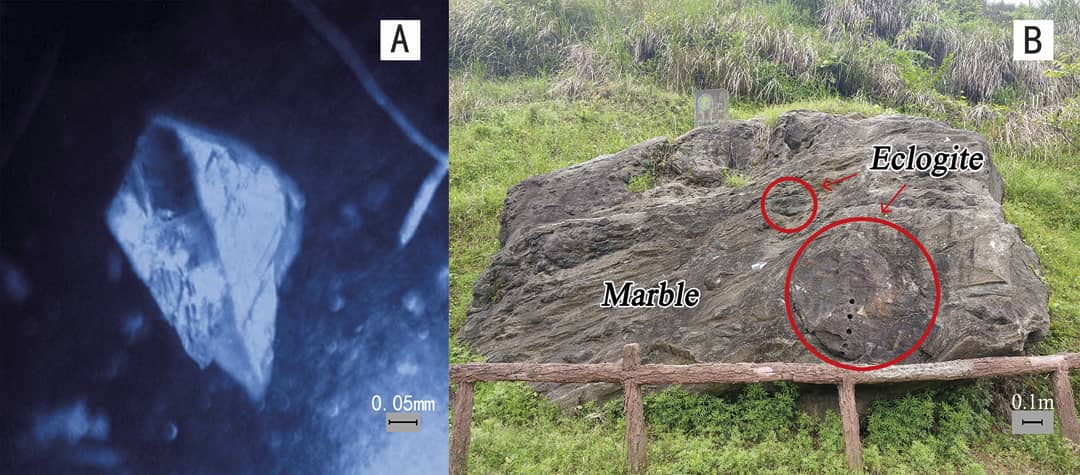
A- Tetrahedral diamond crystal extracted from a rock sample of garnet-pyroxenite in Xindian.
B- Ultrahigh-pressure eclogite lenses within marble in Hanchangchong.
Geological description
The Dabie ultrahigh-pressure metamorphic belt, located in the southwestern portion of the Dabie-Sulu Orogen in eastern China, represents one of Earth’s most extensive and well-preserved records of continental deep subduction (Cong and Liou, 1995). Formed during the Triassic collision between the Yangtze and North China cratons (~240–220 Ma) (Li et al., 2000), it exposes coesite (Wang et al., 1989) and diamond-bearing (Xu et al., 1992) eclogite, gneiss, jadeite quartzite, marble, and other ultra-high-pressure rocks, providing compelling evidence for the subduction of supracrustal materials to mantle depths exceeding 120 kilometer. These rocks were subsequently exhumed through complex tectonic processes, preserving unique mineralogical and structural imprints of extreme pressure-temperature conditions (3.0-6.0 GPa, 700–850°C). Widespread coesite inclusions within host minerals (e.g., garnet, zircon) confirm in-situ ultra-high-pressure metamorphism (Ye et al., 2000). Protolith ages for eclogite and granitic gneiss (~800–750 Ma) are interpreted to reflect the breakup of the Rodinia supercontinent. A multi-stage exhumation history is recorded by retrograde mineral assemblages during the late Triassic and early Jurassic. Furthermore, oxygen isotope data from these rocks suggest that the northern Yangtze craton experienced Snowball Earth conditions and extensive meteoric water alteration during the Neoproterozoic (Zheng et al., 2004).
Scientific research and tradition
From 1987, collaborative research on the Dabie metamorphic belt, involving Chinese and international geologists from over 30 countries, has produced over 1,000 publications, yielding breakthroughs in petrology, geochemistry, and geochronology. It serves as a classic field trip locality for international conferences.
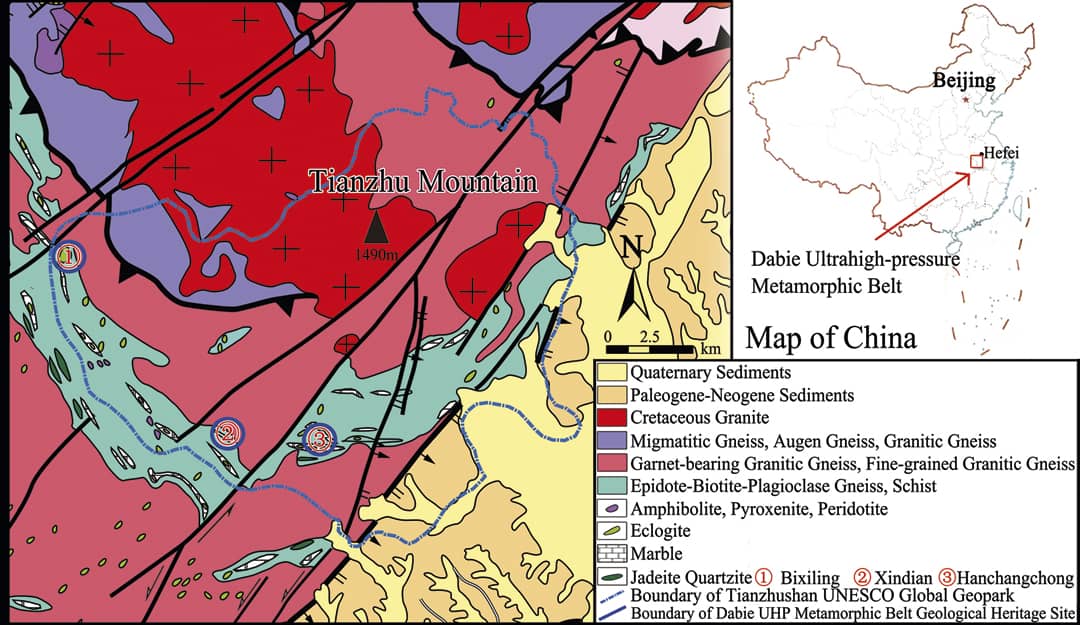
Geological map of Dabie Ultrahigh-pressure Metamorphic Belt.
Reference
Li, S. et al. (2000) “Sm–Nd and Rb–Sr isotopic chronology and cooling history of ultrahigh pressure metamorphic rocks and their country rocks at Shuanghe in the Dabie Mountains, Central China,” Geochimica et Cosmochimica Acta, 64(6), pp. 1077–1093. Available at: https://doi.org/10.1016/S0016-7037(99)00319-1.
Liou, J.G. et al. (1995) “Ultrahigh-P metamorphic rocks and their associated lithologies from the Dabie Mountains, central China : A field trip guide to the third International Eclogite Field Symposium,” Chinese Science Bulletin, 40(Suplement), pp. 1–71.
Xu, S. et al. (1992) “Diamond from the Dabie Shan Metamorphic Rocks and Its Implication for Tectonic Setting,” Science, 256(5053), pp. 80–82. Available at: https://doi.org/10.1126/science.256.5053.80.
Ye, K. et al. (2000) “Large areal extent of ultrahigh-pressure metamorphism in the Sulu ultrahigh-pressure terrane of East China: new implications from coesite and omphacite inclusions in zircon of granitic gneiss,” Lithos, 52(1), pp. 157–164. Available at: https://doi.org/10.1016/S0024-4937(99)00089-4.
Zheng, Y.-F. et al. (2004) “Zircon U-Pb and oxygen isotope evidence for a large-scale 18O depletion event in igneous rocks during the Neoproterozoic,” Geochimica et Cosmochimica Acta, 68(20), pp. 4145–4165. Available at: https://doi.org/10.1016/j.gca.2004.01.007.
Author(s)
Jiandong Huang.
Anhui Geological Museum, China
Yi Chen.
Institute of Geology and Geophysics, Chinese Academy of Sciences, China
Lei Mao.
Anhui Geological Museum, China
Yongfei Zheng.
School of Earth and Space Sciences,University of Science and Technology of China, China
Yonghong Shi.
School of Resource and Environmental Engineering, Hefei University of Technology, Hefei, China