Archean Ultrahigh Temperature Metamorphism in the Napier Complex
Antarctica
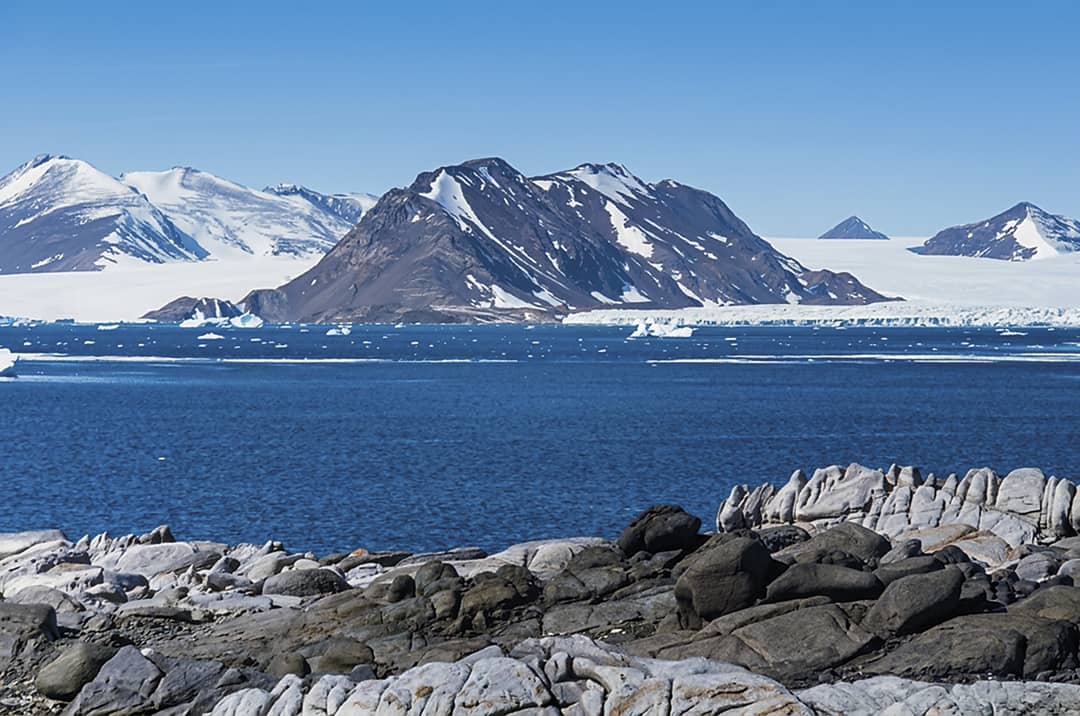
View eastward from Tonagh Island to Mount Trail, in the heart of the Napier Complex Ultra High Temperature domain.
Geological Period
Eo-archean Era to Neo-archean Era
Main geological interest
Igneous and Metamorphic petrology
Mineralogy
Location
Western Enderby Land, East Antarctica, Antarctica
67°5’60” S, 51°12’00” E
View eastward from Tonagh Island to Mount Trail, in the heart of the Napier Complex Ultra High Temperature domain.
The premier example of and type area for Ultrahigh Temperature crustal metamorphism.
Coexisting sapphirine + quartz, widely regarded as the definitive mineralogical indicator of ultra high pressure metamorphism, was first identified in the Napier Complex (Dallwitz, 1968). Also the diversity of protoliths exposed over a wide geographic area means the Napier Complex preserves a unique range of additional ultra high temperature indicators unrivalled by any of the other 70-80 areas worldwide later found to record such conditions (Harley, 2021). This makes the Napier Complex the type area for ultra high temperature metamorphism, now recognised as fundamental to understanding orogeny and continental growth. How such extreme temperatures are attained, whether in back-arc settings or under orogenic plateaus, remains contested.
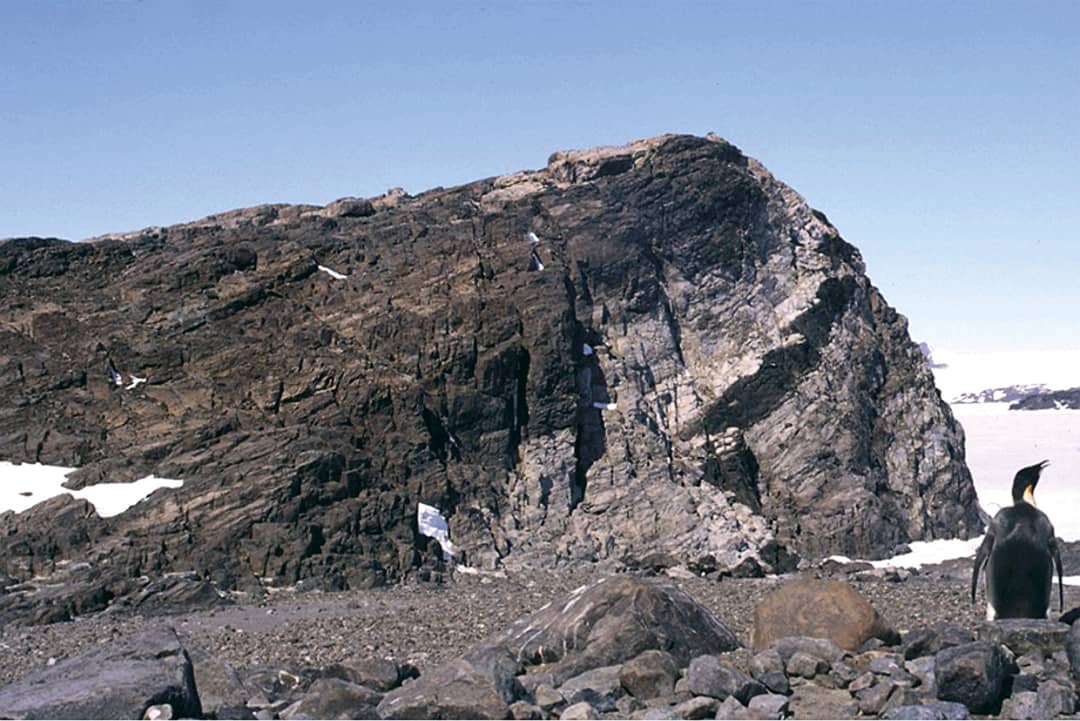
View eastward of the Mount Riiser-Larsen Ultra High Temperature locality of Harley & Motoyoshi (2000). Sapphirine-quartz gneiss comprises the pale unit in this 50-metre high exposure.
Geological description
The Napier Complex of Enderby Land, East Antarctica, is an Archean high-grade metamorphic terrain comprised of intensely deformed gneiss developed during 2550-2480 Ma granulite facies metamorphism at temperatures up to 1050°C and depths of 24-36 kilometres. This extreme tectonothermal episode affected a range of precursor igneous and sedimentary rocks that include the oldest rocks recorded in the southern hemisphere (3850 Ma) as well as lithologies with ages between 3600 and 2600 Ma. The result was the formation of an outstanding variety of mineral assemblages, some previously unknown, that are recognised as diagnostic of metamorphic temperatures in excess of 900°C at moderate crustal depths, now used to define “Ultrahigh Temperature” metamorphism (Harley, 2021).
The site covers an area of some 10,000 square kilometres in western Enderby Land where numerous mountains, nunataks and islands preserve diagnostic mineral assemblages (Harley, 2021). These include sapphirine + quartz (Ellis et al., 1980; Harley and Motoyoshi, 2000), orthopyroxene + sillimanite + quartz, osumilite + garnet + quartz, spinel + quartz, aluminous orthopyroxene (Harley, 2021), ternary feldspar (Hokada, 2001), and pigeonite. The ultra high temperature event also resulted in the formation of a rich and unique array of beryllium-bearing minerals at one locality (Grew et al., 2006).
Scientific research and tradition
Systematic fieldwork and petrography commenced in the 1960-70’s (Dallwitz, 1968; Ellis et al., 1980), followed by geothermobarometric studies utilising existing calibrations (Hokada, 2001) and new approaches (Harley and Motoyoshi, 2000). Recent advances include in-situ dating and accessory mineral thermometry and studies of zircon and monazite behaviours under ultra high temperature conditions.
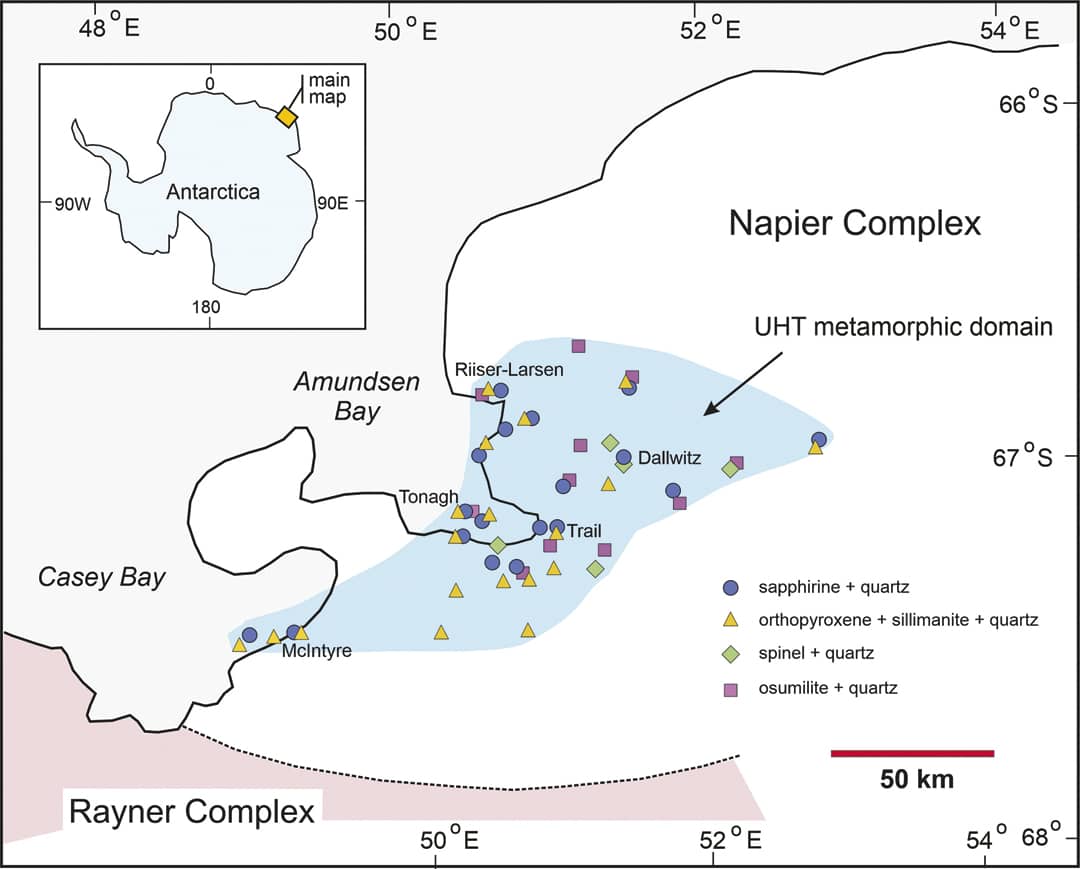
Simplified map of western Enderby Land, showing the Ultra High Temperature domain of the Napier Complex and highlighting the diagnostic metamorphic mineral assemblages within it.
Reference
Dallwitz, W.B. (1968) “Co-existing Sapphirine and Quartz in Granulite from Enderby Land, Antarctica,” Nature, 219, pp. 476–477. Available at: https://doi.org/10.1038/219476a0.
Ellis, D.J. et al. (1980) “Osumilite-sapphirine-quartz granulites from Enderby Land Antarctica — Mineral assemblages and reactions,” Contributions to Mineralogy and Petrology, 72(2), pp. 123–143. Available at: https://doi.org/10.1007/BF00399473.
Grew, E.S. et al. (2006) “Beryllium and Other Trace Elements in Paragneisses and Anatectic Veins of the Ultrahigh-Temperature Napier Complex, Enderby Land, East Antarctica: the Role of Sapphirine,” Journal of Petrology, 47(5), pp. 859–882. Available at: https://doi.org/10.1093/petrology/egi098.
Harley, S.L. (2021) “UHT Metamorphism,” in D. Alderton and S.A. Elias (eds.) Encyclopedia of Geology. 2nd edition. United Kingdom: Academic Press, pp. 522–552. Available at: https://doi.org/10.1016/B978-0-12-409548-9.12543-6.
Harley, S.L. and Motoyoshi, Y. (2000) “Al zoning in orthopyroxene in a sapphirine quartzite: evidence for >1120 °C UHT metamorphism in the Napier Complex, Antarctica, and implications for the entropy of sapphirine,” Contributions to Mineralogy and Petrology, 138(4), pp. 293–307. Available at: https://doi.org/10.1007/s004100050564.
Hokada, T. (2001) “Feldspar thermometry in ultrahigh-temperature metamorphic rocks: Evidence of crustal metamorphism attaining ~1100 °C in the Archean Napier Complex, East Antarctica,” American Mineralogist, 86(7–8), pp. 932–938. Available at: https://doi.org/10.2138/am-2001-0718.
Author(s)
Simon L. Harley.
School of Geosciences, University of Edinburgh, Scotland, UK
Tomokazu Hokada.
National Institute of Polar Research, Tachikawa, Tokyo, Japan
Edward S. Grew.
University of Maine-Orono, USA
Daniel J. Dunkley.
Institute of Geophysics, Polish Academy of Sciences, Warsaw, Poland
Ian Fitzsimons.
School of Earth and Planetary Sciences, Curtin University, Perth, Australia