Combustion Metamorphism Complex of the Hatrurim Formation in the Negev Desert
Israel
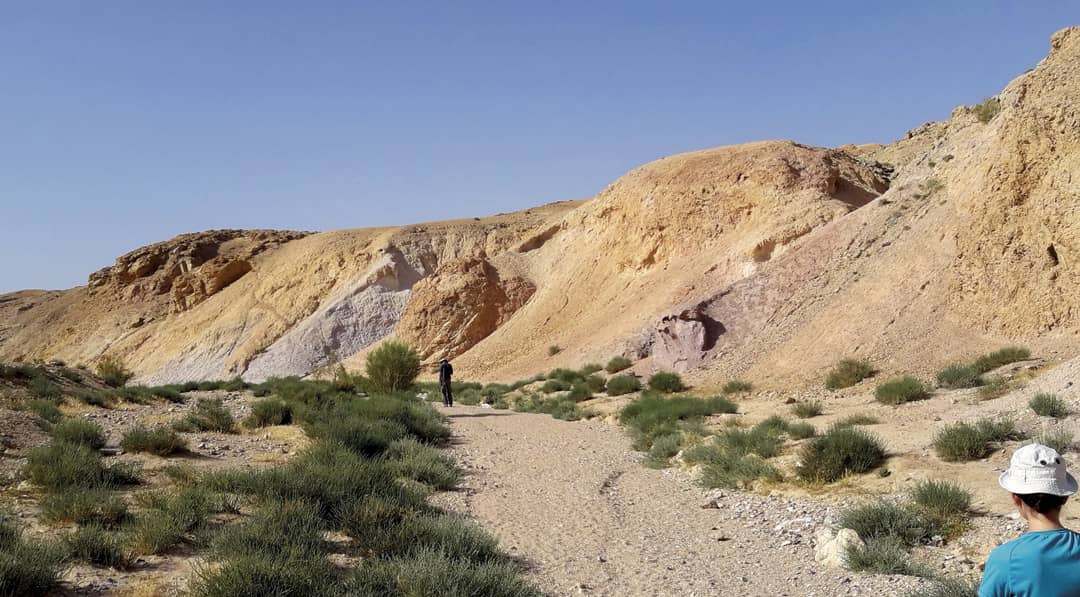
A general view of the Hatrurim Formation landscape showing its irregular structure and exceptionally variegated colours. At the image center is a burning focus.
Geological Period
Cretaceous (Late Cretaceous) to Neogene (Pliocene)
Main geological interest
Igneous and Metamorphic petrology
Mineralogy
Location
Hatrurim Basin, Negev Desert, Israel
31°12’41” N, 35°15’50” E
A general view of the Hatrurim Formation landscape showing its irregular structure and exceptionally variegated colours. At the image center is a burning focus.
An extraordinary exotic mineral assemblage that provides a spectacular example of combustion metamorphism of oil shale.
Combustion metamorphism is a unique high-temperature, low-pressure event. The exotic minerals render the Hatrurim a unique mineralogical phenomenon and the largest sanidinite-facies outcrop in the world. About 150 different minerals are recognized, many of which are very rare and a number new to science. The metamorphic assemblages preserve their relative stratigraphic position and are readily related to their parent sedimentary rock in geological study. The Hatrurim metamorphic rocks are natural analog of Portland cement and allow study of long-term cement durability.
Hatrurim rocks make elegant building stones and were also used in prehistoric times for production of bifacial tools.
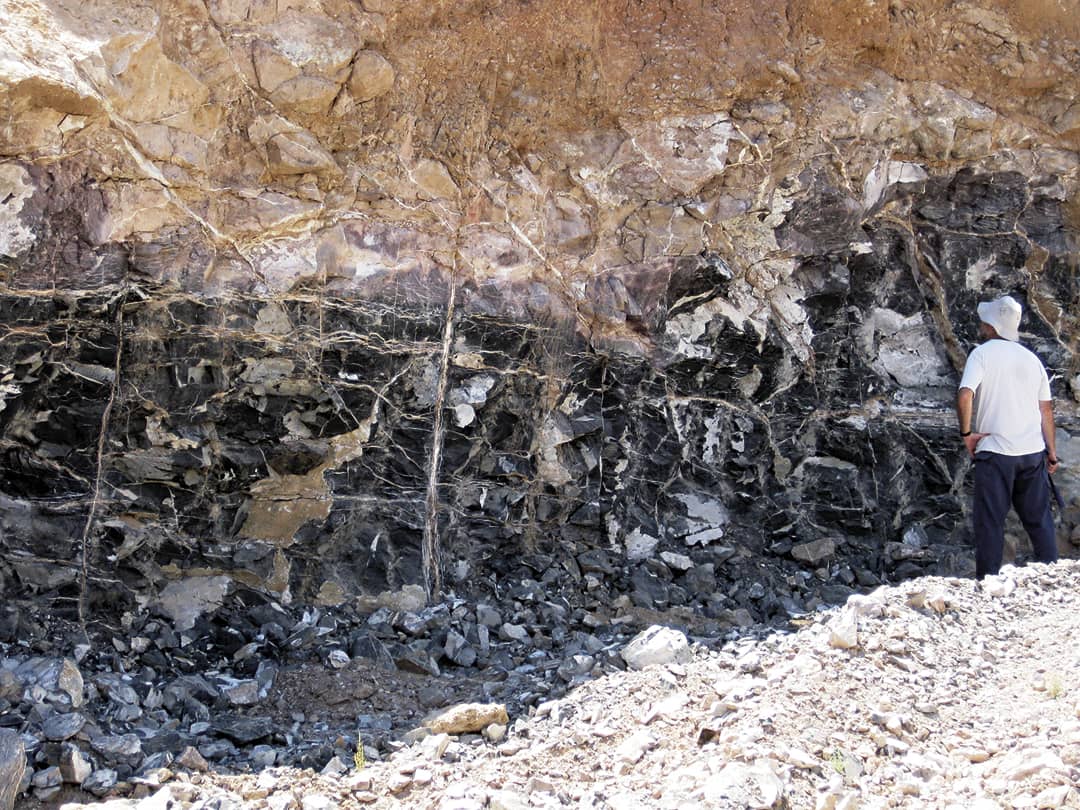
Outcrop of spurrite-calcite marble, a high-temperature metamorphic alteration of chalk. Post-metamorphic criss-crossing veins contain carbonates and Ca–Al–Si hydrate minerals analogous to those occuring in concrete.
Geological description
The Hatrurim Formation is the result of spontaneous combustion metamorphism in Maastrichtian to Paleocene organic-rich chalk and marl. The phenomenon occurs throughout Israel and Jordan and always in the same stratigraphic position. The fully developed mineralogical sequence found in the 50 square kilometer Hatrurim basin is the finest example of high-temperature decarbonation metamorphism during organic matter combustion and the subsequent cooling and weathering. The rocks are characterized by their irregularity, variegated colours, intensive veining, small prismatic carbonate columns and a wide variety of rare calcium-aluminium silicate minerals, some of which are new to science or known as synthetic products of the cement industry. The combustion and metamorphism occurred in separate episodes in the Miocene and Pliocene, when rocks were exposed at the surface. Two phases are recognized; in the isochemical prograde metamorphic stage, high temperatures primarily 600-800°C, rarely exceeding ~1200°C, resulted in dehydration, decarbonation, formation of unique mineral assemblages and localized melting. Lithological variations (primarily clay/carbonate ratio) within the protolith stratigraphic section are expressed in different metamorphic assemblages (gehlenite–larnite, calcite–spurrite, and anorthite–diopside fels). The retrograde cooling and weathering stage features multicolored vein fillings formed by rehydration and recarbonation with a mineralogy composed of hydrated Ca-Al-Si phases and CaCO3 polymorphs.
Scientific research and tradition
The Hatrurim phenomenon has been studied using almost all available scientific methods to describe its complex mineralogy and evolution. This includes mapping, mineralogy, geochemistry, O-C-Si isotopic compositions, dating of metamorphism and weathering processes, combustion duration and temperatures, study of prismatic columns, weathering resistance in the context of radioactive waste storage.
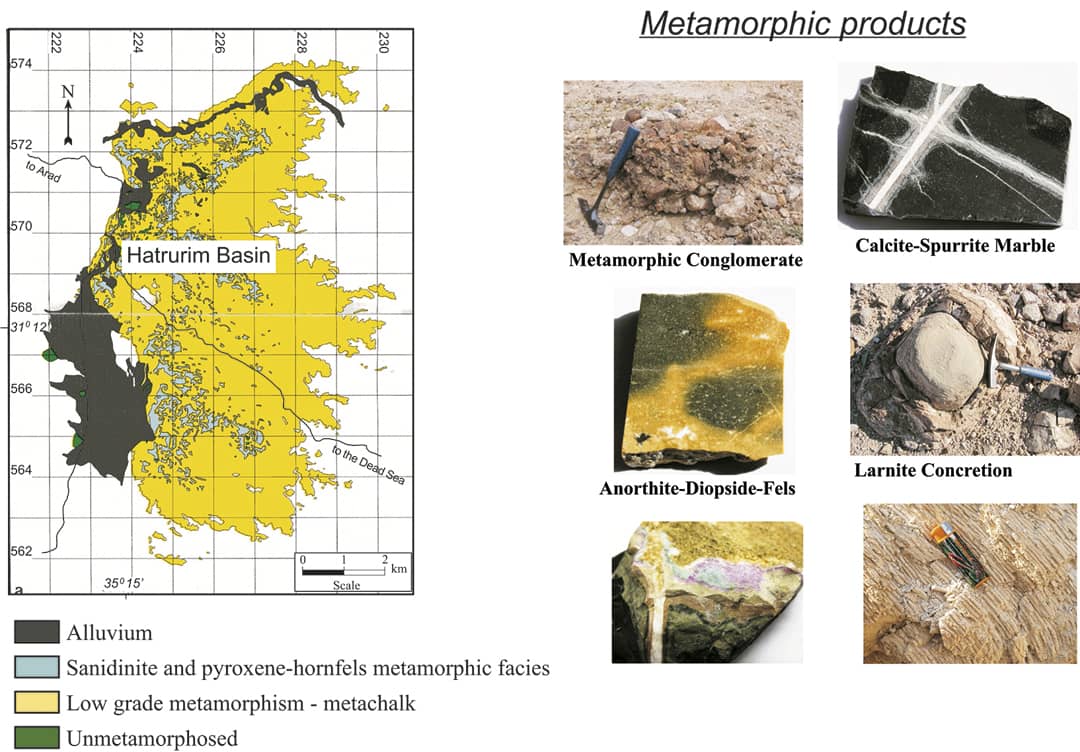
Location-geological map and representative metamorphic rocks occuring throughout the outcrop. Part of the area is a nature reserve and is accessible to hiking and professional visits.
Reference
Burg, A. et al. (1991) “Geology of the Hatrurim Formation (’Mottled Zone’) in the Hatrurim basin,” Israel Journal of Earth Sciences, 40, pp. 107–124.
Kolodny, Y. (1979) “Natural cement factory: a geological story,” in J.P. Skalny (ed.) Cement Production and Use, pp. 203–216.
Kolodny, Y. and Gross, S. (1974) “Thermal metamorphism by combustion of organic matter: Isotopic and petrological evidence,” The Journal of Geology, 82(4), pp. 489–506. Available at: https://doi.org/10.1086/627995.
Matthews, A. and Kolodny, Y. (1978) “Oxygen isotope fractionation in decarbonation metamorphism: the Mottled Zone event,” Earth and Planetary Science Letters, 39(1), pp. 179–192. Available at: https://doi.org/10.1016/0012-821X(78)90154-1.
Sokol, E.V. et al. (2019) “Mineralogical diversity of Ca2SiO4-bearing combustion metamorphic rocks in the Hatrurim Basin: Implications for storage and partitioning of elements in oil shale clinkering,” Minerals, 9(8), p. 465. Available at: https://doi.org/10.3390/min9080465.
Wang, H.-W. et al. (2013) “Multi-scale characterization of pore evolution in a combustion metamorphic complex, Hatrurim basin, Israel: Combining (ultra) small-angle neutron scattering and image analysis,” Geochimica et Cosmochimica Acta, 121, pp. 339–362. Available at: https://doi.org/10.1016/j.gca.2013.07.034.
Author(s)
Avihu Burg.
Geological Survey of Israel
Alan Matthews.
Institute of Earth Sciences, The Hebrew University of Jerusalem