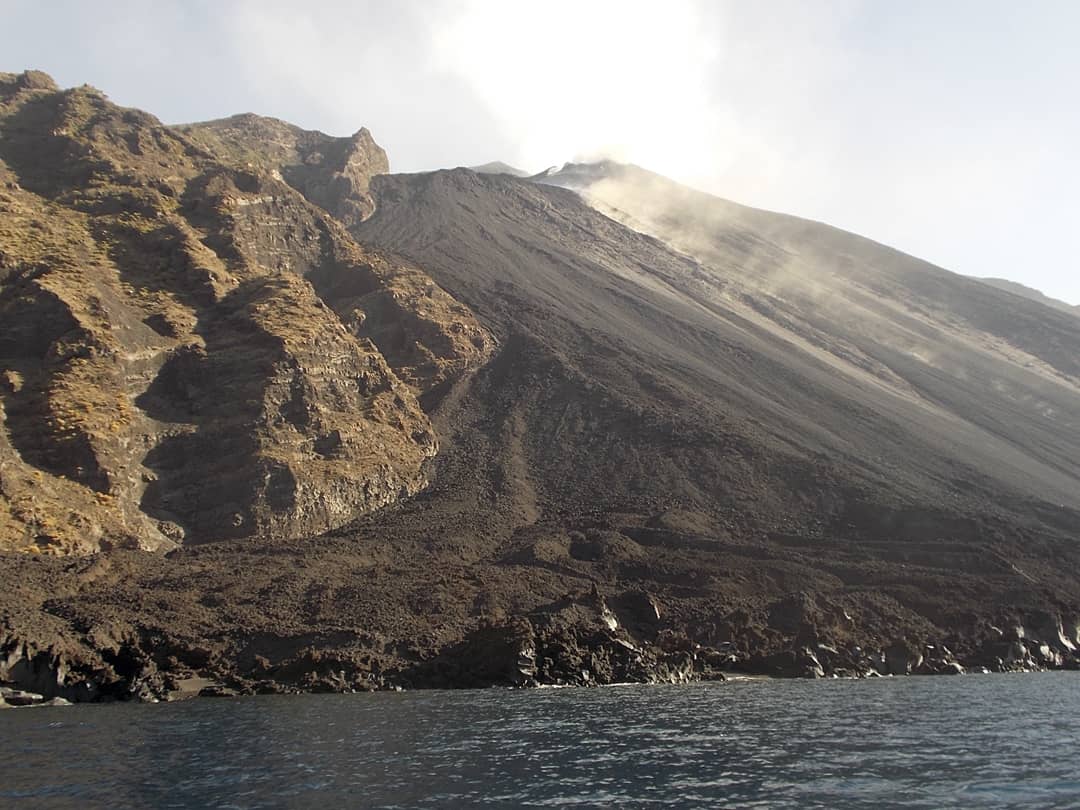
Eruption products roll along the steep slope of the Sciara del Fuoco scar, originated by a volcano flank collapse. (Photo: D.M. Palladino).
Geological Period
Quaternary
Main geological interest
Volcanology
History of geosciences
Location
Aeolian Islands, Italy
38°47’38” N, 15°12’40” E
Eruption products roll along the steep slope of the Sciara del Fuoco scar, originated by a volcano flank collapse. (Photo: D.M. Palladino).
The "lighthouse of the Mediterranean" stands out as the reference locality for Strombolian eruptions worldwide.
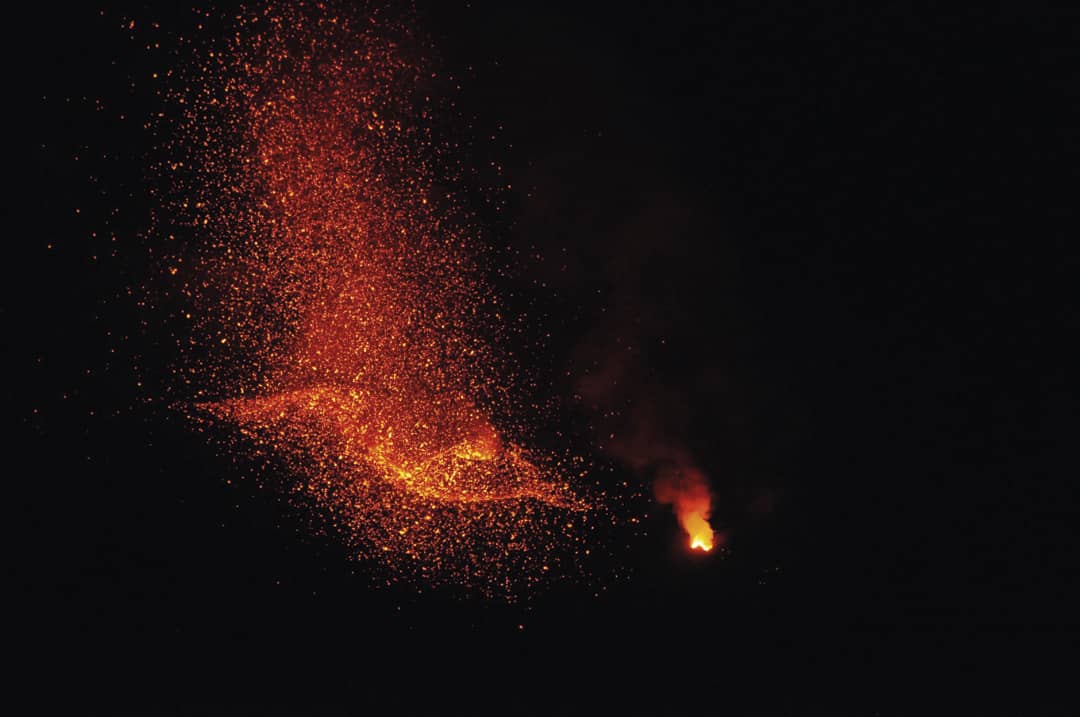
Stromboli is one of the most active volcanoes on Earth, featuring open-conduit, persistent volcanic activity, including spectacular lava fountains at the summit vents that, every few to tens of minutes, eject scoria lapilli and bombs. Occasional lava flows, ash explosions, and paroxysmal events producing high eruptive columns and pyroclastic flows also occur. This variety of styles defines ordinary to violent Strombolian activity in the general classification of volcanic eruptions adopted worldwide. During ordinary activity, most eruptive products roll along the steep Sciara del Fuoco, which testify for the most recent flank collapse episode that affected the history of the volcano.
Ordinary Strombolian activity displays rhythmic explosions lasting a few seconds that eject scoria lapilli and bombs up to tens of meters in height. (Photo: G. Giordano).
Geological description
Stromboli island (Aeolian Islands, Sicily) is the subaerial portion of a largely submerged composite volcano. The exposed edifice developed through distinct epochs of activity: Paleostromboli (85-34 ka), Vancori (26-13 ka), Neostromboli (13-4 ka) and Recent Stromboli (2.4 ka-Present), during which mafic products of calc-alkaline to shoshonitic and potassic-alkaline series were erupted. Repeated sector collapses cut the NW and SE flanks of the volcano down to its submerged basis. Stromboli provides an outstanding record of volcanic island-building and destruction, and ongoing volcanic phenomena. It is well-known in historical times for its persistent, mild explosive, eruptive activity (categorized “ordinary Strombolian”), sometimes alternating with effusive activity, and punctuated by more intense explosive events (“paroxysms” and “violent Strombolian” eruptions) that produce ash-rich convective plumes, up to 8 kilometers in height, and eject large ballistic blocks reaching the inhabited areas on the island. Occasional, short-lived, pyroclastic currents from column collapse are confined within the Sciara del Fuoco and may reach the sea, as observed during the most recent paroxysms in 2019. Recurrent gravitational instabilities and collapses at various scales along the steep slopes of Sciara del Fuoco are recorded in the last decades, eventually resulting in tsunami waves along the Stromboli and surrounding coasts.
Scientific research and tradition
Its scientific study since the 18th century provided the Strombolian category to the classification of volcanic activity. Field observations and instrumental monitoring make Stromboli a natural laboratory for the definition of eruptive parameters and conduit dynamics. Also, it is remarkable example of tidal modulation of eruptive activity at open-vent volcanoes.
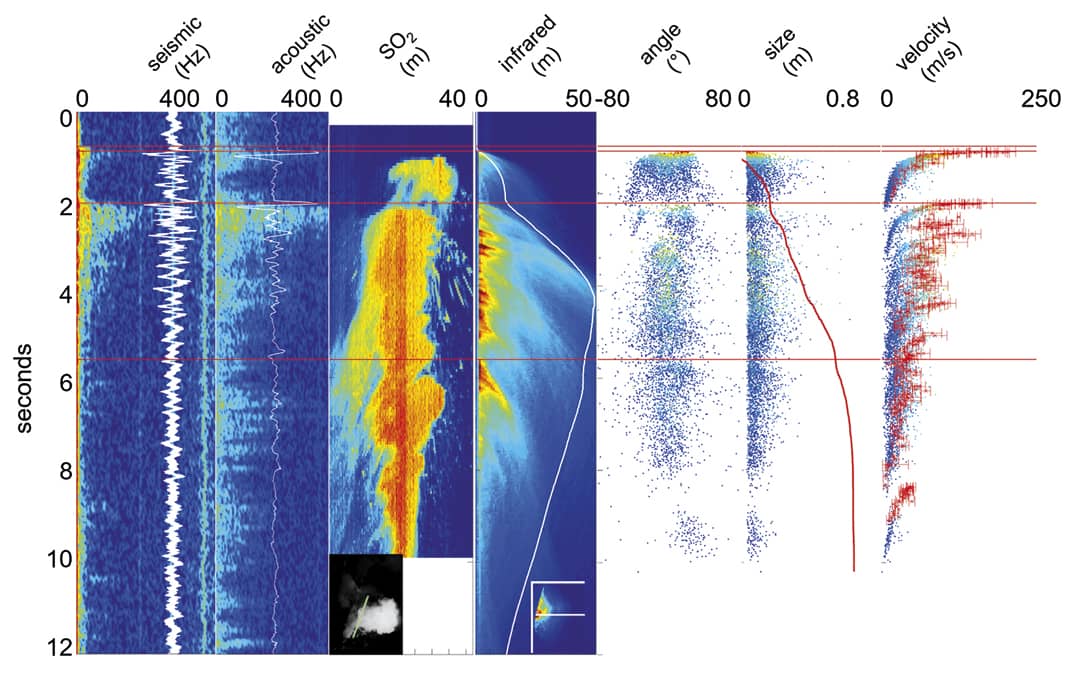
Multiparametric analysis of a single, short-lived explosive event. Persistent activity and accessibility make Stromboli one of the prime volcano laboratories. (J.Taddeucci).
Reference
Blackburn, E.A., Wilson, L. and Sparks, R.S.J. (1976) “Mechanisms and dynamics of strombolian activity,” Journal of the Geological Society, 132(4), pp. 429–440. Available at: https://doi.org/10.1144/gsjgs.132.4.0429.
Patrick, M.R. et al. (2007) “Strombolian explosive styles and source conditions: insights from thermal (FLIR) video,” Bulletin of Volcanology, 69(7), pp. 769–784. Available at: https://doi.org/10.1007/s00445-006-0107-0.
Taddeucci, J. et al. (2012) “High-speed imaging of Strombolian explosions: The ejection velocity of pyroclasts,” Geophysical Research Letters, 39(2). Available at: https://doi.org/10.1029/2011GL050404.
Valentine, G.A. and Gregg, T.K.P. (2008) “Continental basaltic volcanoes — Processes and problems,” Journal of Volcanology and Geothermal Research, 177(4), pp. 857–873. Available at: https://doi.org/10.1016/j.jvolgeores.2008.01.050.
Vergniolle, S. and Mangan, M. (2000) “Hawaiian and Strombolian Eruptions,” in H. Sigurdsson (ed.) The Encyclopedia of Volcanoes. San Diego, CA: Academic Press, pp. 447–461. Available at: https://doi.org/10.1016/B978-0-12-385938-9.00027-4.
Walker, G.P.L. (1973) “Explosive volcanic eruptions — a new classification scheme,” Geologische Rundschau, 62(2), pp. 431–446. Available at: https://doi.org/10.1007/BF01840108.
Author(s)
Danilo M. Palladino.
Dipartimento di Scienze della Terra Sapienza-Università di Roma, Rome, Italy
Guido Giordano.
Dipartimento di Scienze, Università di Roma Tre, Rome, Italy
Jacopo Taddeucci.
Istituto Nazionale di Geofisica e Vulcanologia, Sezione di Roma, Rome, Italy
Greg A. Valentine.
Department of Earth Sciences, University at Buffalo, Buffalo, NY, USA
Marco Viccaro.
Dipartimento di Scienze Biologiche, Geologiche e Ambientali, Università di Catania, Catania, Italy.