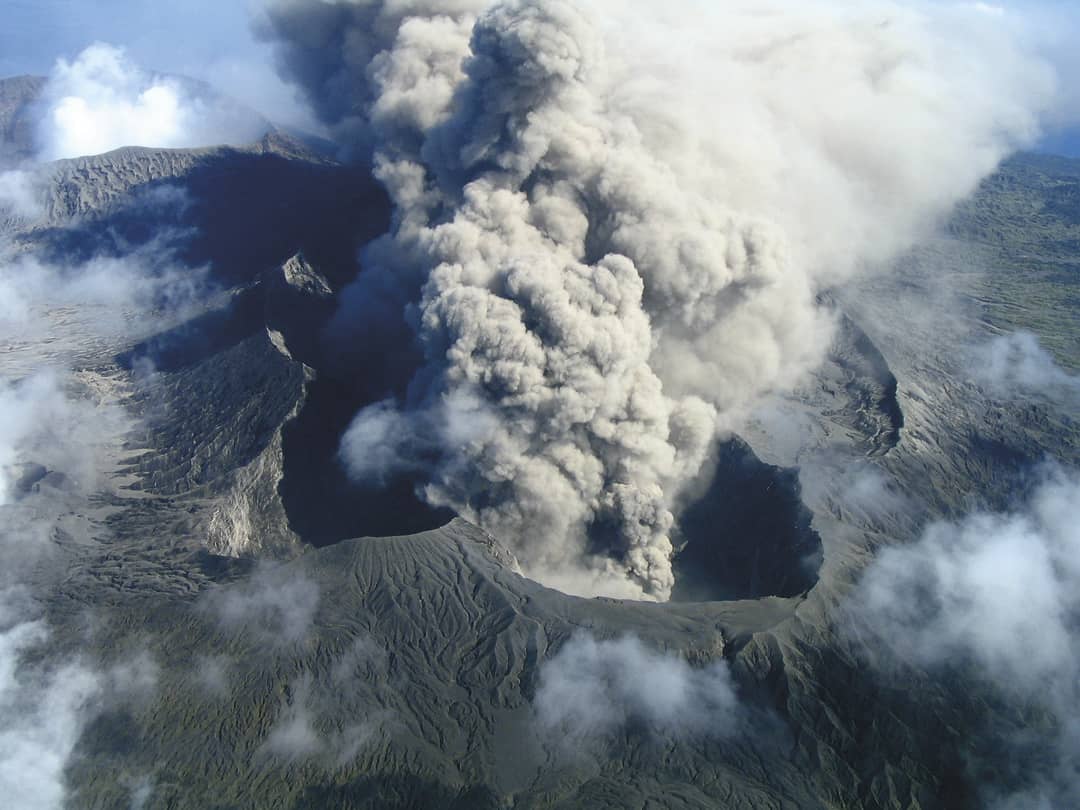
Typical sub-Plinian explosive eruption from the central vents of Ambrym in 2005 produced ash that covered the landscape and feed complex volcaniclastic sedimentary networks.
Neogene (Pliocene) to Quaternary (Holocene)
Volcanology
Geomorphology and active geological processes
SW Pacific, Vanuatu
16°14’47” S, 168°7’10” E
Typical sub-Plinian explosive eruption from the central vents of Ambrym in 2005 produced ash that covered the landscape and feed complex volcaniclastic sedimentary networks.
Ambrym is an example of an open-vent, continuously degassing active basaltic caldera. It feature an active lava lake, continuous degassing, and frequent ash-producing explosive eruptions. Ambrym exhibits a significant volcaniclastic sedimentary system and experiences interaction with the water-rich environment that leads to highly explosive eruptions along its coastal rift axis. It became a focal point of scientific debate over the role of explosive magma-water interaction in mafic caldera formation versus passive caldera floor subsidence through magma drainage sideways. Ambrym is noted for its volcaniclastic succession in a mafic volcano-sedimentary system.
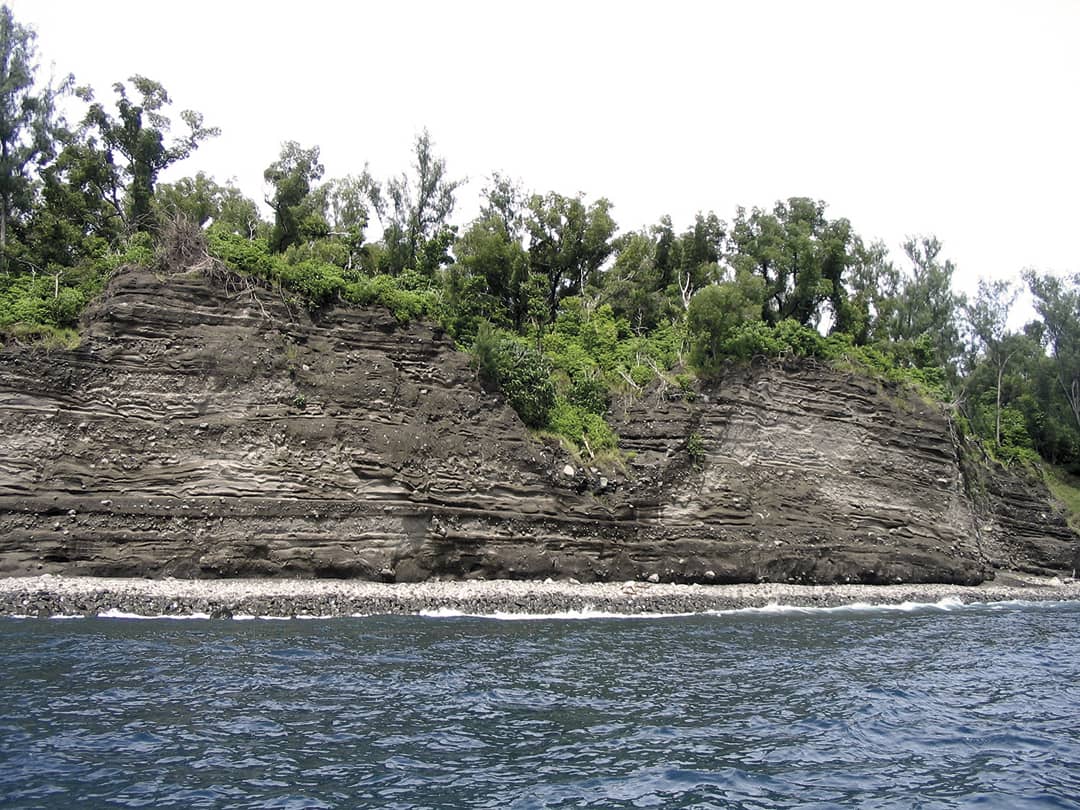
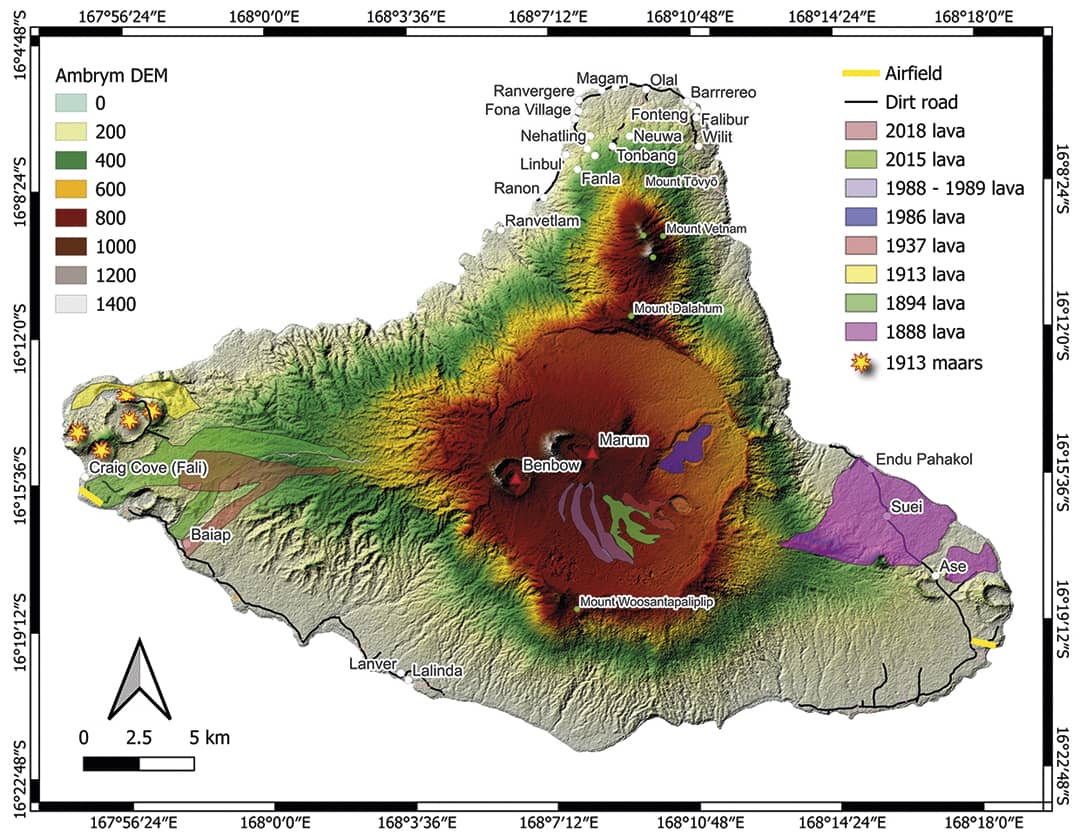
Ambrym is an active mafic volcanic island featuring a 12-kilometer-wide basaltic caldera with volcaniclastic infill. This large basaltic caldera, exhibiting evidence of highly explosive eruptions through the Holocene, has been attributed to magma-water interaction and the formation of a partially destroyed giant tuff cone. This theory has led to ongoing scientific debate and positioned Ambrym as a significant site for research into explosive mafic volcanism within the field of volcanology. The island contains two active volcanoes, one of which has a near-permanent lava lake. Explosive eruptions frequently emit ash that affects the rainforest, creating a landscape with gullies formed by high-intensity rainfall. The volcano operates as an open-vent system, releasing substantial volumes of sulphur dioxide and fluorine gas. These conditions limit vegetation growth on the ash-dominated terrain and increase erosion, creating unique tropical badlands. The considerable release of fluorine gas makes Ambrym important for studying fluorosis in human populations due to groundwater contamination. Historical eruptions, such as the 1913 phreatomagmatic event in West Ambrym, formed maar craters and destroyed a missionary station and hospital, leaving behind a significant pyroclastic succession. Eruptions have occurred both at the central vent and along the rift zones, posing natural hazards to local communities.
Ambrym is home to the concept of a giant tuff cone that exploded due to violent magma and water interaction, a debated model, continuously explored in combination with understanding the open vent frequent activity of the system by international research teams over the last 50 years.
Bani, P. et al. (2009) “Surge in sulphur and halogen degassing from Ambrym volcano, Vanuatu,” Bulletin of Volcanology, 71(10), pp. 1159–1168. Available at: https://doi.org/10.1007/s00445-009-0293-7.
Németh, K. and Cronin, S.J. (2007) “Syn- and post-eruptive erosion, gully formation, and morphological evolution of a tephra ring in tropical climate erupted in 1913 in West Ambrym, Vanuatu,” Geomorphology, 86(1), pp. 115–130. Available at: https://doi.org/10.1016/j.geomorph.2006.08.016.
Németh, K. and Cronin, S.J. (2008) “Volcanic craters, pit craters and high-level magma-feeding systems of a mafic island-arc volcano: Ambrym, Vanuatu, South Pacific,” Geological Society, London, Special Publications, 302(1), pp. 87–102. Available at: https://doi.org/10.1144/SP302.6.
Németh, K. and Cronin, S.J. (2011) “Drivers of explosivity and elevated hazard in basaltic fissure eruptions: The 1913 eruption of Ambrym Volcano, Vanuatu (SW-Pacific),” Journal of Volcanology and Geothermal Research, 201(1), pp. 194–209. Available at: https://doi.org/10.1016/j.jvolgeores.2010.12.007.
Robin, C., Eissen, J.-P. and Monzier, M. (1993) “Giant tuff cone and 12-km-wide associated caldera at Ambrym Volcano (Vanuatu, New Hebrides Arc),” Journal of Volcanology and Geothermal Research, 55(3), pp. 225–238. Available at: https://doi.org/10.1016/0377-0273(93)90039-T.
Shreve, T. et al. (2019) “From prodigious volcanic degassing to caldera subsidence and quiescence at Ambrym (Vanuatu): the influence of regional tectonics,” Scientific Reports, 9(1), 18868. Available at: https://doi.org/10.1038/s41598-019-55141-7.
Károly Németh.
Saudi Geological Survey, Kingdom of Saudi Arabia
Camillia Garae.
Ministry of Lands and Natural Resources, Vanuatu
Gary Lee.
The Pacific Community (SPC), Fiji
Josh Brown.
The Pacific Community (SPC), Fiji