Giant sheath folds in Wadi Mayh

Oman

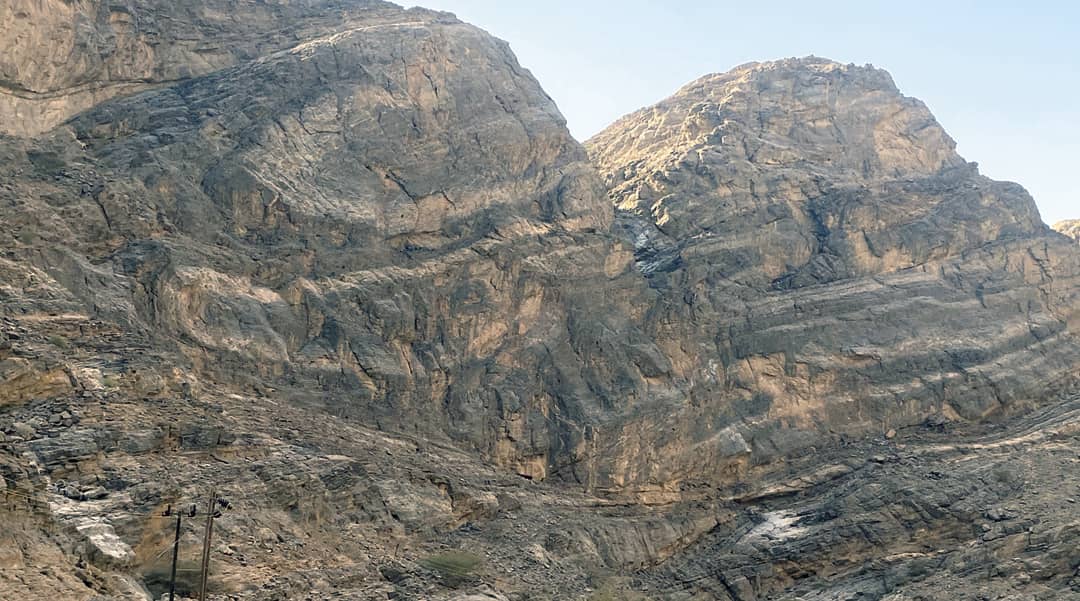
Sheath fold with “eye-shape” structure in Wadi Mayh (view to the south-southest). Width of photograph is 150 meters (23°25’34.6N, 58°32’37.3″E).

Geological Period

Cretaceous (Upper Cretaceous)

Main geological interest

Tectonics

Location

Eastern Oman Mountains, Sultanate of Oman, Oman
23°25’38” N, 58°32’37” E

Sheath fold with “eye-shape” structure in Wadi Mayh (view to the south-southest). Width of photograph is 150 meters (23°25’34.6N, 58°32’37.3″E).

This site displays rare, large and superbly exposed sheath folds, which formed during high non-coaxial strain.

Sheath folds form under particular non-coaxial shear and ductile conditions in a variety of tectonic environments, i.e., Barrovian-facies metamorphism, high-pressure terrains, salt diapirs and sub-glacial sediments. Thus, understanding of the geometry of sheath folds and their formation is an important task in structural geology, which improves the understanding of regional tectonic processes. Along Wadi Mayh, these fascinating structures can be conveniently studied in all three dimensions. This, in combination with the excellent outcrop conditions makes Wadi Mayh a world-class reference outcrop for sheath folds.

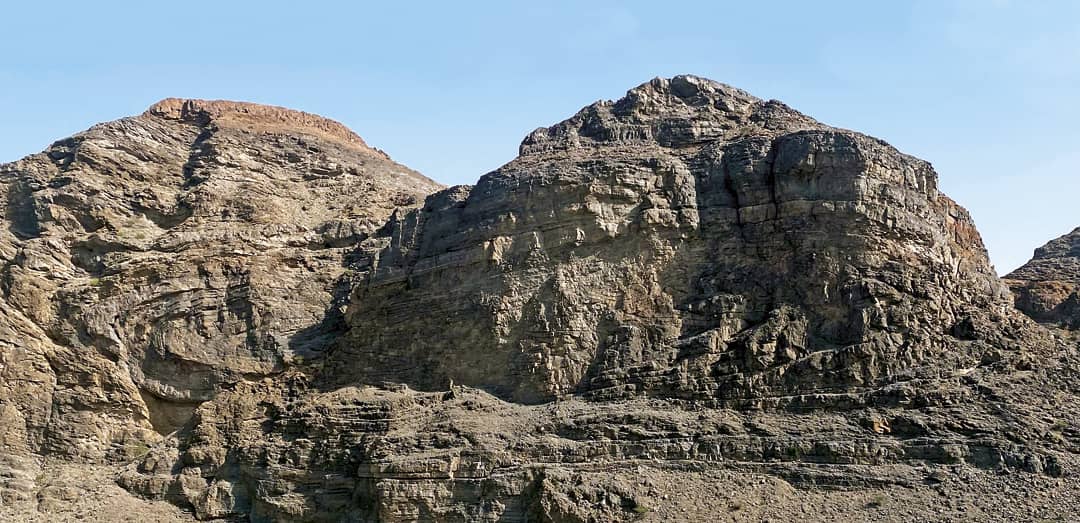
Sheath folds with “eye-shape” structure on top of each other in Wadi Mayh (view to the north). Width of photograph is 150 meters (23°25’34.1″N, 58°31’52.6″E) .

Permian carbonate rocks within Wadi Mayh of the Eastern Oman Mountains contain superbly exposed sheath folds as part of a mega-sheath fold sequence. These structures, which formed during intense non-coaxial shear and ductile conditions, can be observed along a section 10-15 kilometers long. The wadi cuts the folds at different angles, which allows for studying the folds in all dimensions. At several places, the sheath folds expose the typical “eye-shape” double closure in sections perpendicular to the “sheaths”/x-axis. The width (y-axis) of the folds can be as much as 150 meters. At places, several sheath folds sit on top of each other.
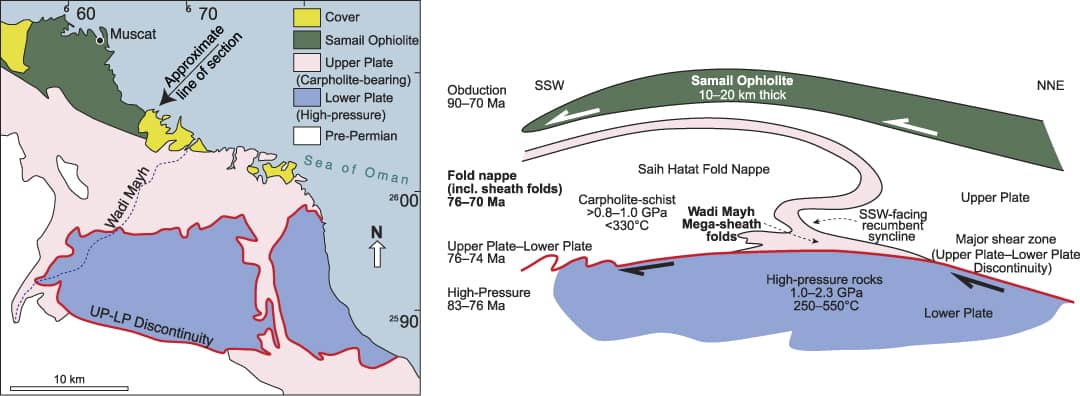
Within Wadi Mayh, the stretching lineations trend dominantly north-northeast to south-southwest, and the fold closure is towards the south-southwest. The folds formed during south-southwest directed exhumation of continental rocks as part of Samail Ophiolite obduction during the Late Cretaceous as indicated by carpholite within the limestone (0.6-0.8 GPa, 275-375°C; Gray et al., 2005; Searle and Alsop, 2007; Cornish and Searle 2017). The sheath folds are part of an south-southwest closing recumbent syncline with length of several kilometers. This syncline is below the regional Saih Hatat Fold Nappe (Miller et al., 2002).

The easily accessible sheath folds in Wadi Mayh, which are located near the capital of Oman, have been studied since the 1990’s. The sheath folds are part of a bucket-list for any professional and amateur geologist visiting Oman.

Section of the greater Wadi Mayh area. Simplified after Gray and Gregory (2003) and Hansman et al. (2021).

Cornish, S. and Searle, M. (2017) “3D geometry and kinematic evolution of the Wadi Mayh sheath fold, Oman, using detailed mapping from high-resolution photography,” Journal of Structural Geology, 101, pp. 26–42. Available at: https://doi.org/10.1016/j.jsg.2017.06.009.

Gray, D.R. and Gregory, R.T. (2003) “Ophiolite obduction and the Samail Ophiolite: the behaviour of the underlying margin,” Geological Society of London Special Publications, 218, pp. 449–465. Available at: https://doi.org/10.1144/GSL.SP.2003.218.01.23.

Gray, D.R., Miller, J.McL. and Gregory, R.T. (2005) “Strain state and kinematic evolution of a fold-nappe beneath the Samail Ophiolite, Oman,” Journal of Structural Geology, 27(11), pp. 1986–2007. Available at: https://doi.org/10.1016/j.jsg.2005.06.011.

Hansman, R.J. et al. (2021) “Structural architecture and Late Cretaceous exhumation history of the Saih Hatat Dome (Oman), a review based on existing data and semi-restorable cross-sections,” Earth-Science Reviews, 217, p. 103595. Available at: https://doi.org/10.1016/j.earscirev.2021.103595.

Miller, J.M., Gray, D.R. and Gregory, R.T. (2002) “Geometry and significance of internal windows and regional isoclinal folds in northeast Saih Hatat, Sultanate of Oman,” Journal of Structural Geology, 24(2), pp. 359–386. Available at: https://doi.org/10.1016/S0191-8141(01)00061-X.

Searle, M.P. and Alsop, G.I. (2007) “Eye-to-eye with a mega–sheath fold: A case study from Wadi Mayh, northern Oman Mountains,” Geology, 35(11), pp. 1043–1046. Available at: https://doi.org/10.1130/G23884A.1.

Andreas Scharf.
Sultan Qaboos University, Oman

Frank Mattern.
Sultan Qaboos University, Oman

Christopher M. Bailey.
William & Mary, Virginia, U.S.A.

The Third 100 IUGS Geological Heritage Sites have been officially announced!
Privacy overview

This website uses cookies so that we can offer you the best possible user experience. Cookie information is stored in your browser and performs functions such as recognizing you when you return to our website or helping our team to understand which sections of the website you find most interesting and useful.