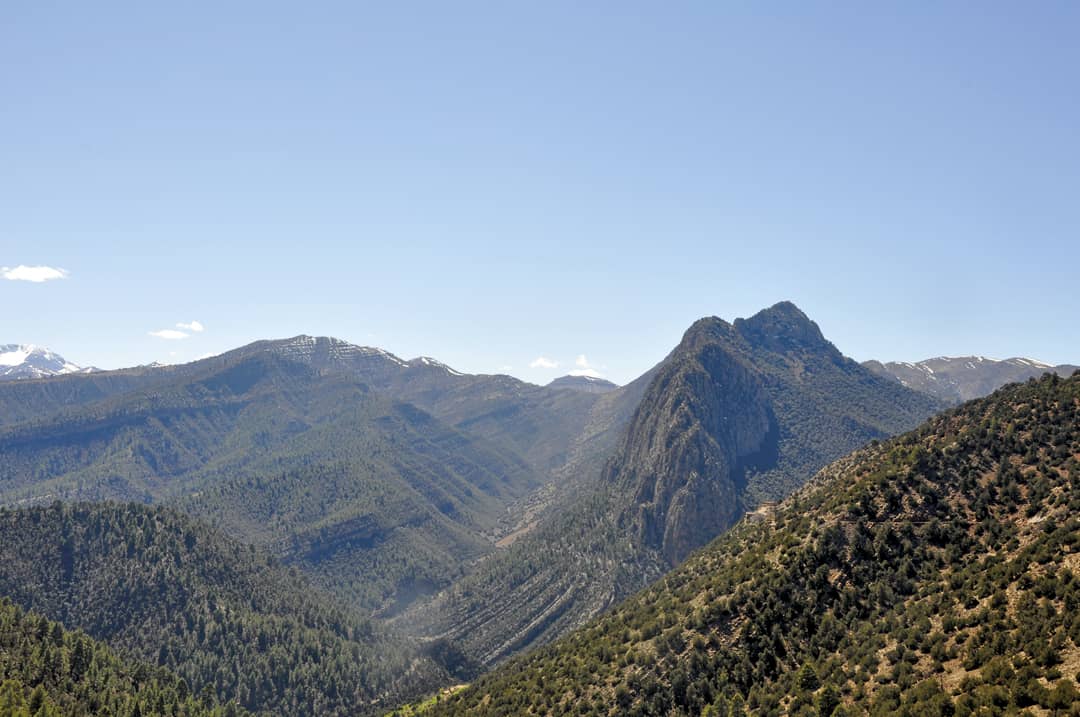
Lower to Middle Jurassic sedimentary fan within the Amezrai Basin on the southeastern flank of the Tazoult diapiric ridge.
Geological Period
Jurassic (early Jurassic) to Neogene (Pliocene)
Main geological interest
Tectonics
Stratigraphy and sedimentology
Location
High Atlas, Morocco
31°57’13” N, 6°7’07” W
Lower to Middle Jurassic sedimentary fan within the Amezrai Basin on the southeastern flank of the Tazoult diapiric ridge.
A world class syn-sedimentary Jurassic diapir and alpine tectonic inversion with post diapiric sedimentation.
Tazoult Ridge and Cathedral Conglomerate, located in the heart of the M’Goun UNESCO Global Geopark, constitute an exceptional tectono-sedimentary system illustrating the transition from Jurassic syn-rift salt tectonics to Alpine compressional inversion in the Central High Atlas. The site provides a world-class example of diapiric salt-wall growth, halokinetic sedimentation, passive diapirism, and later tectonic reactivation during basin inversion, as documented by Saura et al. (2014). The remarkable preservation of diapir-related geometries, syn-tectonic sedimentary architectures, and Neogene post-diapiric deposits makes this site a key international reference for understanding the tectonic evolution of salt-influenced rift basins and inverted passive margins.
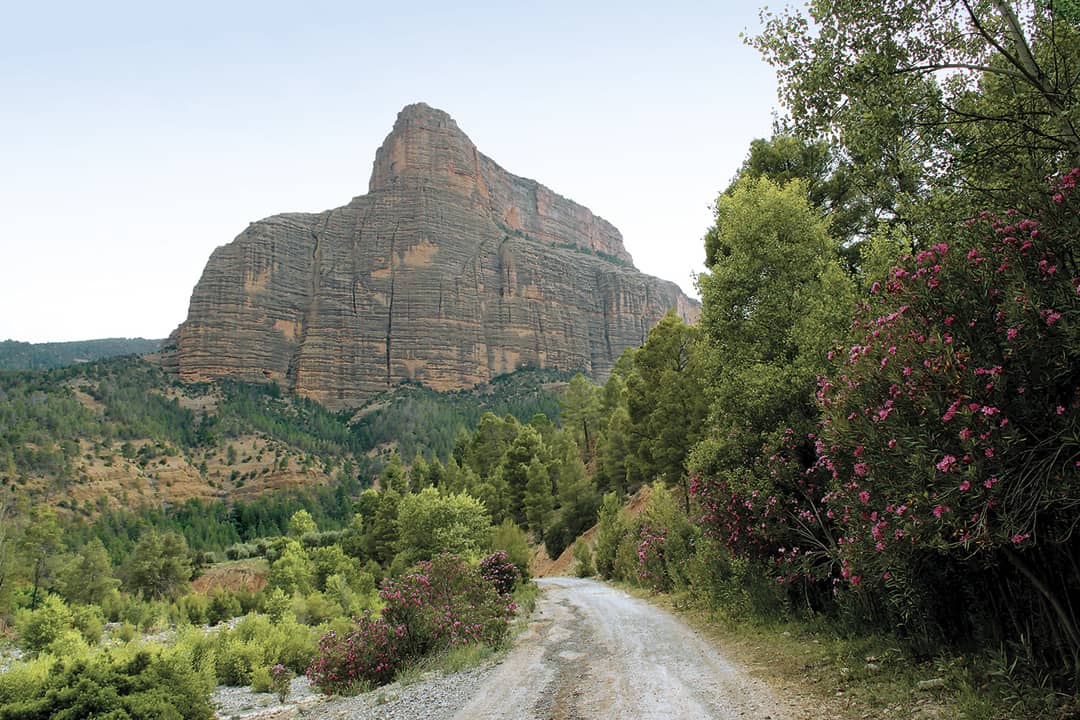
The ‘Cathedral’: a 700-meter-high rock body representing the Neogene infill of the northern flank of the Tazoult Diapiric Ridge.
Geological description
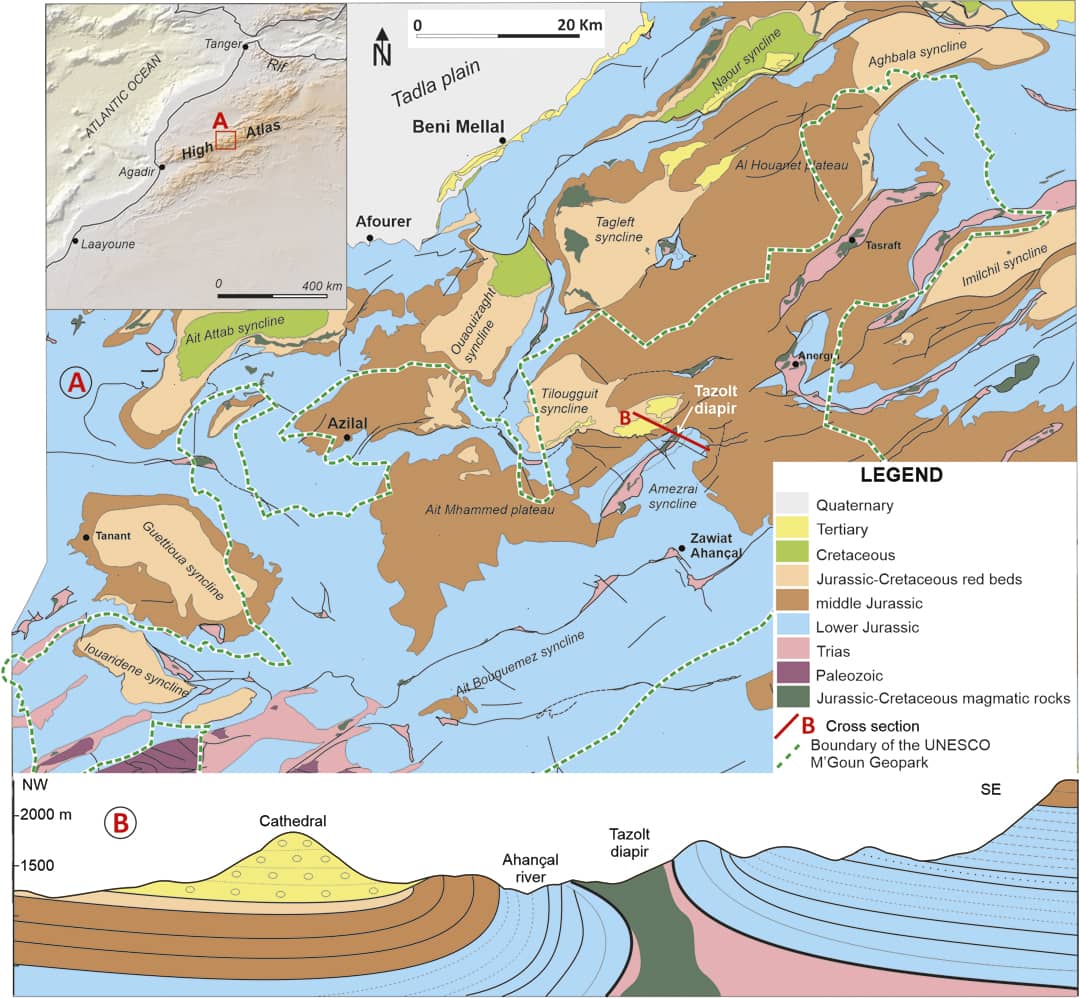
The Tazoult Ridge is a remarkable NE–SW-trending diapiric wall extending northeast to southwest over approximately 20 kilometers in the Central High Atlas (Morocco). Its core exposes Triassic red beds, basalt, and evaporite intruded by Jurassic–Cretaceous gabbro related to syn-rift tectono-magmatic activity. The ridge separates the Jurassic Amezraï Basin to the south from the Tilougguit Basin to the north and represents an outstanding example of syn-sedimentary diapiric activity characteristic of the Early Jurassic rifting phase in the High Atlas.The diapir initiated during the early Liassic with the tilting of adjacent carbonate platforms and the progressive passive upward extrusion of salt. Fan-shaped sedimentary geometries developed synchronously with diapiric uplift and extensional tectonics. The diapir was subsequently partially sealed by Middle Jurassic carbonate and later reactivated as a sharp anticline during Alpine compression, leading to tectonic inversion of the High Atlas basin system. The Tilougguit syncline preserves thick Mio-Pliocene post-diapiric deposits recording this compressional inversion phase.
Scientific research and tradition
The site has been extensively investigated through structural, tectonic, and sedimentological studies and frequently visited during international geological field excursions. It has become a key reference for Jurassic salt tectonics, diapiric growth, and Alpine basin inversion in the Central High Atlas.
Simplified structural cross-section of the Tazoult Diapiric Ridge
Reference
Bouchouata, A. et al. (1995) “Jurassic sequence stratigraphy and geodynamic evolution in the Talmest-Tazoult area, Central High Atlas, Morocco,” Comptes Rendus de l’Académie des Sciences, 320(8), pp. 749–756.
Frizon de Lamotte, D. et al. (2008) “The Atlas System,” in André Michard et al. (eds.) Continental Evolution: The Geology of Morocco: Structure, Stratigraphy, and Tectonics of the Africa-Atlantic-Mediterranean Triple Junction. Berlin, Heidelberg: Springer, pp. 133–202. Available at: https://doi.org/10.1007/978-3-540-77076-3_4.
Jossen, J.A. and Couvreur, G. (1990) Carte Géologique du Maroc au 1/100 000, num 741 feuille Zawyat Ahançal.
Martín-Martín, J.D. et al. (2017) “Diapiric growth within an Early Jurassic rift basin: The Tazoult salt wall (central High Atlas, Morocco),” Tectonics, 36(1), pp. 2–32. Available at: https://doi.org/10.1002/2016TC004300.
Saura, E. et al. (2014) “Syn- to post-rift diapirism and minibasins of the Central High Atlas (Morocco): the changing face of a mountain belt,” Journal of the Geological Society, 171(1), pp. 97–105. Available at: https://doi.org/10.1144/jgs2013-079.
Souhel, A. et al. (2011) “Circuit C12: North-western Central High Atlas,” in A. Michard et al. (eds.) New geological and mining guidelines for Morocco, vol. 7. (Notes et Mémoires du Service Géologique, 562), pp. 63–109.
Author(s)
Abdellatif Souhel.
Department of Geology, Faculty of Sciences, Chouaib Doukkali University, El Jadida, Morocco
Ezzoura Errami.
LGG, Department of Geology, Faculty of Sciences, Chouaib Doukkali University, El Jadida, Morocco
Brahim Nait Ouacha.
Department of Geology, Faculty of Sciences, Chouaib Doukkali University, El Jadida, Morocco
Joseph Canérot.
3, chemin Cordeau, 31200 Toulouse, France