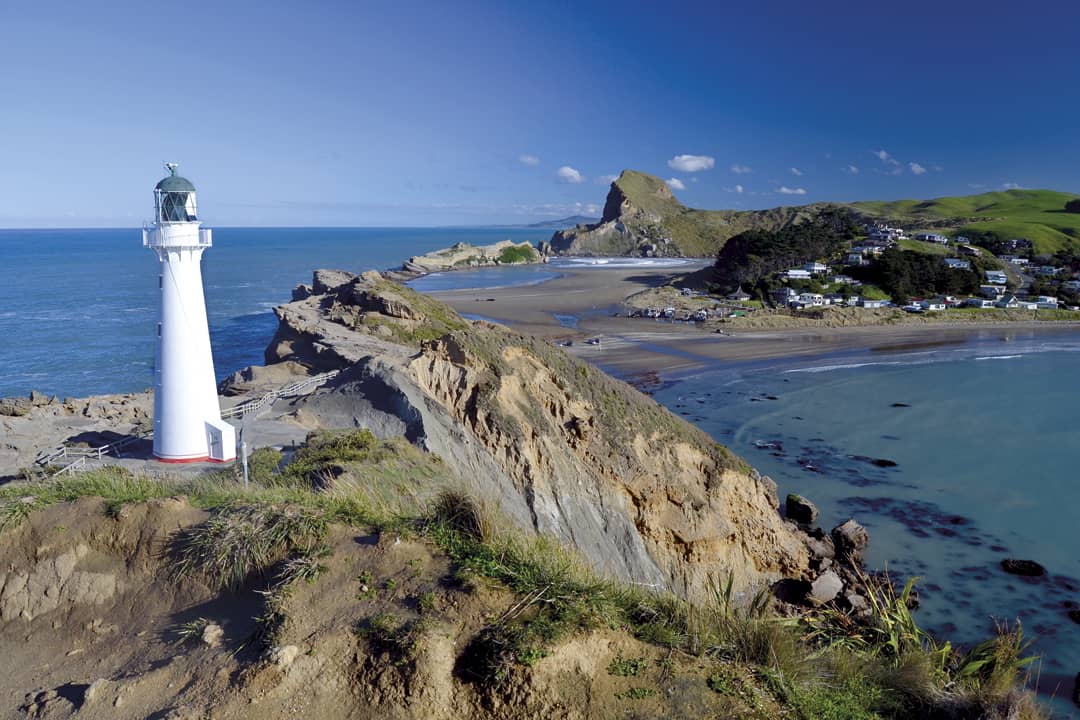
Sedimentary structures within the beds of the Pleistocene fossil-rich Castlepoint Formation at Castlepoint promontory confirm gravity sliding into a canyon head in a subduction front.
Neogene (Miocene) to Neogene (Pliocene)
Tectonics
Stratigraphy and sedimentology
North Island, New Zealand
40°54’01” S, 176°13’54” E
Sedimentary structures within the beds of the Pleistocene fossil-rich Castlepoint Formation at Castlepoint promontory confirm gravity sliding into a canyon head in a subduction front.
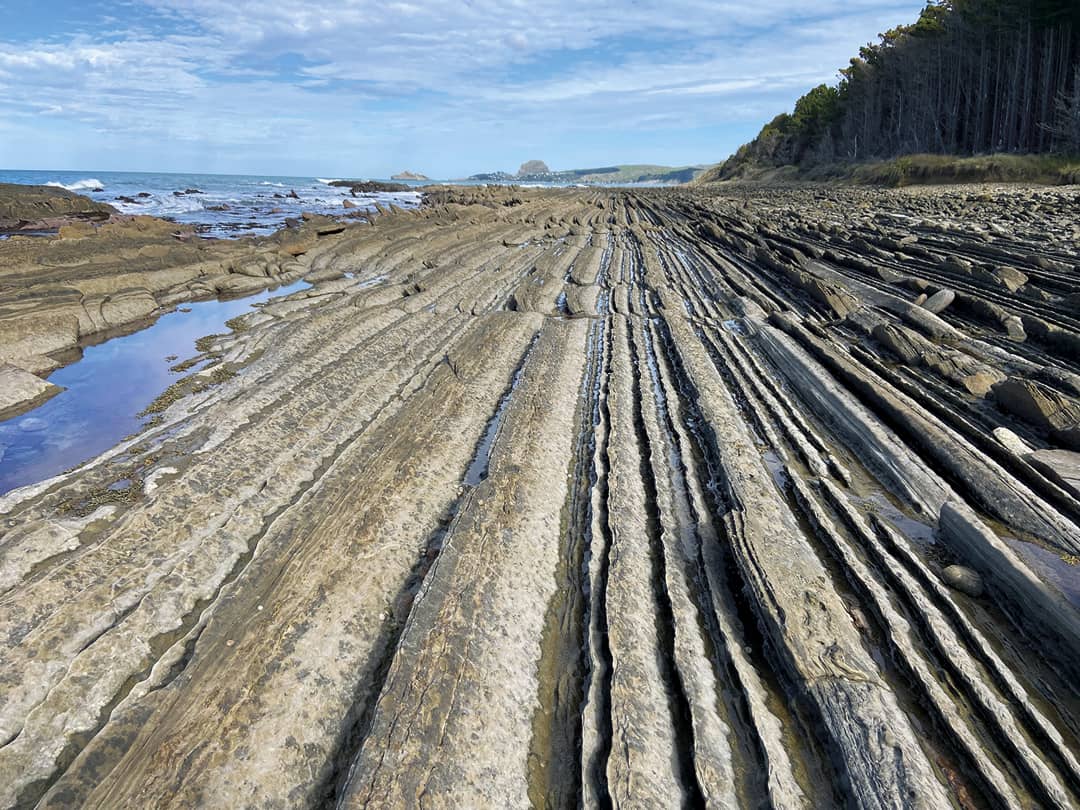
The east coast of the North Island of New Zealand records stages of accretionary wedge formation, compressional tectonism, and development of forearc basins. Turbidite successions along the current coastline comprise Miocene to Pleistocene rocks. The active subduction front about 200 kilometers away from the current shore continues to drive seismic and tsunami hazards to the coast. Exposed turbidite sequences provide one of the best global examples of frequency of major turbidity events in the Miocene, like the paleoseismic record of the modern period of subduction. This location is, therefore, a unique site for geoeducation, showing links between the geology and active processes.
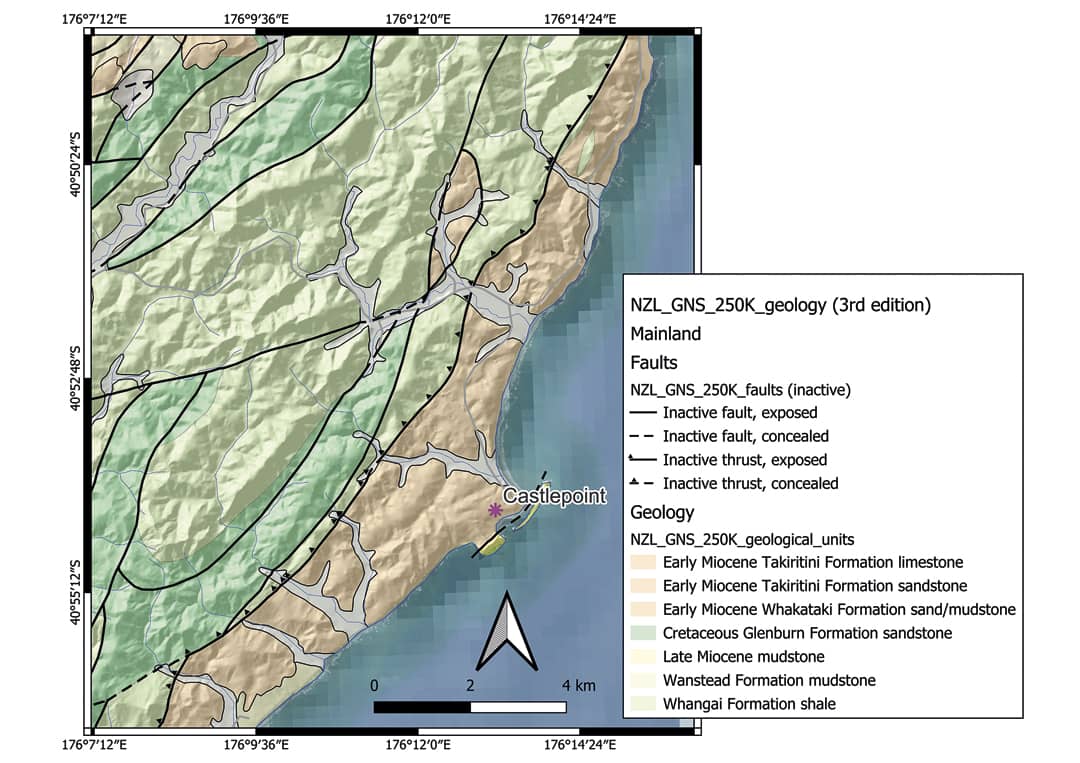
The east coast of the North Island of New Zealand is a globally significant geological archive that demonstrates continuous accretionary prism formation driven by oblique subduction since the Miocene, as the Pacific Plate subducts beneath the Australia-India Plate. This geotectonic zone is one of the world’s best examples of oblique subduction and its influences on sedimentary processes, uplift, and tectonic movements. These processes significantly contribute to New Zealand’s hazardscape. Exceptional turbidite successions are laterally exposed over tens of kilometers, providing world-class examples of an accretionary prism. Due to its extent, accessibility, and shore platform settings, this outcrop is considered superior to the iconic “flysch” locations of the North American Cordillera, the Alps, the Pyrenees, or the Carpathians, particularly for demonstrating active seafloor processes initiated by large mass movements and influence of subduction earthquakes preserved within a turbidite succession. The turbidite successions are associated with thrust faults, folds, and related mélange sequences from outcrop to regional scale, making this region one of the best examples of an exposed accretionary prism on Earth. The complex Bouma sequences, formed over hundreds of thousands of years also preserve a record of catastrophic events, including the breakage of blocks that form olistostromes, such as Castlepoint itself.
The region has been well mapped, resulting in international scientific papers on accretionary wedge geology, convergent plate margins and paleoseismicity. The region also forms a core geological site in understanding formation of modern New Zealand and the convergent plate margin processes of the eastern part of the Zealandia micro continent.
Buckeridge, J.S., Beu, A.G. and Gordon, D.P. (2018) “Depositional environment of the early Pleistocene Castlepoint Formation, New Zealand: a canyon fill in situ,” New Zealand Journal of Geology and Geophysics, 61(4), pp. 524–542. Available at: https://doi.org/10.1080/00288306.2018.1516227.
Clark, K. et al. (2011) “Investigating subduction earthquake geology along the southern Hikurangi margin using palaeoenvironmental histories of intertidal inlets,” New Zealand Journal of Geology and Geophysics, 54(3), pp. 255–271. Available at: https://doi.org/10.1080/00288306.2011.562903.
Field, B.D. (2005) “Cyclicity in turbidites of the Miocene Whakataki Formation, Castlepoint, North Island, and implications for hydrocarbon reservoir modelling,” New Zealand Journal of Geology and Geophysics, 48(1), pp. 135–146. Available at: https://doi.org/10.1080/00288306.2005.9515104.
Johnston, M.R. (1973) “Geology of Castlepoint Headland and Reef, Wairarapa, New Zeland,” New Zealand Journal of Geology and Geophysics, 16(4), pp. 909–916. Available at: https://doi.org/10.1080/00288306.1973.10555230.
Palmer, J. et al. (2020) “Geoheritage Values of the Wairarapa ‘Mudstone Country’, North Island, New Zealand,” Geoconservation Research, 3(2), pp. 97–127. Available at: https://doi.org/10.30486/gcr.2020.677854.
Sloss, C.R. et al. (2021) “Sedimentology and stratigraphy of syn-subduction Miocene fine-grained turbidites deposited in first stages of trench-slope basin development: Whakataki Formation, North Island, New Zealand,” Sedimentary Geology, 414, p. 105819. Available at: https://doi.org/10.1016/j.sedgeo.2020.105819.
Károly Németh.
The Geoconservation Trust Aotearoa Pacific, Ōpōtiki, New Zealand
Ilmars Gravis.
The Geoconservation Trust Aotearoa Pacific, Ōpōtiki, New Zealand
Chris Twemlow.
The Geoconservation Trust Aotearoa Pacific, Ōpōtiki, New Zealand