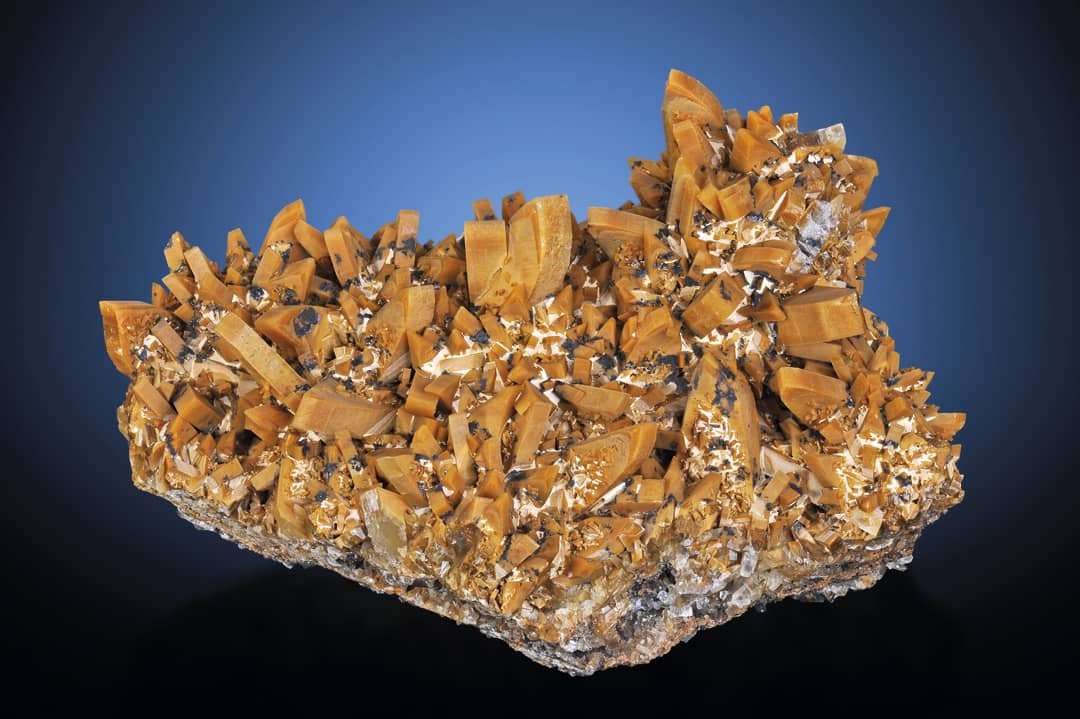
A typical sample of barite, the major ore mineral, from Clara Mine, 26 by 17 centimeters in size (photo: H. Meyer).
Jurassic to Cretaceous
Mineralogy
Black Forest, Germany
48°17’09” N, 8°12’47” E
A typical sample of barite, the major ore mineral, from Clara Mine, 26 by 17 centimeters in size (photo: H. Meyer).
As a result of diverse hydrothermal mineralization processes, the Clara barite and fluorite mine is known as one of the most outstanding mines on Earth based on mineral diversity and type minerals. The exceptional range of observed minerals results from the occurrence of unusually variable polyphase hydrothermal vein systems and later supergene overprint. The mine is not only unique because of its variety of minerals but also because of related studies to structural geology, fluid inclusion and isotope studies, age dating, groundwater issues and even processing technology (e.g., Heyde, 2002; Bucher et al., 2009; Walter et al., 2015; Burisch et al. 2018).
The Black Forest is located in southwest Germany and consists geologically of a Variscan basement covered by Lower Permian to Upper Jurassic sedimentary rocks. Paragneiss units of the basement that locally contain orthogneiss and amphibolite were intruded by post-collisional granite between about 335 and 315 Ma. Different Late Carboniferous to Post Cretaceous hydrothermal activities led to a plethora of mineralizations such as quartz- and quartz-tourmaline veins with W-Sb-, Sb-Au-Ag- and Fe-ores as well as fluorite-barite-quartz-carbonate veins hosting Pb-Zn-Cu-Fe-Mn- and Ag-Bi-Co-Ni-U-ores.
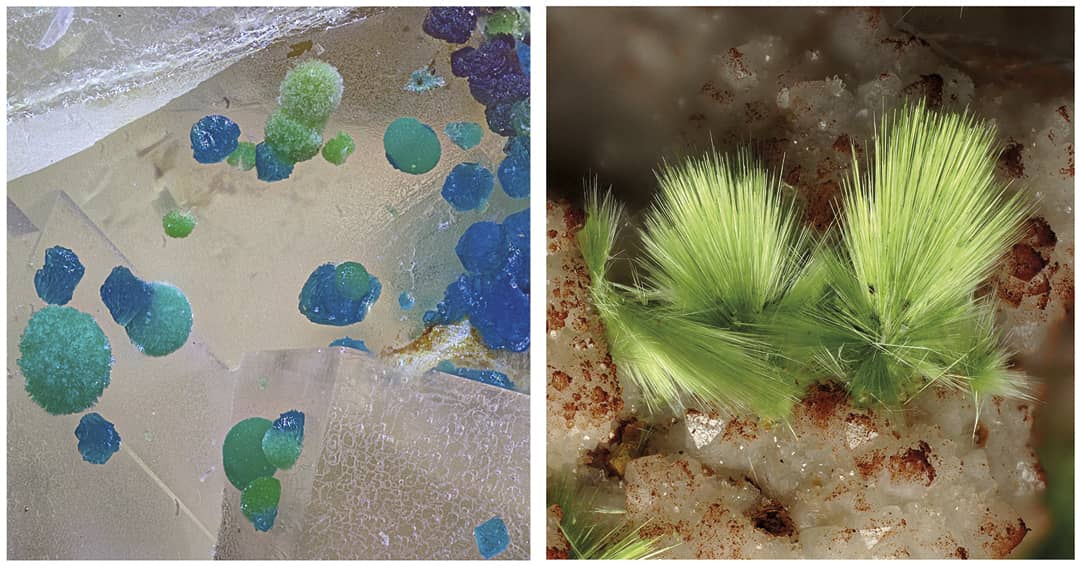
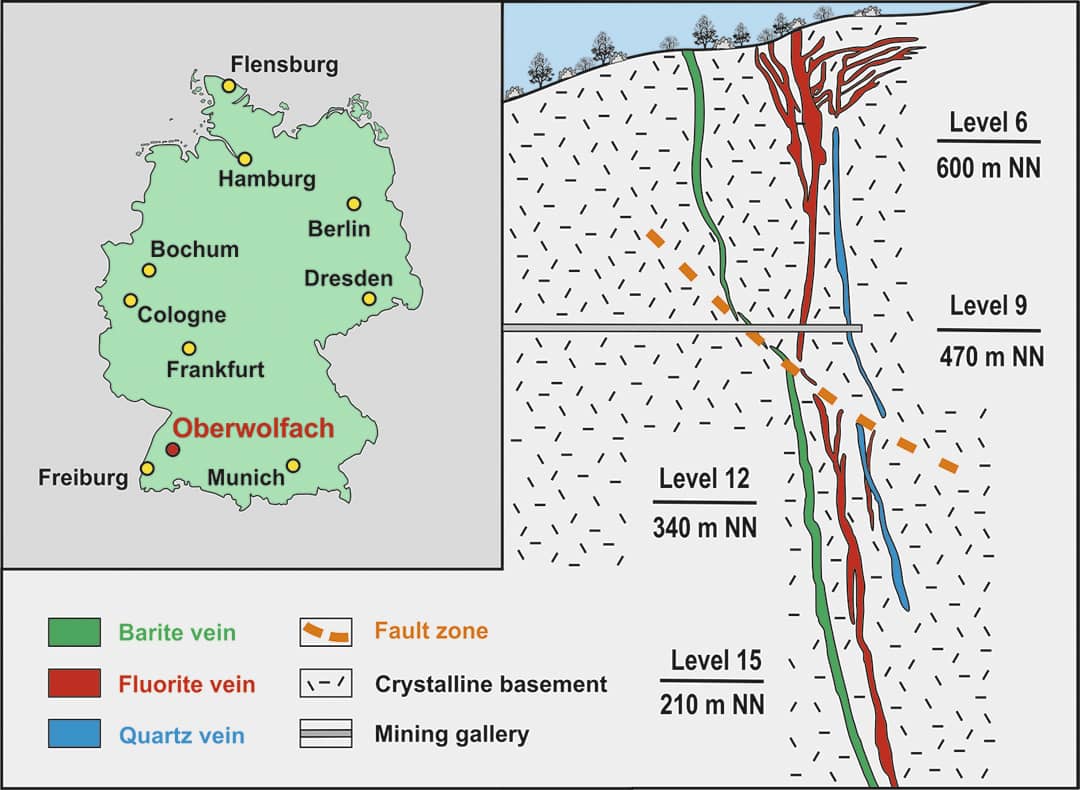
At the Clara mine, five different mineralization stages including different substages were distinguished (Keim et al., 2019). They comprise for instance fluorite-quartz-sellaite veins up to 12 meters thick, bearing pyrite, chalcopyrite, ferberite, and fahlore (fluorite main stage). The later barite main stage exhibits a substage with barite, fluorite and quartz which is interbedded with sulfides and contains a so-called “silverspar” with fahlore, chalcopyrite and rare enargite in the upper levels (levels 4 to 10) and more complex Ag-sulfosalts-bearing ores (below level 10). A further important stage is the quartz main stage, crosscutting older fluorite and barite veins. Claraite, a complex secondary Cu-Zn-mineral was described by Walenta and Dunn (1982) from Clara mine.
Early mining activities occurred in the mid 17th century; the most important ones started with industrialization and increased demand of barite. The careful work of K. Walenta (University Stuttgart) led to countless publications on new minerals at the end of the 20th and beginning of the 21st century.
Bucher, K., Zhu, Y. and Stober, I. (2009) “Groundwater in fractured crystalline rocks, the Clara mine, Black Forest (Germany),” International Journal of Earth Sciences, 98(7), pp. 1727–1739. Available at: https://doi.org/10.1007/s00531-008-0328-x.
Burisch, M. et al. (2018) “Late-stage anhydrite-gypsum-siderite-dolomite-calcite assemblages record the transition from a deep to a shallow hydrothermal system in the Schwarzwald mining district, SW Germany,” Geochimica et Cosmochimica Acta, 223, pp. 259–278. Available at: https://doi.org/10.1016/j.gca.2017.12.002.
Heyde, R. (2002) “Paragenetische und aufbereitungstechnische Untersuchungen silberhaltiger Erze der Baryt-Flussspatgrube Clara, Wolfach, Deutschland,” Hallesches Jahrbuch für Geowissenschaften, 15, pp. 65–121.
Keim, M.F. et al. (2019) “Polyphase enrichment and redistribution processes in silver-rich mineral associations of the hydrothermal fluorite-barite-(Ag-Cu) Clara deposit, SW Germany,” Mineralium Deposita, 54(2), pp. 155–174. Available at: https://doi.org/10.1007/s00126-018-0799-z.
Walenta, K. and Dunn, P.J. (1982) “Clarait, ein neues Karbonatmineral aus der Grube Clara (mittlerer Schwarzwald),” Chemie der Erde, 41, pp. 97–102.
Walter, B.F. et al. (2015) “Exploration of hydrothermal carbonate magnesium isotope signatures as tracers for continental fluid aquifers, Schwarzwald mining district, SW Germany,” Chemical Geology, 400, pp. 87–105. Available at: https://doi.org/10.1016/j.chemgeo.2015.02.009.
Hans-Peter Schertl.
Ruhr-University Bochum, Germany
Andreas Massanek.
TU Bergakademie Freiberg, Germany