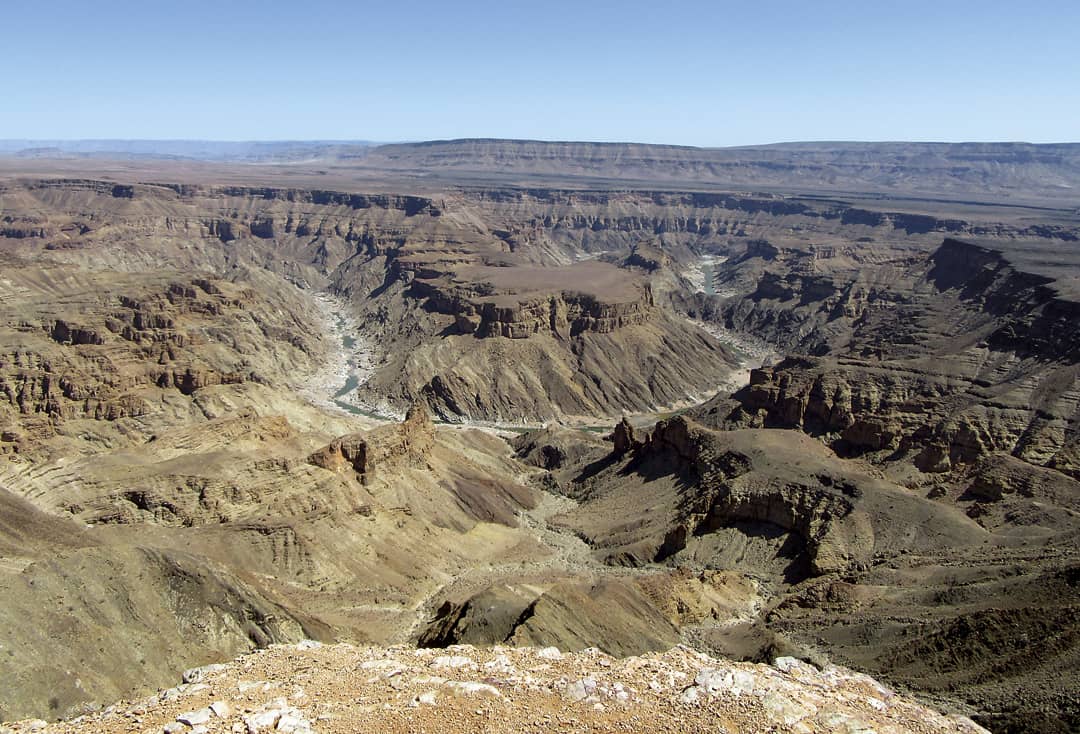
View of the Fish River Canyon (Hobas viewsite) displaying the distinct unconformity between Namaqua Province basement rocks and the overlying Nama Group strata.
Geological Period
Orosirian to Cambrian
Main geological interest
Geomorphology and active geological processes
Stratigraphy and sedimentology
Location
Karas Region, Namibia, Namibia
27°35’22” S, 17°36’54” E
View of the Fish River Canyon (Hobas viewsite) displaying the distinct unconformity between Namaqua Province basement rocks and the overlying Nama Group strata.
One of the largest canyon on Earth eroded through rocks spanning more than 2 billion years and revealing three orogenic cycles.
Fish River Canyon, cutting a deep transect through the southern Namibia desert, is the largest canyon in Africa and the second largest in the world. Not only is it a geomorphological wonder of Earth, but it also exposes rocks formed over 2 billion years. The Namaqua Province gneisses and granitoids, formed in two orogenic cycles in the Paleoproterozoic (~2.0-1.8 Ga) and Mesoproterozoic (~1.2-1.0 Ga), form the basement of the canyon and are unconformably overlain by late Neoproterozoic to Cambrian Nama Group sedimentary rocks, famous for their unique range of Ediacaran fossils that document global climate change and biological transition at that time.
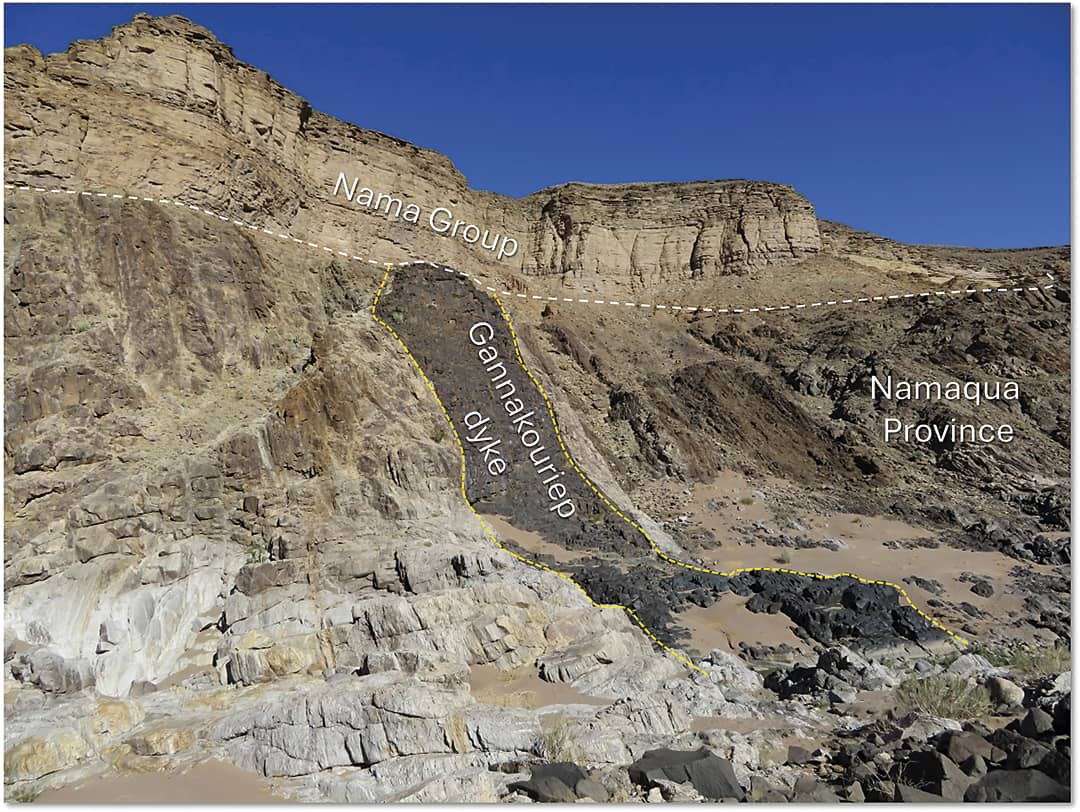
The FRC exposes the Proterozoic Namaqua Province (~2.0-1.0Ga), intruded by the Gannakouriep dyke swarm (~0.8 Ga), with both overlain by the Ediacaran-Cambrian Nama Group.
Geological description
Fish River Canyon, 160 kilometers long, as much as 27 kilomerters and almost 550 meters deep, is the largest canyon in Africa and the second largest in the world. Carved by the Fish River through rocks formed over 2 billion years, it reveals a long geological history shaped by several major global tectonic events. The canyon exposes a significant unconformity between the Paleo- to Mesoproterozoic rocks of the Namaqua Province (2000–1000 Ma, formed during Rodinia’s assembly) and the overlying late Neoproterozoic–Cambrian Nama Group, deposited in foreland basins linked to the Pan-African Gariep and Damara Orogens during the formation of Gondwana.. The Nama Group contains unique Ediacaran fossils documenting global climate change and the Cambrian explosion of life.
Fish River Canyon is the result of a combination of faulting and erosion. First, a set of north-northeast striking faults developed along reactivated older fractures first formed in early Gariep times. Once the rift was formed, the ancient Fish River followed this natural topographic low and over millions of years eroded the canyon to levels observed today, probably assisted by periods of landscape rejuvenation. The faults host groundwater, which reaches the surface as hot springs of which ǀAi-ǀAis is the best known.
Scientific research and tradition
Geologic investigations of the canyon have been ongoing for more than 60 years. They have included significant research on the unique paleontology of the Nama Group and recently have involved detailed geological mapping of the Precambrian Namaqua basement rocks by the Namibian Geological Survey. A new, combined geology and hiking map has been produced for geotourism.
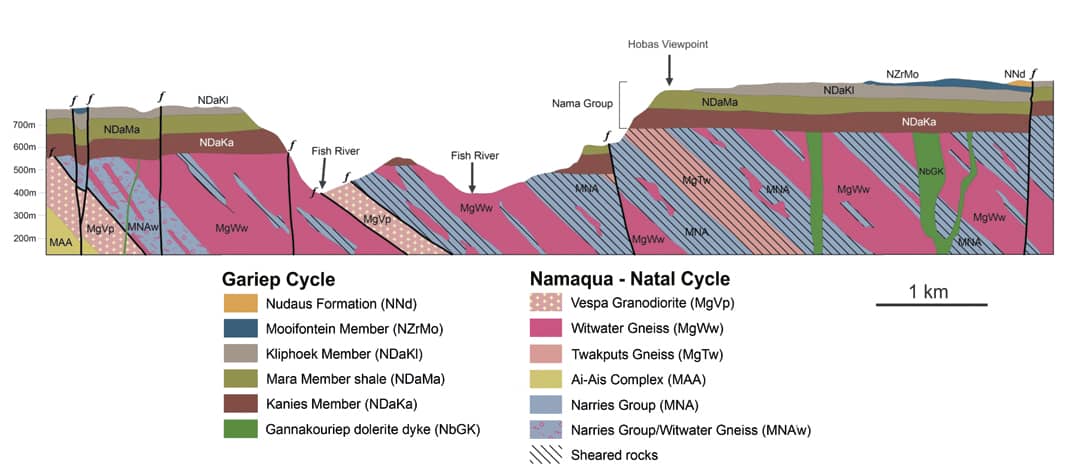
Cross-section of the Fish River Canyon.
Reference
Macey, P. (2017) “A new hiking and geological map of the Fish River Canyon, Namibia,” Geological Society of South Africa geobulletin, 60(4), pp. 48–54.
Macey, P.H. et al. (2022) “A continental back-arc setting for the Namaqua belt: Evidence from the Kakamas Domain,” Geoscience Frontiers, 13(4), p. 101408. Available at: https://doi.org/10.1016/j.gsf.2022.101408.
Miller, R.M. and Becker, T. (2008) The geology of Namibia: Neoproterozoic to Lower Paleozoic. Windhoek, Namibia: Ministry of Mines and Energy, Geological Survey.
Mvondo, F., Dauteuil, O. and Guillocheau, F. (2011) “The Fish River canyon (Southern Namibia): A record of Cenozoic mantle dynamics?,” Comptes Rendus Geoscience, 343(7), pp. 478–485. Available at: https://doi.org/10.1016/j.crte.2011.07.003.
Simpson, E.S.W. and Davies, D.H. (1957) “Observations on the Fish River Canyon in South West Africa,” Transactions of the Royal Society of South Africa, 35(2), pp. 97–107. Available at: https://doi.org/10.1080/00359195709519013.
Viljoen, R., Viljoen, M.J. and Anhaeusser, C.R. (eds.) (2016) Africa’s top geological sites: 35th International Geological Congress commemorative volume. International Geological Congress, Century City, South Africa: Struik Nature (an imprint of Penguin Random House South Africa (Pty) Ltd).
Author(s)
Anna Nguno.
Geological Survey of Namibia
Paul Macey.
Macey Geological Consulting Pty Ltd, South Africa