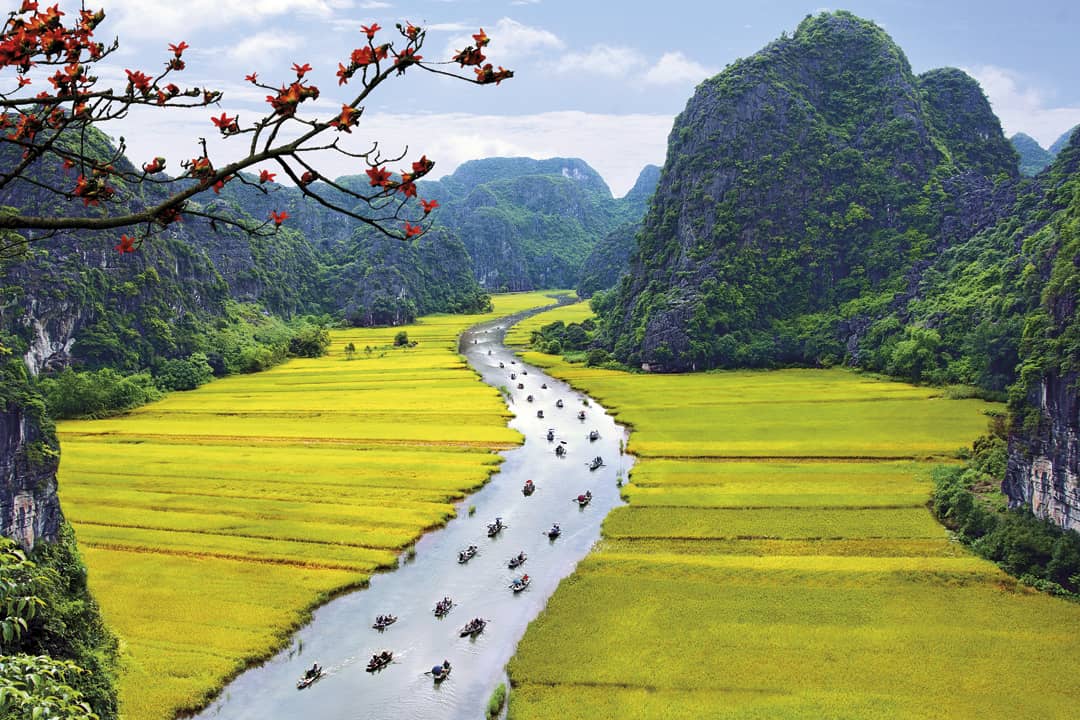
A fault-controlled valley in Trang An featuring spectacular karst ridges, piano key-like rice fields and small tourist boats gently drifting on the water.
Geological Period
Neogene to Quaternary
Main geological interest
Geomorphology and active geological processes
Location
Ninh Binh Province, in the Southern edge of the Red River Delta, Vietnam
20°15’24” N, 105°53’47” E
A fault-controlled valley in Trang An featuring spectacular karst ridges, piano key-like rice fields and small tourist boats gently drifting on the water.
The best-known example of a marine-invaded but now emerged-on-land tropical karst in the world.
Trang An is an ideal model of mature tropical karst that displays the full range of karst processes developed on-land long before being repeatedly invaded and reworked by recent marine transgressions, and remains at present an emerged-on-land landscape. Tectonic dissections resulted in arrays of inter-connected cones and isolated towers, intra-mountain cockpits and poljes and fault-controlled channels. Sea level fluctuations are evidenced by erosion notches with associated caves, wave-cut platforms, beach deposits and sea-shell accumulations. The emergence on-land of Trang An is due to the combined action of tectonic displacement, coastal sedimentation and human dyke construction in the last 1,000 years.
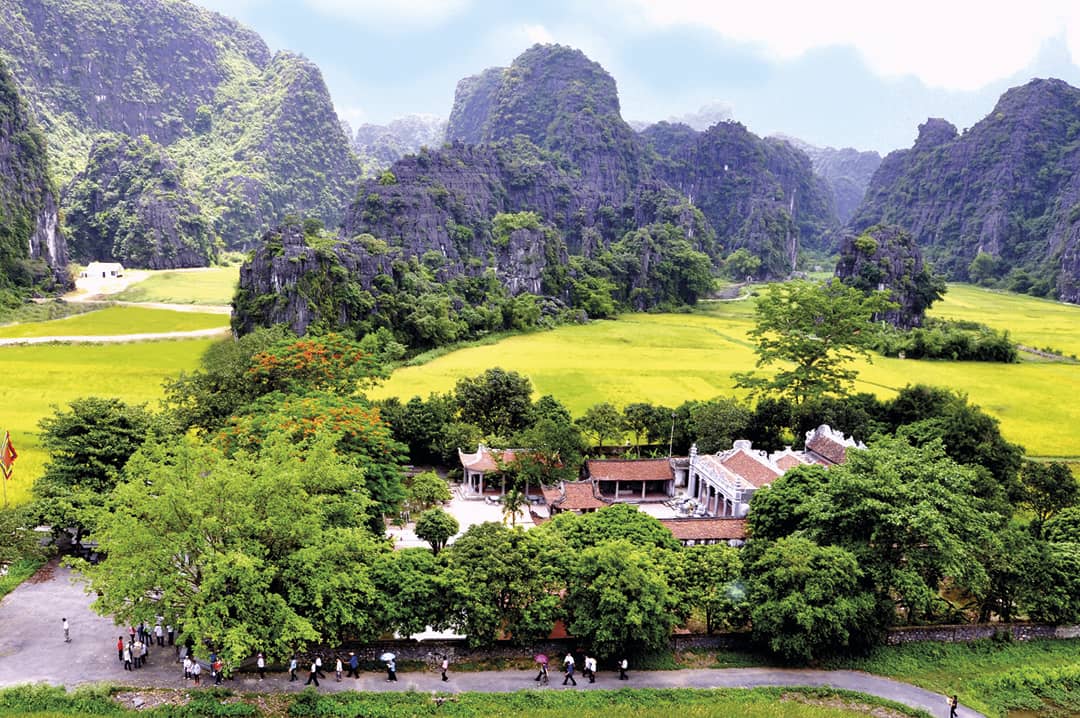
A breathtaking scenery woven with limestone ridges, temples and golden rice paddies.
Geological description
Trang An is an extraordinary geological site that uniquely showcases the final stages of karst evolution in a humid tropical environment. The deep dissection of an uplifted limestone massif, spanning more than 20 million years, has created an array of classic karst landforms, including cones, towers, cockpits, poljes, foot-caves, and subterranean cave passages adorned with speleothems. A particularly significant feature of the site is the presence of transitional forms between cone karst and tower karst, where towers stand isolated on alluvial plains. Trang An is an exceptional autogenic karst system, solely rain-fed and hydrologically isolated from nearby rivers. Past sea inundations, driven by climatic changes, temporarily turned several times the massif into an archipelago; today, it is fully emergent, due essentially to tectonic activity along the renowned Red River Fault, the river sediment transport and deposition along the coast, and human flood-control dyke construction. The scenic beauty of the site is further enriched by its remarkable biodiversity. Archaeological research reveals continuous human occupation for at least 40,000 years, including its role as the capital of Vietnam’s first feudal dynasty over 1,000 years ago.
Scientific research and tradition
Having been used since ancient times and subjected to first scientific studies since the late 19th century, at present Trang An is still being systematically studied, notably by the joint Vietnamese-UK research projects (SUNDASIA https://sundasia.com/). Trang An became a UNESCO World Cultural and Natural Heritage in 2014 due to its geological, aesthetic and nature-human interaction, and an attempt to develop a Geopark around the WHS is on-going.
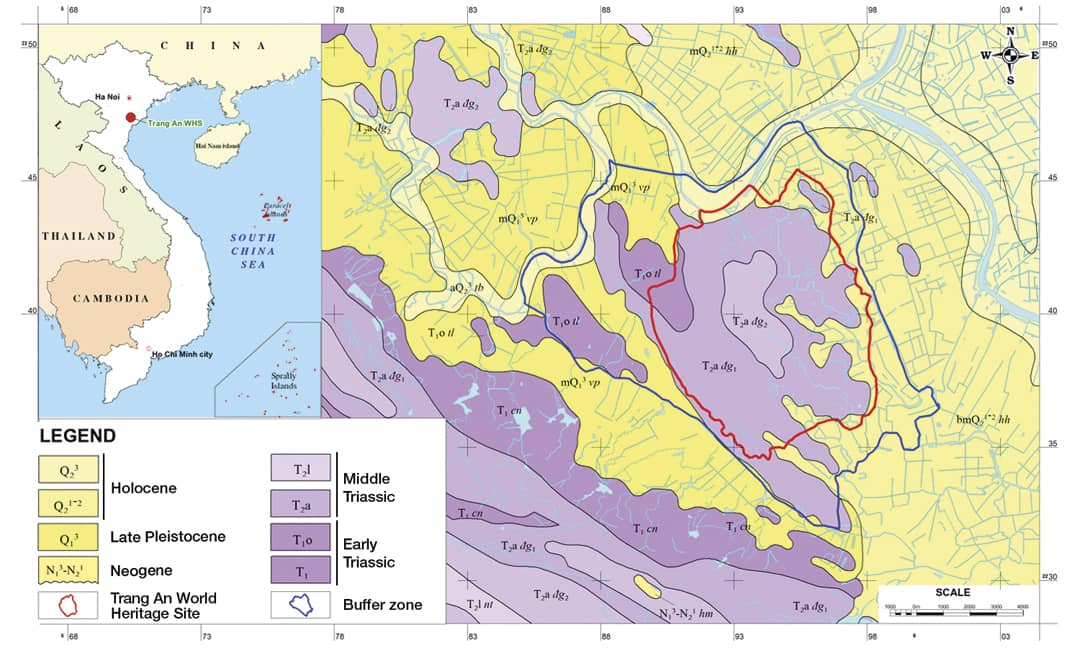
Simplified geological map of the Trang An marine-drowned but now emerged-on-land tropical karst, Vietnam.
Reference
Do Tuyet et al. (2013) “Global outstanding values of the Trang An Landscape Complex (Ninh Binh),” Journal of Geology, Series B, (39-40/2013), pp. 95–103.
Kahlert, T. et al. (2021) “Mid-Holocene coastline reconstruction from geomorphological sea level indicators in the Tràng An World Heritage Site, Northern Vietnam,” Quaternary Science Reviews, 263, p. 107001. Available at: https://doi.org/10.1016/j.quascirev.2021.107001.
Pham Kha Tuy et al. (2013) “Geomorphological characteristics and outstanding landscape values of the Trang An area (Ninh Binh),” Journal of Geology, Series B, (39-40/2013), pp. 38–51.
Rabett, R. et al. (2017) “Human Adaptation to Coastal Evolution: Late Quaternary evidence from Southeast Asia (SUNDASIA) – A report on the first year of the project,” State of conservation report by the State Party. WHS UNESCO Report, pp. 51-74 (SUB-ANNEX 1.1). Available at: https://whc.unesco.org/en/documents/165143.
Tran Van Tri and Dang Vu Khuc (eds.) (2011) Geology and Earth Resources of Viet Nam. Ha Noi: Publishing House for Science and Technology.