Part of the longest and most complete age sequence of coastal dune systems in the world.
While older analogous coastal dunes sequences have been recorded from passive margins such as the eastern United States, south-east Brazil, and parts of South Africa, none have dune field histories of the complexity and completeness of K’gari (Formerly Fraser Island), in south-eastern Queensland. In most settings these dune fields are age-confined to the Holocene. Tectonic stability, consistent climate, and a large and reliable sediment supply have combined to permit the formation of the world’s largest sequence of coastal dune fields. K’gari’s complex dune systems, with an array of rare and unique features, including dune lakes and tall rainforests, are still evolving.
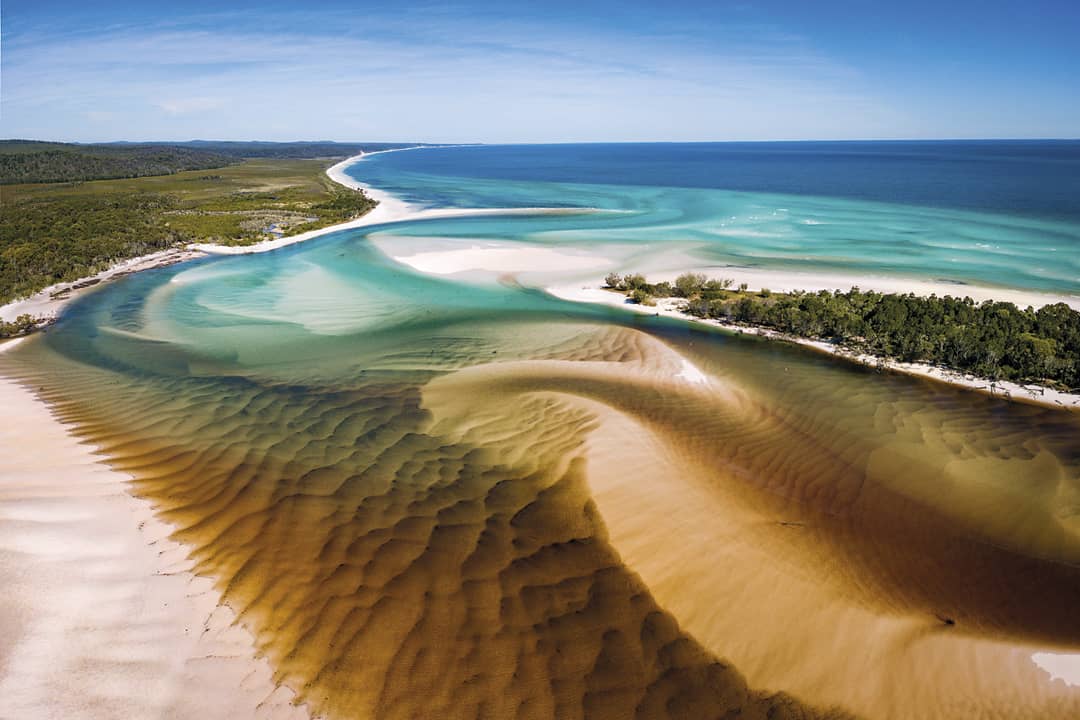
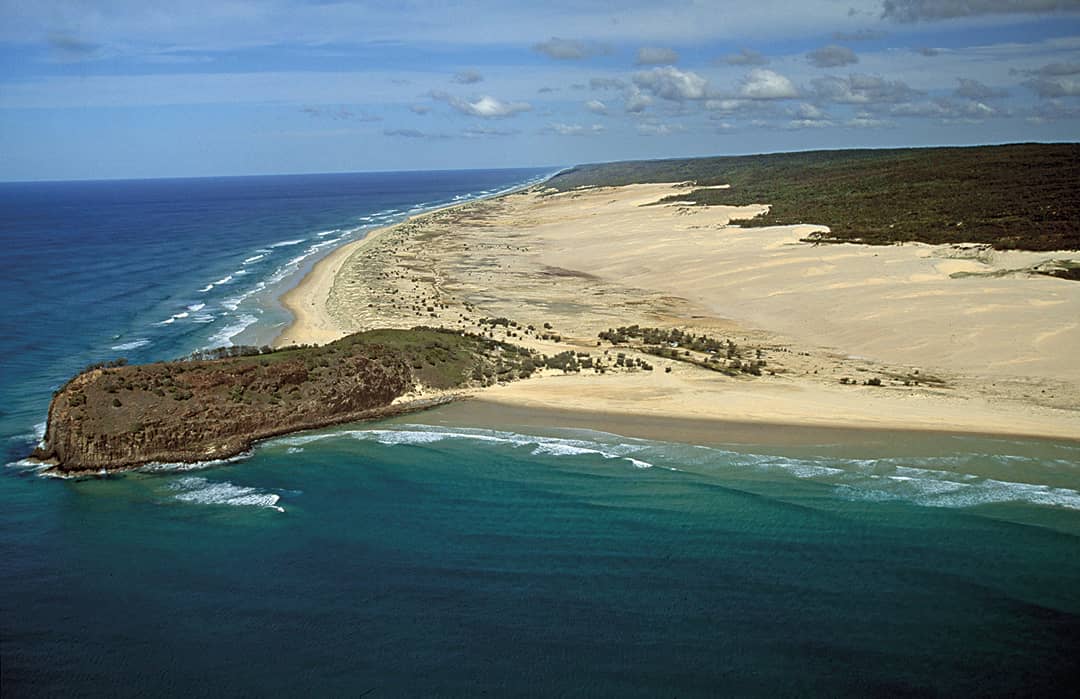
K’gari, more than 120 kilometers long and 5-25 kilometers wide, is the largest sand island in the world with extensive active coastal dune fields, reaching 240 meters above sea level and extend 30-60 meters below sea level (see photos). The dune fields have been divided into seven morphological units: the Awinya, Yankee Jack, Bowarrady, Triangle Cliff, Freshwater, Station Hill, and Cape. Optically-stimulated Luminescence dating of the dunes indicate the Awinya unit is more than 340 ka, and the Yankee Jack and Bowarrady units are approximately 180 ka old. Holocene dune sequences comprise Triangle Cliff (approximately 8.5 ka), Freshwater (approximately 4 ka), Station Hill (approximatgely 1.5 ka) and Cape (less than 0.5 ka). The dune units were emplaced during intermediate to high sea levels at least as far back as Marine Isotope Stage 7. Shulmeister et al. (2024) demonstrated for at least the last three glacial cycles the dunes were emplaced during intermediate to high sea levels. At shorter time intervals (decades to centuries), some dune formation is affected by storms. Initial formation of the dune field occurred in the mid-Pleistocene, but the most recent widespread stabilisation of dunes occurred late in Marine Isotope Stage 7 (MIS 7: 190–240 ka).
Scientific research and tradition
The study by Shulmeister et al. (2024) is the first systematic study to determine the ages of the major dune phases on K’gari. Previously, the antiquity of the main Pleistocene dune field has been inferred to extend back more than 800 ka from dates obtained from the adjacent Cooloola Sand Mass.
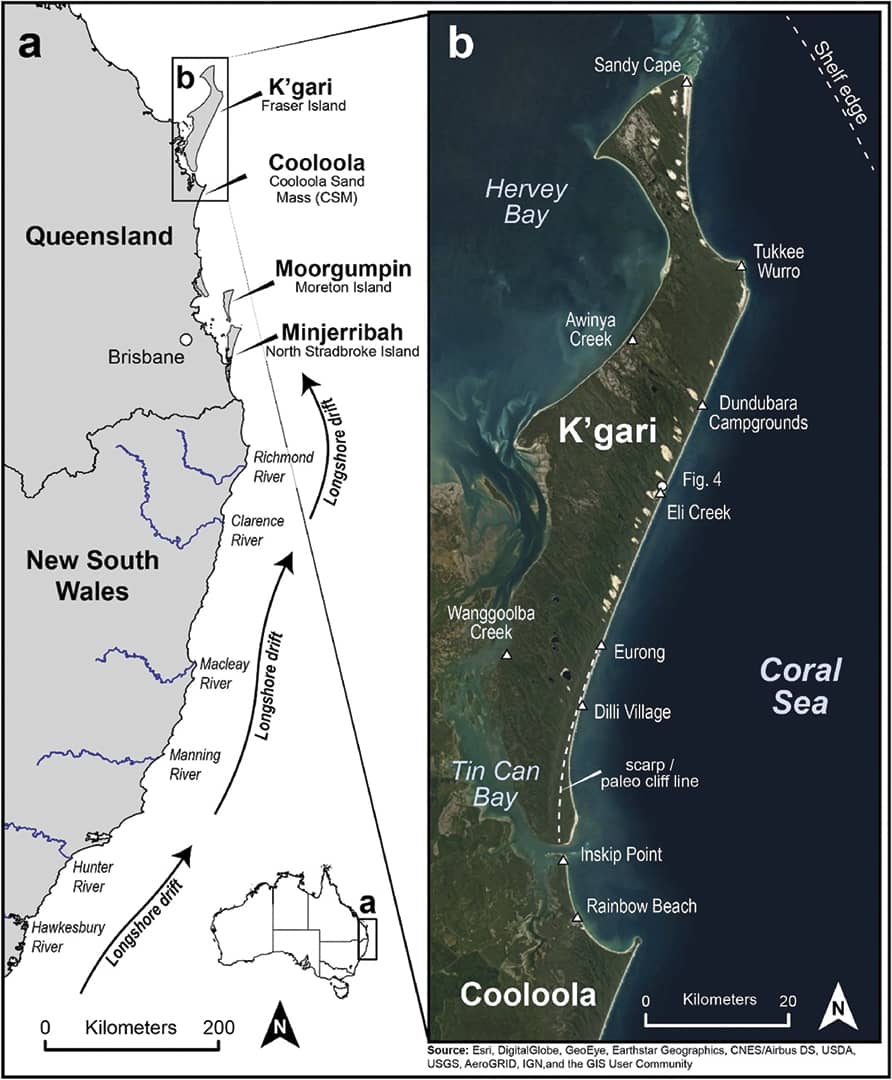
(a) Location map K’gari and Cooloola Sand Mass and (b) satellite image of K’gari and the northern portion of Cooloola Sand Mass (Shulmeister et al. 2024).
Reference
Coaldrake, J.E. (1960) “The coastal sand dunes of Southern Queensland,” Proceedings of the Royal Society of Queensland, 72(7), p. 16.
Figgis, P. and Mosley, G. (1988) Australia’s Wilderness Heritage: World heritage areas. Sidney: Weldon Publishing.
Foley, S. (1992) Aboriginal Cultural Heritage. Location of Sites of Significance to the Aboriginal Community, Great Sandy Region, South-Eastern Queensland. Maryborough: Report prepared for Queensland Department of Environment and Heritage.
Queensland Parks and Wildlife Service (2024) Nature, culture and history | K’gari, Great Sandy National Park, Parks and forests | Department of the Environment, Tourism, Science and Innovation. Available at: https://parks.qld.gov.au/parks/kgari-fraser/about/culture (Accessed: April 30, 2026).
Shulmeister, J. et al. (2024) “Chronology and evolution of the world’s largest sand island: K’gari (Fraser Island), South East Queensland, Australia,” Quaternary Science Reviews, 328, p. 108529. Available at: https://doi.org/10.1016/j.quascirev.2024.108529.
Ward, W.T. (2006) “Coastal dunes and strandplains in southeast Queensland: Sequence and chronology,” Australian Journal of Earth Sciences, 53(2), pp. 363–373. Available at: https://doi.org/10.1080/08120090500507354.
Author(s)
Margaret Brocx.
Murdoch University, Western Australia, Australia
Vic Semeniuk.
Murdoch University, Western Australia, Australia
Mark Cody.
Queensland Government Department of the Environment, Tourism, Science and Innovation.
Samantha Young.
Queensland Government Department of the Environment, Tourism, Science and Innovation.