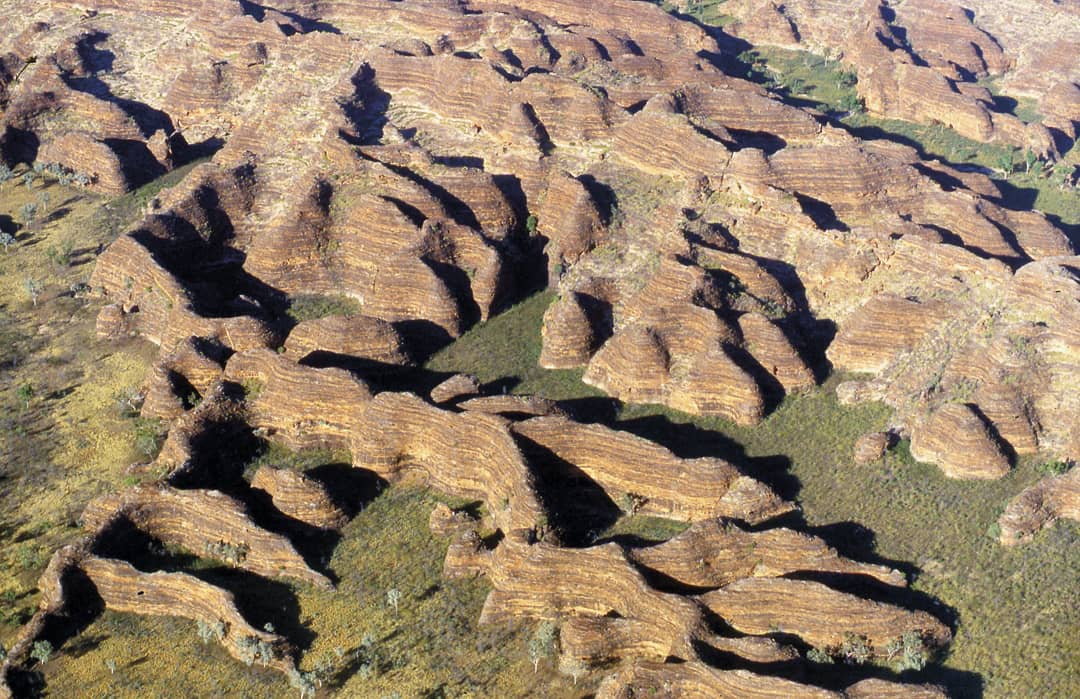
Sinuous ridges separated by small flat-floored embayments on the north-eastern edge of the Purnululu massif. Many ridges coincide with case hardening on intersecting joints.
Geological Period
Paleogene to Quaternary
Main geological interest
Geomorphology and active geological processes
Stratigraphy and sedimentology
Location
Northwestern Australia, Australia
17°32’33” S, 128°30’51” E
Sinuous ridges separated by small flat-floored embayments on the north-eastern edge of the Purnululu massif. Many ridges coincide with case hardening on intersecting joints.
Unique sandstone tower karst and the key site to recognize solutional weathering of silica and rock control in geomorphology.
The Purnululu massif was the first place where dissolution of quartz and its influence on rock strength was linked to erosional processes in sandstone landscapes. It provided key evidence that quartzose sandstone may be subject to intense dissolution focused on grain contacts, quartz overgrowths and cement. This was demonstrated as critical for landform evolution and hence, the erosional array of towers, sinuous ridges and ruiniform relief may be considered as a variant of a karstic landscape. It shows how apparently minor lithological differences in the massif coincide with changes in morphology, setting up new research avenues in structural geomorphology.
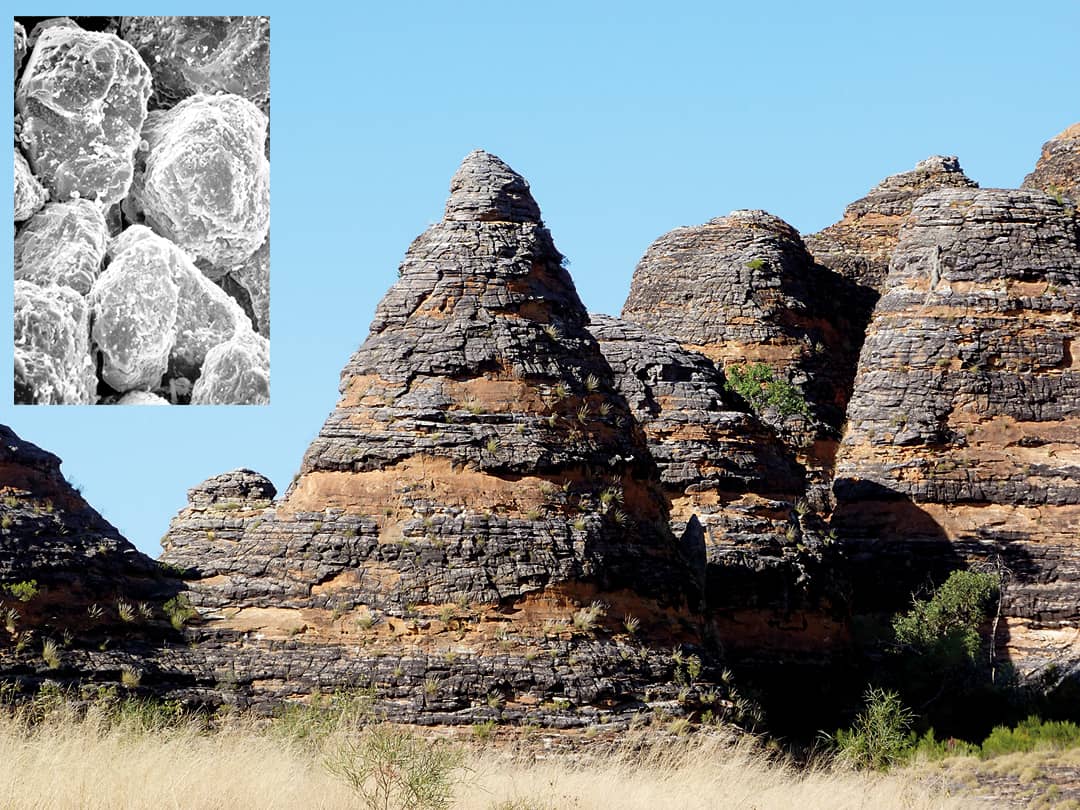
Pyramidal tower karst developed in friable sandstone. Inset shows SEM image (x120) of intensely etched quartz grains, their close interlocking but lack of interstitial cement.
Geological description
The Purnululu massif (Bungle Bungle Range) is an erosional landscape formed in very friable sandstone of Devonian age, which showcases the diversity of sandstone morphologies due to rock control. The highly etched quartz overgrowths on the sand grains show that while the sandstone was once deeply buried, the primary porosity was sufficient to allow deep seepage since at least the Paleogene. The now almost complete absence of cement between the grains has imparted a very low shearing strength (<5 MPa); but contact between the grains has imparted a much higher compressive strength (35-50 MPa). The sandstone can still support steep faces, producing clusters of pyramidal towers in the eastern part of the massif. Jointing has little effect in the main tower complex, but along the northeast margin, towers give way to long narrow ridges. Many of these ridges coincide with case hardening caused by seepage along major fractures; others are remarkably sinuous, resulting from the growth of small valleys on either side of a ridge. In the centre of the massif, where sandstone is much harder, erosion was focused along major joints, producing ruiniform relief. The striking grey and red banding is a surface phenomenon of cyanobacterial crust.
Scientific research and tradition
Geological mapping began in this region during the 1960s (Veevers, 1969), and detailed study of sandstone geomorphology began in 1980s (Young, 1986, 1987, 1988, 2010), extending pioneering work on sandstone karst elsewhere in Australia (Jennings, 1979) and becoming a reference place for subsequent studies of silicate karst and sandstone landscapes.
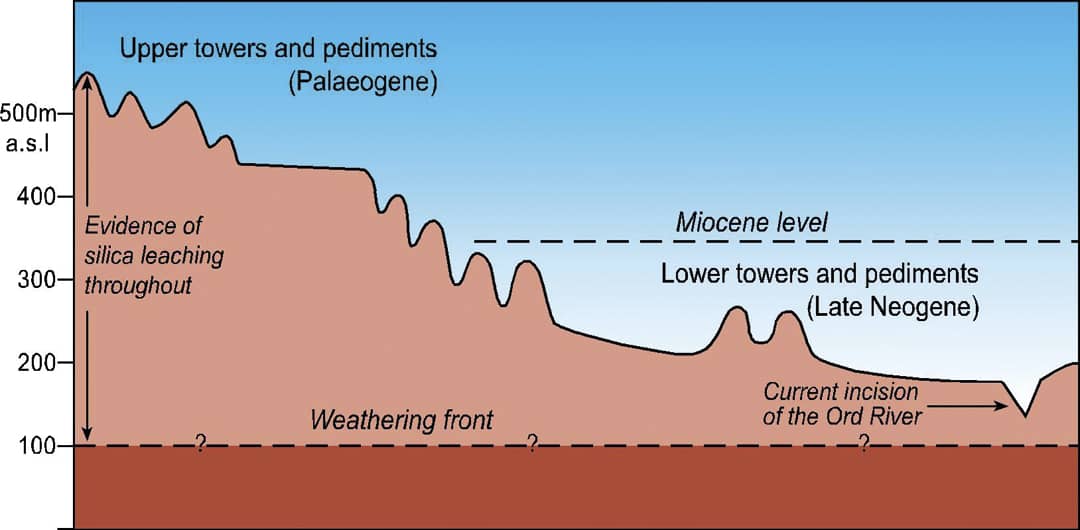
Stages in geomorphic evolution of Purnululu. The upper level probably dates to the Palaeogene, and the lower storey developed in the Neogene (after Young, 2010).
Reference
Jennings, J.N. (1979) “Arnhem Land city that never was,” Geographical Magazine, 60, pp. 822–827.
Veevers, J.J. (1969) “Sedimentology of the Upper Devonian and Carboniferous platform sequence of the Bonaparte Gulf Basin,” Bureau Mineral Resources of Australia Bulletin, 109, p. 86.
Young, R.W. (1986) “Tower Karst in Sandstone: Bungle Bungle massif, northwestern Australia,” Zeitschrift für Geomorphologie, pp. 189–202. Available at: https://doi.org/10.1127/zfg/30/1986/189.
Young, R.W. (1987) “Sandstone Landforms of the Tropical East Kimberley Region, Northwestern Australia,” The Journal of Geology, 95(2), pp. 205–218. Available at: https://doi.org/10.1086/629120.
Young, R.W. (1988) “Quartz etching and sandstone Karst: Examples from the East Kimberleys, Northwestern Australia,” Zeitschrift für Geomorphologie, pp. 409–423. Available at: https://doi.org/10.1127/zfg/32/1988/409.
Young, R.W. (2010) “Bungle Bungle: Tower Karst in Sandstone,” in P. Migon (ed.) Geomorphological Landscapes of the World. Dordrecht: Springer Netherlands, pp. 333–340. Available at: https://doi.org/10.1007/978-90-481-3055-9_34.
Author(s)
Robert W. Young.
University of Wollongong (retired)