Cretaceous – Paleogene Stratigraphic Section of Stevns Klint
Denmark
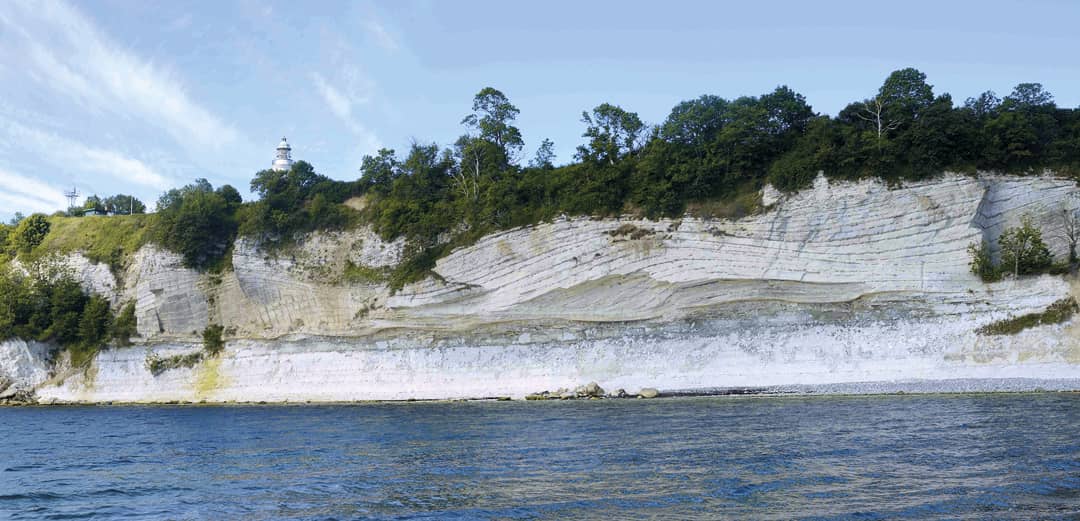
Stevns Klint illustrates geometry, dimensions and architecture of one of the finest carbonate mound complexes known (Photo: Morten Bjerager).
Geological Period
Cretaceous (Late Cretaceous) to Paleogene (Paleocene) boundary
Main geological interest
Stratigraphy and sedimentology
History of geosciences
Location
Sjælland, Denmark
55°16’02” N, 12°25’24” E
Stevns Klint illustrates geometry, dimensions and architecture of one of the finest carbonate mound complexes known (Photo: Morten Bjerager).
One of the most studied, complete, and best-exposed Cretaceous–Paleogene boundary sections in the world.
Stevns Klint is a classical Cretaceous–Paleogene boundary locality. The boundary is marked by a thin clay layer containing an Iridium anomaly at Stevns Klint discovered by Walter Alvarez in 1978, demonstrating its global nature and led to the hypothesis of an extraterrestrial impact causing the mass extinction. Stevns Klint is adopted by UNESCO on the World Heritage List as a stratigraphic and scientific site for this event. It also illustrates geometry, dimensions and architecture of one of the finest carbonate mound complexes known and constitutes the type locality of the Danian Stage together with the nearby Faxe quarry.
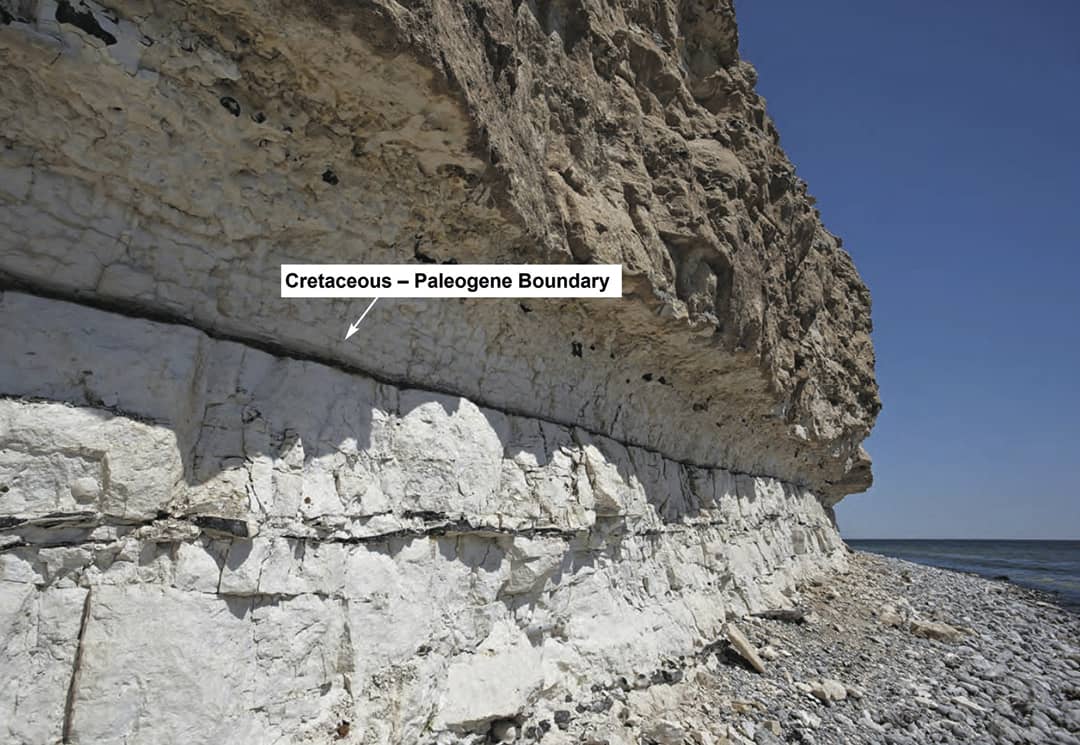
The black and famous Iridium-bearing clay, the Fiskeler, marks the mass extinction (Photo: Jakob Lautrup).
Geological description
Stevns Klint is a picturesque 15 km long sea cliff – arguably the most scenic Cretaceous–Paleogene boundary site in the World.
The exposed succession is about 45 m thick. It shows the stratigraphic evolution from the latest Maastrichtian, across the Cretaceous–Paleogene boundary and into the earliest Danian. It is one of the few stratigraphically complete boundary successions in the World.
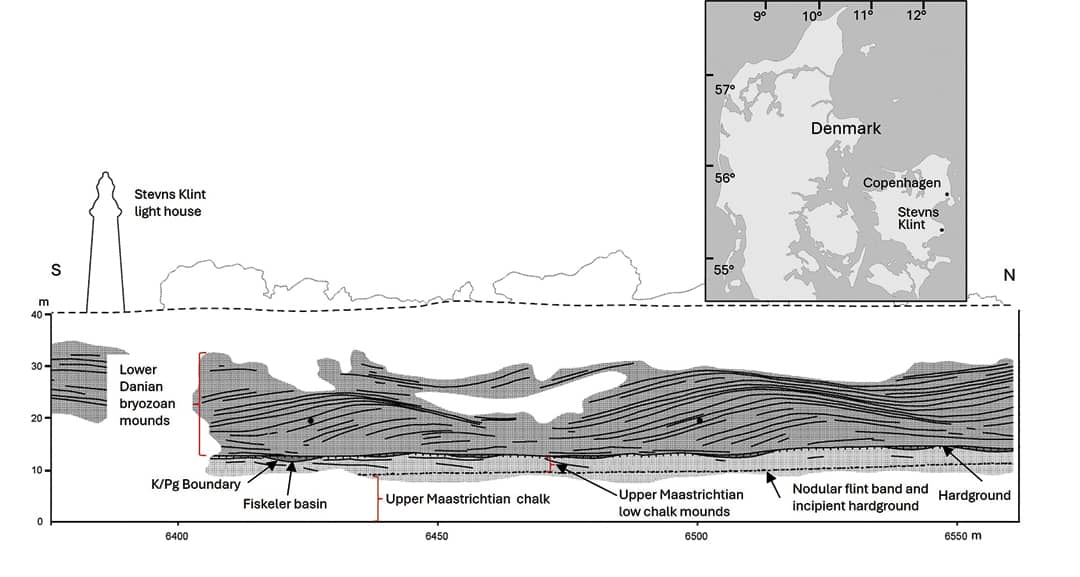
The top part of the Maastrichtian chalk shows irregular low-amplitude mounded bedding outlined by thin layers of nodular flint. It is overlain by the 5-10 cm thick clay, the lowermost Danian Fiskeler, which drapes the troughs between the mound crests and wedges out gradually towards the margins of the troughs. The Fiskeler is famous for its relatively high Iridium concentrations otherwise only known from extraterrestrial objects.
The clay passes gradually upwards into an up to 60 cm thick, strongly burrowed limestone. An erosional hardground surface truncates the top of this limestone and the intervening crests of the uppermost Maastrichtian mounds.
The erosion surface is overlain by up to 20 m of lower Danian bryozoan limestone mound complexes. The internal architecture of these mounds is outlined by thick black nodular flint layers and bryozoan limestone.
Scientific research and tradition
Virtually all scientists working with the Cretaceous–Paleogene boundary have visited Stevns Klint, resulting in more than 300 papers.
The seminal paper by Alvarez et al. (1980) was followed by more than 180 papers based on studies of Stevns Klint material in addition to numerous educational field trips.
Map of Denmark with Stevns Klint. Photogrammetric interpretation of the Cretaceous–Paleogene boundary section at the Stevns Klint light house (From Surlyk et al., 2006).
Reference
Alvarez, L.W. et al. (1980) “Extraterrestrial Cause for the Cretaceous-Tertiary Extinction,” Science, 208(4448), pp. 1095–1108. Available at: https://doi.org/10.1126/science.208.4448.1095.
Bjerager, M. and Surlyk, F. (2007) “Danian Cool-Water Bryozoan Mounds at Stevns Klint, Denmark—A New Class of Non-Cemented Skeletal Mounds,” Journal of Sedimentary Research, 77(8), pp. 634–660. Available at: https://doi.org/10.2110/jsr.2007.064.
Desor, P.J.E. (1847) “Sur le terrain Danien, nouvel étage de la craie,” Bulletin de la Societé Géologique de France, 2(4), pp. 179–182.
Surlyk, F., Damholt, T. and Bjerager, M. (2006) “Stevns Klint, Denmark: Uppermost Maastrichtian chalk, Cretaceous-Tertiary boundary, and lower Danian bryozoan mound complex,” Bulletin of the Geological Society of Denmark, 54(1–2), pp. 1–48. Available at: https://doi.org/10.37570/bgsd-2006-54-01.
Author(s)
Tove Damholt.
Stevns Klint Experience, Denmark
Finn Surlyk.
University of Copenhagen, Denmark
Morten Bjerager.
Geological Survey of Denmark and Greenland
Jesper Milán.
Østsjællands Museum
Jakob Walløe Hansen.
Geological Society of Denmark