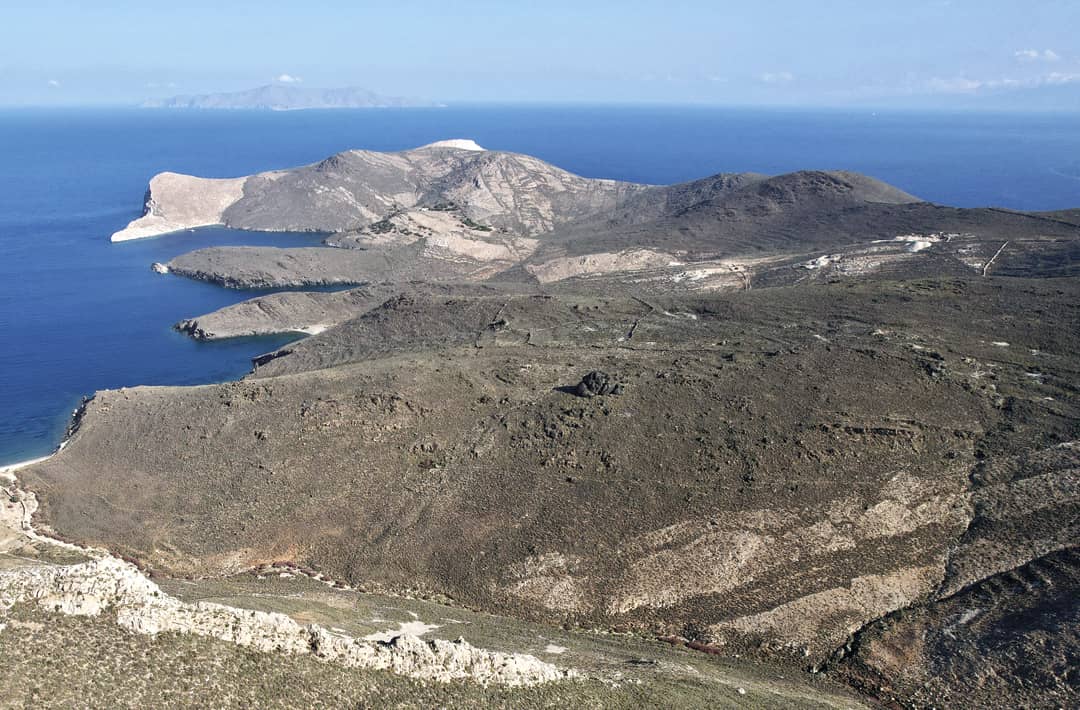
View across the Lia valley. Disrupted roof segments of the subduction channel form a broad ridge overlying lighter marble layers. The foreground frame is about 800 meters wide. (Drone image, P. Lanari).
Geological Period
Paleogene
Main geological interest
Igneous and Metamorphic petrology
Tectonics
Location
Cyclades Islands, Greece
37°29’32” N, 24°54’25” E
View across the Lia valley. Disrupted roof segments of the subduction channel form a broad ridge overlying lighter marble layers. The foreground frame is about 800 meters wide. (Drone image, P. Lanari).
One of the world’s best preserved fossilised subduction channels, displaying blueschist and eclogite exhumed from mantle depths.
Syros, a picturesque island in the Aegean Sea, is home to some most remarkable metamorphic rocks. Among them are blueschists and eclogites that formed at high pressure and unusually low temperature conditions. These rare rocks record a dramatic journey: a tectonic collision dragged them down to depths of ~70 kilometers and then forced them back up. The island offers spectacular exposures of these very colorful rocks, especially in its northern regions. There, results of the enormous tectonic forces acting on the Earth’s lithosphere are evident. A key witness is glaucophane, a rare mineral that was first described from Syros (Hausmann, 1845).
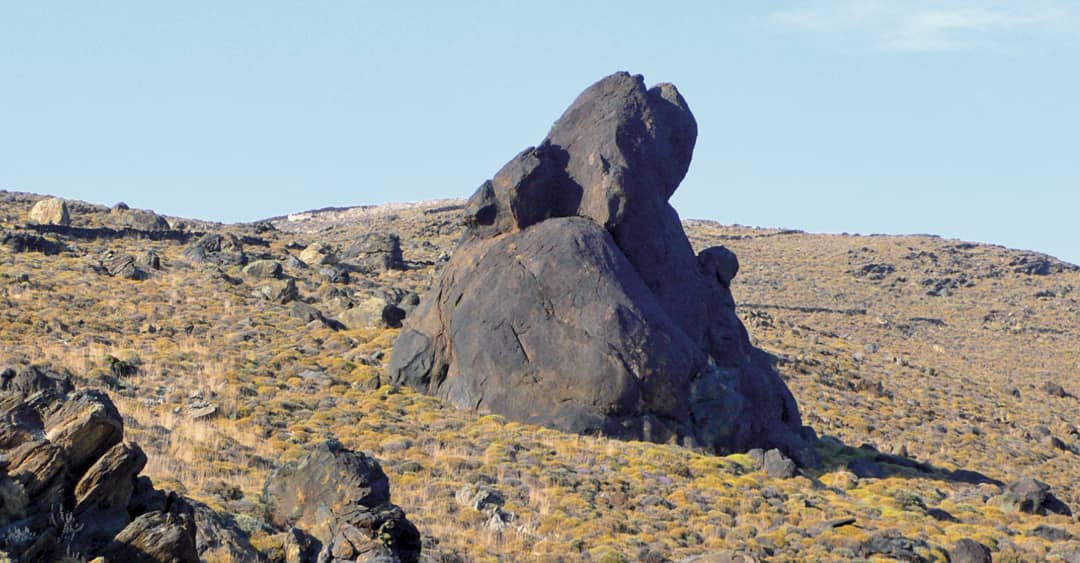
Numerous massive eclogite fragments, including 20 meter high “Aerolithos”, stand out in the mélange zone between Kampos and Lia. (Field photo, M. Engi).
Geological description
Understanding subduction zones –where one tectonic plate plunges beneath another– is crucial as they are associated with some of the most powerful earthquakes and explosive volcanism on Earth. Key insights are provided by the Kampos-Lia mélange zone in northern Syros (Gyomlai et al., 2021), which showcases how rocks from the mantle and oceanic crust were compressed, fragmented, transformed and mixed together deep inside a subduction zone.
This mélange zone comprises spectacular rocks, including blocks of dark eclogite embedded in a fine-grained matrix made from altered mantle rocks, bands of transformed volcanic rocks that show veins of dark blue glaucophanite. Layers of aragonitic marble and silvery schist offer clues about the original ocean-floor sediments. The entire zone itself is a remnant of an ancient shear zone – essentially a fossilized subduction channel within which these rocks once were buried and later returned to the surface. What makes Syros outstanding is the limited overprinting of these features by later exhumation processes. Unlike similar units on neighboring islands, the structures and high-pressure mineral assemblages remain well preserved in northern Syros. This allows scientists to reconstruct how rock units behave and transform during their journey through subduction zones.
Scientific research and tradition
Scientists consider Syros a natural laboratory to study subduction zone processes (Laurent et al., 2016, 2018). Outstanding geological features of scientific importance and accessibility have made Syros highly attractive for education and research. Scientists aim to understand the mechanisms that return subducted rocks from mantle depths up to the surface.
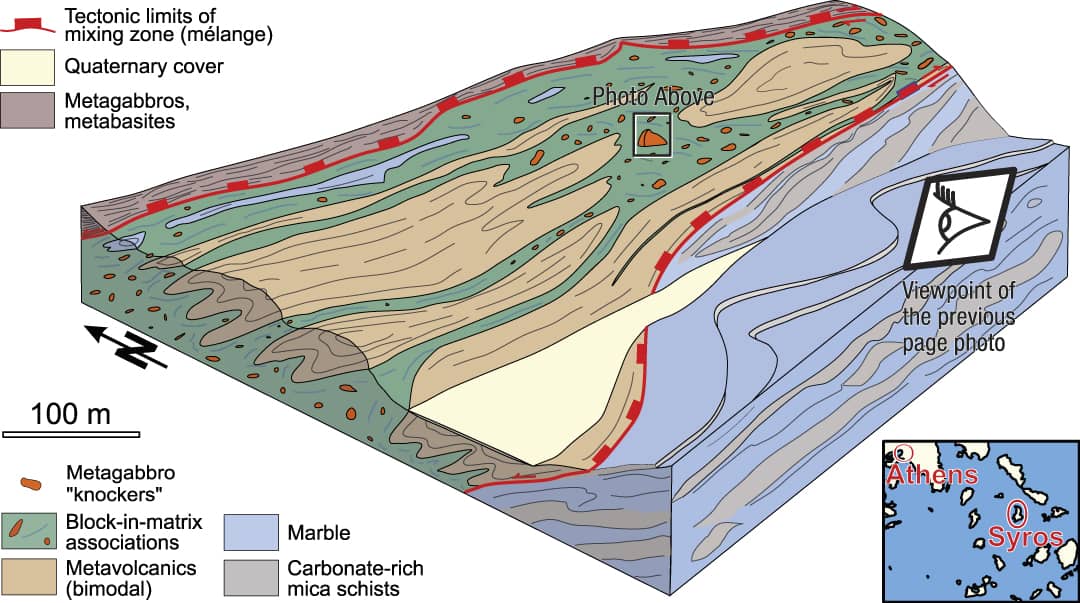
Block diagram showing the Kampos-Lia mixing zone (after Gyomlai et al., 2021) juxtaposed against the adjacent metasedimentary and metabasite units by tectonic faults.
Reference
Gyomlai, T. et al. (2021) “Metasomatism and deformation of block-in-matrix structures in Syros: The role of inheritance and fluid-rock interactions along the subduction interface,” Lithos, 386–387, p. 105996. Available at: https://doi.org/10.1016/j.lithos.2021.105996.
Hausmann, H. (1845) “Beiträge zur Oryktographie von Syra und ein neues Mineral, der Glaukophan,” Göttingische gelehrte Anzeigen, 20, pp. 193–198.
Kotowski, A.J. and Behr, W.M. (2019) “Length scales and types of heterogeneities along the deep subduction interface: Insights from exhumed rocks on Syros Island, Greece,” Geosphere, 15(4), pp. 1038–1065. Available at: https://doi.org/10.1130/GES02037.1.
Laurent, V. et al. (2016) “Strain localization in a fossilized subduction channel: Insights from the Cycladic Blueschist Unit (Syros, Greece),” Tectonophysics, 672–673, pp. 150–169. Available at: https://doi.org/10.1016/j.tecto.2016.01.036.
Laurent, V. et al. (2018) “Exhumation of eclogite and blueschist (Cyclades, Greece): Pressure–temperature evolution determined by thermobarometry and garnet equilibrium modelling,” Journal of Metamorphic Geology, 36(6), pp. 769–798. Available at: https://doi.org/10.1111/jmg.12309.
Searle, M.P. and Lamont, T.N. (2022) “Compressional origin of the Aegean Orogeny, Greece,” Geoscience Frontiers, 13(2), p. 101049. Available at: https://doi.org/10.1016/j.gsf.2020.07.008.
Author(s)
Martin Engi.
University of Bern. Switzerland.
Valentin Laurent.
Imperial College London. United Kingdom.
Pierre Lanari.
University of Lausanne. Switzerland.