Intrusive Contact at Sea Point

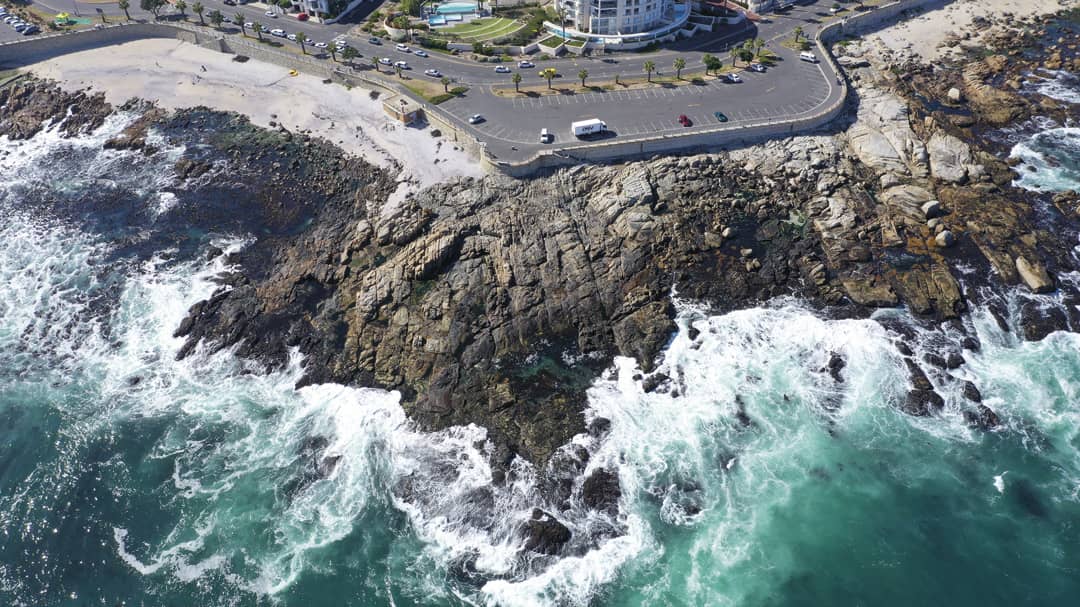
Aerial-view of the Sea Point Contact, transitioning from Malmesbury Group rocks (left) to the main contact-zone (centre) and S-type granite (right) (Photo: S. Davey).

Geological Period

Ediacaran

Main geological interest

History of geosciences
Igneous and Metamorphic petrology

Location

Sea Point, western Cape Town adjacent to the Atlantic Ocean, South Africa
33°55’20” S, 18°22’39” E

Aerial-view of the Sea Point Contact, transitioning from Malmesbury Group rocks (left) to the main contact-zone (centre) and S-type granite (right) (Photo: S. Davey).

A historically significant geological contact, studied by Charles Darwin in 1836, that continues to provide valuable insights into intrusion-wall-rock interactions.

The site was significant in the early 19th–century Plutonist–Neptunist debate regarding igneous rocks. First described by Clarke Abel in 1818, it gained prominence following Charles Darwin’s visit, where he supported the Plutonist view that granite forms from magma (Darwin, 1844). Furthermore, before contact metamorphism was widely studied, Darwin identified granites as heat sources that transform sedimentary rocks into metamorphic ones, noting changes like mica coarsening and cordierite formation towards the contact. Darwin also observed that the exposure of magmatic rocks at the surface required long periods of erosion, reinforcing his broader belief that inherited traits in species evolve gradually over extended timescales.

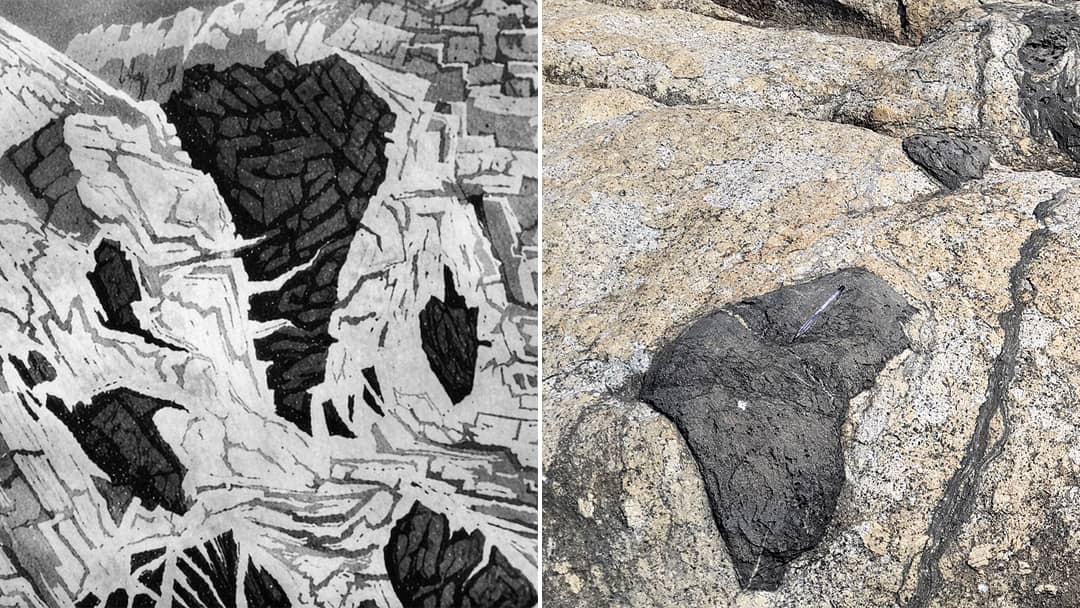
Intrusive granite relationships with country rock from Abel (1818) (left) and modern views at the Sea Point Contact (right). Engraving (left) obtained from Master (2010).

The Sea Point Contact is an example of an intrusive contact between the 560-555 Ma metasedimentary Tygerberg Formation of the Malmesbury Group and the 540 Ma S-type Peninsula Pluton of the Cape Granite Suite. During his voyage on the HMS Beagle, Charles Darwin visited this outcrop in 1836, proposing that the country rock ‘enclaves’ in the granite were once interconnected and folded sedimentary rocks intruded by granite along their schistosity planes and later eroded to reveal “floating” fragments (Darwin, 1844).
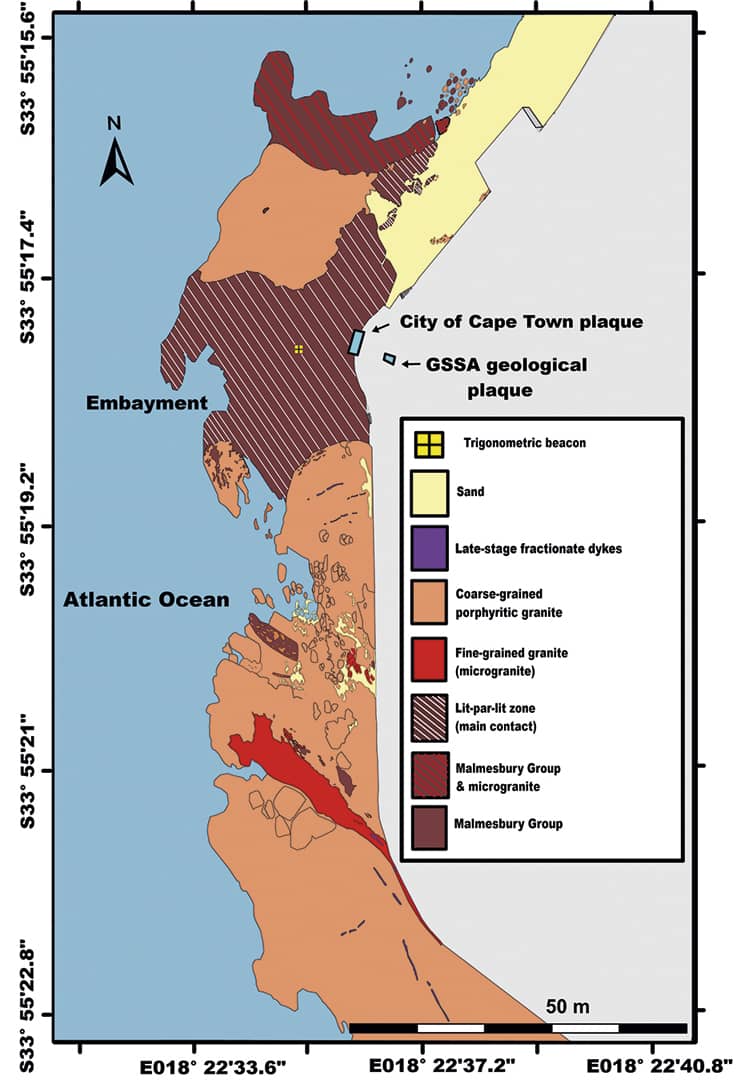
The outcrop transitions from Malmesbury Group rocks in the north through a complex main contact-zone comprising compositionally variable S-type granites and metasedimentary rocks before reaching the coarse-grained porphyritic S-type granite to the south. Fine-grained varieties of the granite are also present within the exposure. The main contact-zone is characterised by numerous, roughly parallel sheets of granite injections into the country-rock. It acquired its complex nature from the intermingling and commonly diffuse contacts between the various granitic types and the country-rock, resulting in hybrid rocks of mixed character. Xenoliths of the country-rock also occur in this zone. The site’s accessibility continues to facilitate the study of geological processes such as deformation, metamorphism, and the origin of feldspar phenocrysts in the wall-rock.

Abel and Darwin provided their interpretations in 1818 and 1844, respectively, with further descriptions by Walker and Mathias (1946). Master (2010) examined the historical debate on the origin of Cape Province granites. Bailie, Mhlanga and Reinhardt (2024) and Bailie et al. (2024) highlighted the outcrop’s geological significance and the origins of embedded feldspar in the country-rock.

A simplified geological map of the Sea Point Contact. GSSA = Geological Society of South Africa.

Abel, C. (1818) Narrative of a journey in the interior of China : and of a voyage to and from that country, in the years 1816 and 1817, containing an account of the most interesting transactions of Lord Amherst’s embassy to the court of Pekin and observations on the countries which it visited. London : Printed for Longman, Hurst, Rees, Orme, and Brown. Available at: http://archive.org/details/narrativeajourn00abelgoog.

Bailie, R. et al. (2024) “Magma through-flow and embedding of magmatic crystals in metasedimentary country rocks adjacent to the Peninsula Granite, Cape Granite Suite (South Africa),” Lithos, 488–489, p. 107812. Available at: https://doi.org/10.1016/j.lithos.2024.107812.

Bailie, R.H., Mhlanga, M. and Reinhardt, J. (2024) “The Sea Point contact, Cape Town, South Africa: A geological site made famous by Charles Darwin’s visit,” Geological Society, London, Special Publications, 543(1), pp. SP543-2022–237. Available at: https://doi.org/10.1144/SP543-2022-237.

Darwin, C. (1844) Geological Observations on the Volcanic Islands, Visited During the Voyage of HMS Beagle: Together with Some Brief Notices on the Geology of Australia and the Cape of Good Hope. Smith Elder and Company, London. Available at: https://doi.org/10.1017/CBO9780511973109.

Master, S. (2010) “Plutonism versus Neptunism at the southern tip of Africa: the debate on the origin of granites at the Cape, 1776–1844,” Earth and Environmental Science Transactions of The Royal Society of Edinburgh, 100(1–2), pp. 1–13. Available at: https://doi.org/10.1017/S1755691009016193.

Walker, F. and Mathias, M. (1946) “The petrology of two granite-slate contacts at Cape Town, South Africa,” Quarterly Journal of the Geological Society of London, 102(1–4), pp. 499–521. Available at: https://doi.org/10.1144/GSL.JGS.1946.102.01-04.21.

Musa Mhlanga.
University of the Western Cape, Cape Town, South Africa

Russell Bailie.
University of the Western Cape, Cape Town, South Africa

Douglas Cole.
Geoheritage Committee of the Geological Society of the Western Cape, Cape Town, South Africa

John Rogers.
Geoheritage Committee of the Geological Society of the Western Cape, Cape Town, South Africa

The Third 100 IUGS Geological Heritage Sites have been officially announced!
Privacy overview

This website uses cookies so that we can offer you the best possible user experience. Cookie information is stored in your browser and performs functions such as recognizing you when you return to our website or helping our team to understand which sections of the website you find most interesting and useful.