Iron-manganese-polymetallic mineralization at the Långban mines
Sweden
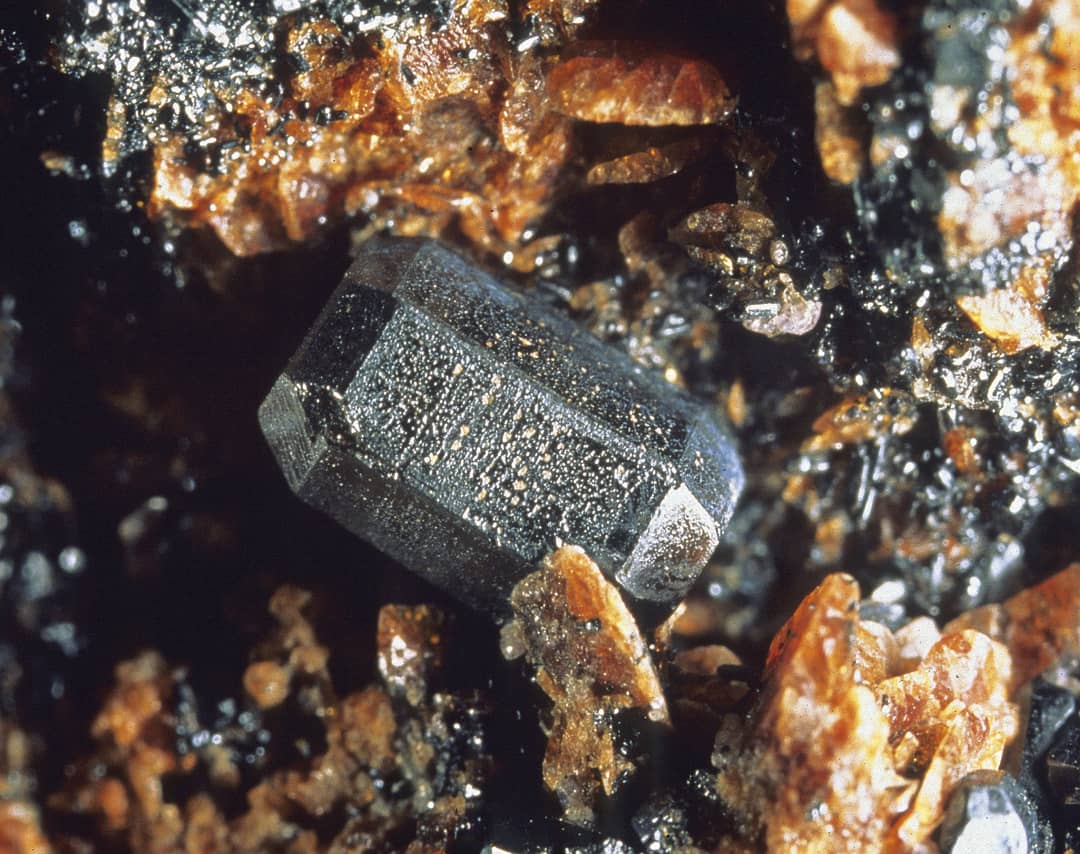
The mineral långbanite, named after the locality, as a 5 millimeter crystal with orange richterite. (Photo: Michael P. Cooper. Swedish Museum of Natural History collection).
Geological Period
Paleo-proterozoic Era to Neo-proterozoic Era
Main geological interest
Mineralogy
History of geosciences
Location
Värmland County, Sweden
59°51’21” N, 14°15’43” E
The mineral långbanite, named after the locality, as a 5 millimeter crystal with orange richterite. (Photo: Michael P. Cooper. Swedish Museum of Natural History collection).
Mineralogy’s Cornucopia: one of the most mineralogically diverse deposits on Earth and type locality of some 80 mineral species.
The Långban mines constitute one of the most mineralogically diverse locations on Earth, featuring some 330 mineral species of which around 80 have Långban as type locality, exemplified by exotica such as sverigeite, långbanite and swedenborgite. It has drawn scientists internationally to study its mineralogy for well over 200 years. The original diverse range of elements in the deposit combined with recrystallisation and remobilisation of components over time at variable pressure and temperature conditions with strong contrasts in host rock reactivity, resulted in this unique and extremely mineralogically diverse deposit: truly a mineralogy’s Horn of Plenty.
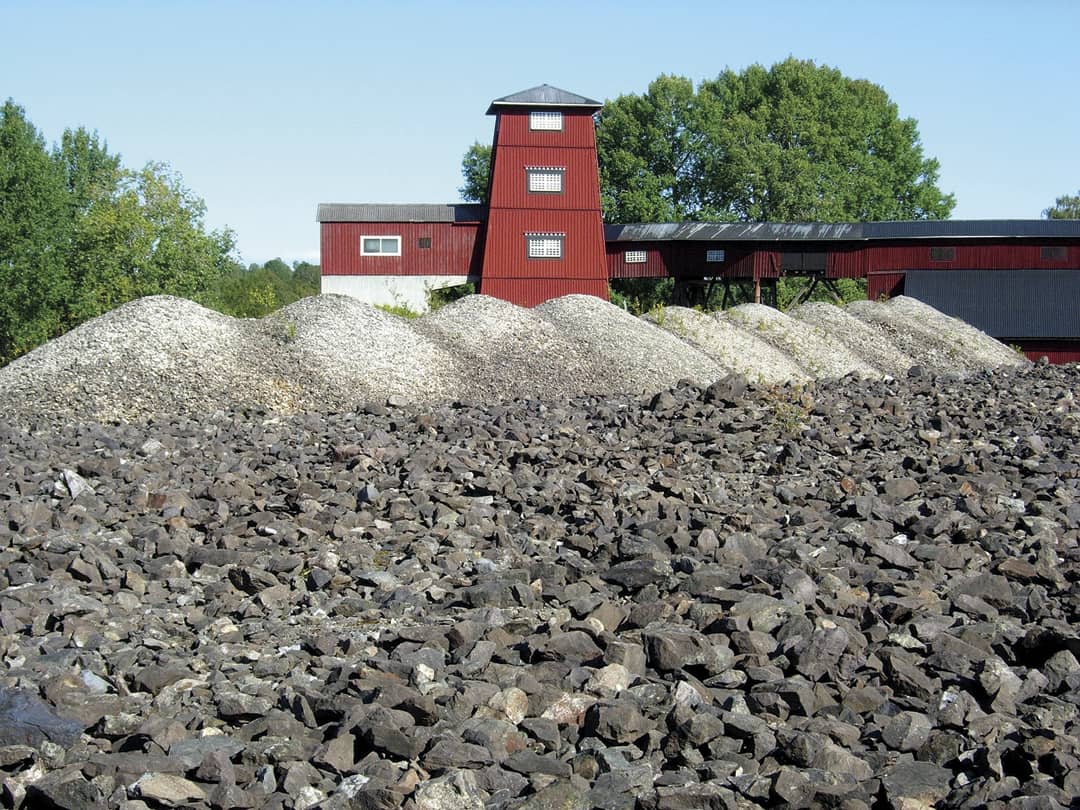
Overview of mineral-rich mine dumps at Långban; the Nya Schaktet headframe is in the background. The mines, having medieval origins, closed in 1972. (Photo: Erik Jonsson).
Geological description
The Långban mines, over time worked for iron, manganese and dolomite, are hosted by a Palaeoproterozoic package of metamorphosed and deformed mainly felsic metavolcanic rocks and marbles, formed at around 1.9 Ga (billion years) and characteristic of the Bergslagen ore province in south central Sweden, the most ancient and classic among mining regions in the Fennoscandian shield (Magnusson, 1930; Björk, 1986; Allen et al., 1996; Holtstam and Langhof, 1999). Here, original submarine volcanic to sub-volcanic hydrothermal activity in a shallow marine environment resulted in the precipitation of iron and manganese proto-ores, probably both on and below the seafloor. These ores were dominated by iron and manganese but also carried locally abundant elements such as antimony, arsenic, barium, beryllium, copper and lead, and are thus polymetallic in nature. Regional metamorphism around 1.85 Ga led to recrystallisation of ores and host rocks and extensive mineral reactions and folding. A later stage of magmatism at 1.8 Ga led to new thermal input and mineral reactions. Post-dating these events, multiple stages of brittle tectonic activity and renewed remobilisation yielded diverse fracture-hosted mineralisation formed through low-temperature, fluid-mediated remobilisation of an array of elements from the pre-existing mineralisation and its host rocks (Jonsson and Broman, 2002).
Scientific research and tradition
Historically, Långban minerals were investigated already in the early 19th century by scientific giants such as J. Berzelius. and studies and discoveries are still on-going. New minerals for planet Earth are still being discovered and published in scientific journals, such as the recently discovered skogbyite (Jonsson et al., 2025).
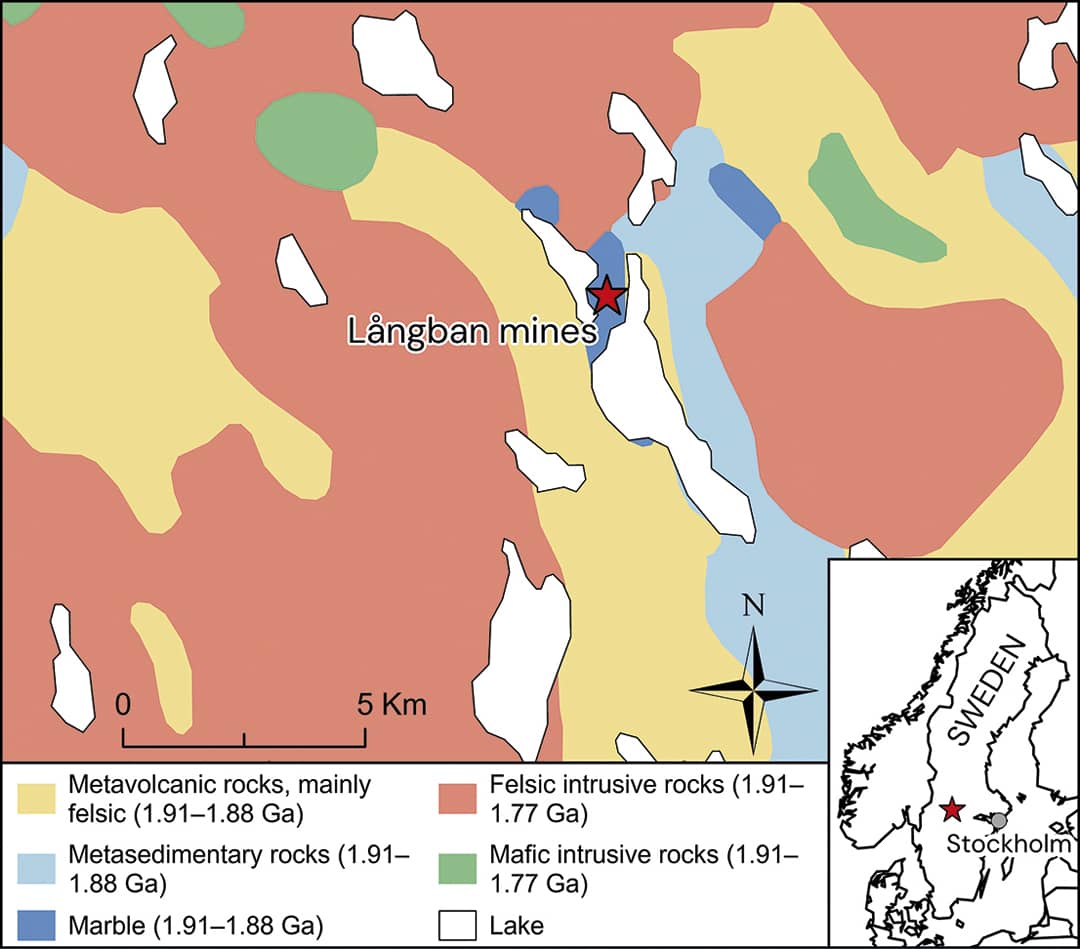
Simplified bedrock geology map of the Långban area in westernmost Bergslagen. Inset map shows position within the Nordic countries of northern Europe. Modified by Stefan Andersson from SGU databases.
Reference
Allen, R.L. et al. (1996) “Facies analysis of a 1.9 Ga, continental margin, back-arc, felsic caldera province with diverse Zn-Pb-Ag-(Cu-Au) sulfide and Fe oxide deposits, Bergslagen region, Sweden,” Economic Geology, 91(6), pp. 979–1008. Available at: https://doi.org/10.2113/gsecongeo.91.6.979.
Björk, L. (1986) Berggrundskartan Filipstad NV med beskrivning. Sveriges Geologiska Undersökning, Serie Af 147.
Jonsson, E. et al. (2025) “Skogbyite, Zr(Mg2Mn3+4)Sio12, A new zirconium mineral in the braunite group from Långban, Bergslagen, Sweden,” European Journal of Mineralogy, 37, pp. 269–277. Available at: https://doi.org/10.5194/ejm-37-269-2025.
Jonsson, E. and Broman, C. (2002) “Fluid inclusions in late-stage Pb-Mn-As-Sb mineral assemblages in the Långban deposit, Bergslagen, Sweden,” The Canadian Mineralogist, 40(1), pp. 47–65. Available at: https://doi.org/10.2113/gscanmin.40.1.47.
Magnusson, N.H. (1930) Långbans malmtrakt : Geologisk beskrivning. Stockholm: Sveriges Geologiska Undersökning , Serie Ca 23.
Author(s)
Erik Jonsson.
Geological Survey of Sweden and Uppsala University