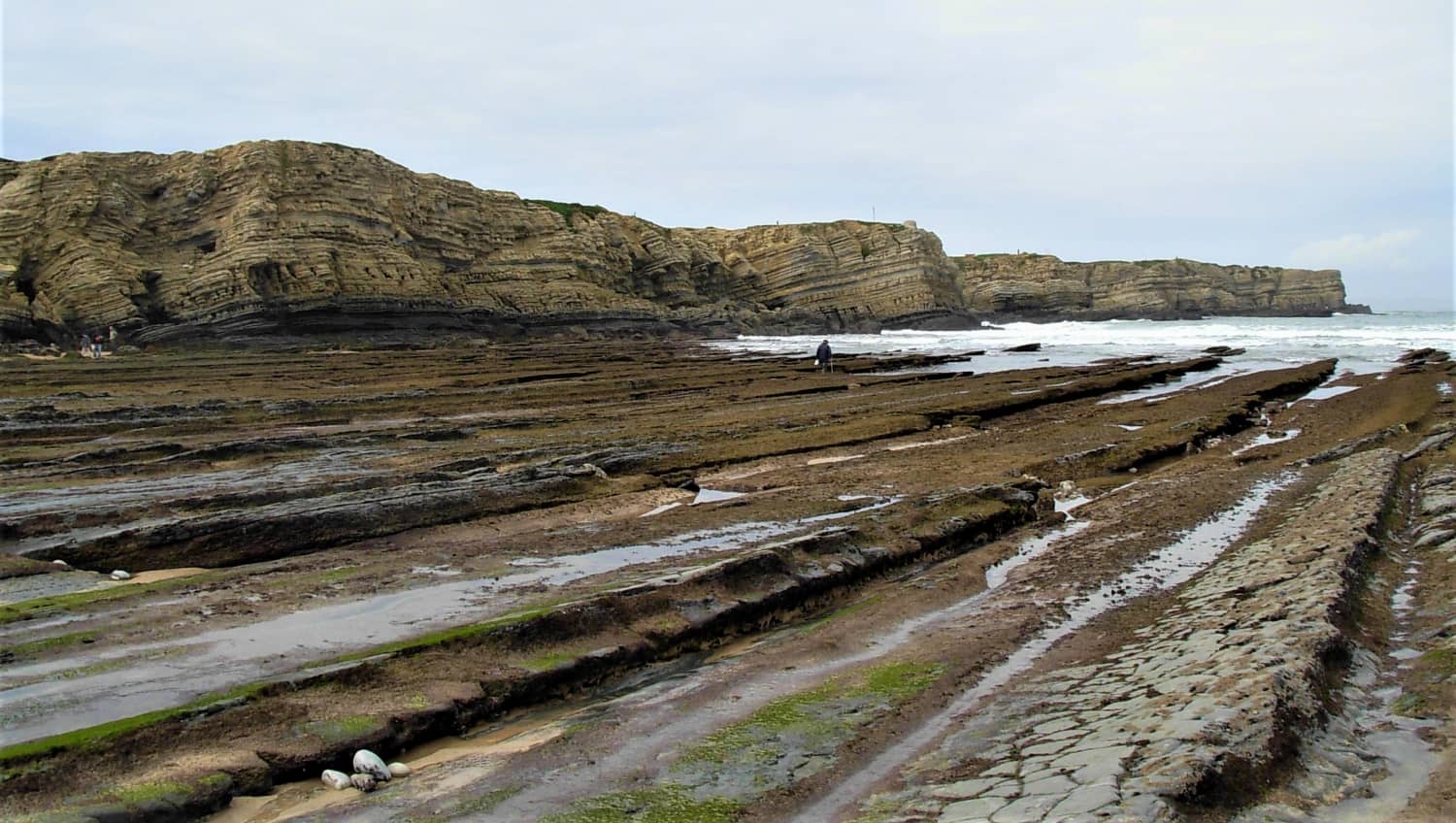
The iconic Pliensbachian succession (Vale das Fontes and Lemede formations) cropping out in northern part of the Peniche Peninsula.
Geological Period
Jurassic (Early Jurassic)
Main geological interest
Stratigraphy and sedimentology
Paleontology
Location
Peniche, Portugal.
39º22’15” N, 9º23’07” W
The iconic Pliensbachian succession (Vale das Fontes and Lemede formations) cropping out in northern part of the Peniche Peninsula.
Where the Atlantic meets the Tethys, in one of the world's most iconic and studied lower jurassic section.
Located in one of the most iconic and geomorphologically significant areas of the Portuguese coast, Peniche hosts one of the most continuous and extensively studied Lower Jurassic carbonate sequences in the world. Among its many remarkable stratigraphical, sedimentological, and palaeontological features, this succession is globally recognized for its Pliensbachian organic-rich facies, the Toarcian stratotype, and, in particular, the T-OAE (Duarte et al.., 2017). This event holds one of its top global records in Peniche, evidenced by a second-order mass extinction and geochemical proxies indicating a disruption in the carbon cycle and hyperthermal conditions (e.g., Reolid et al. 2020).
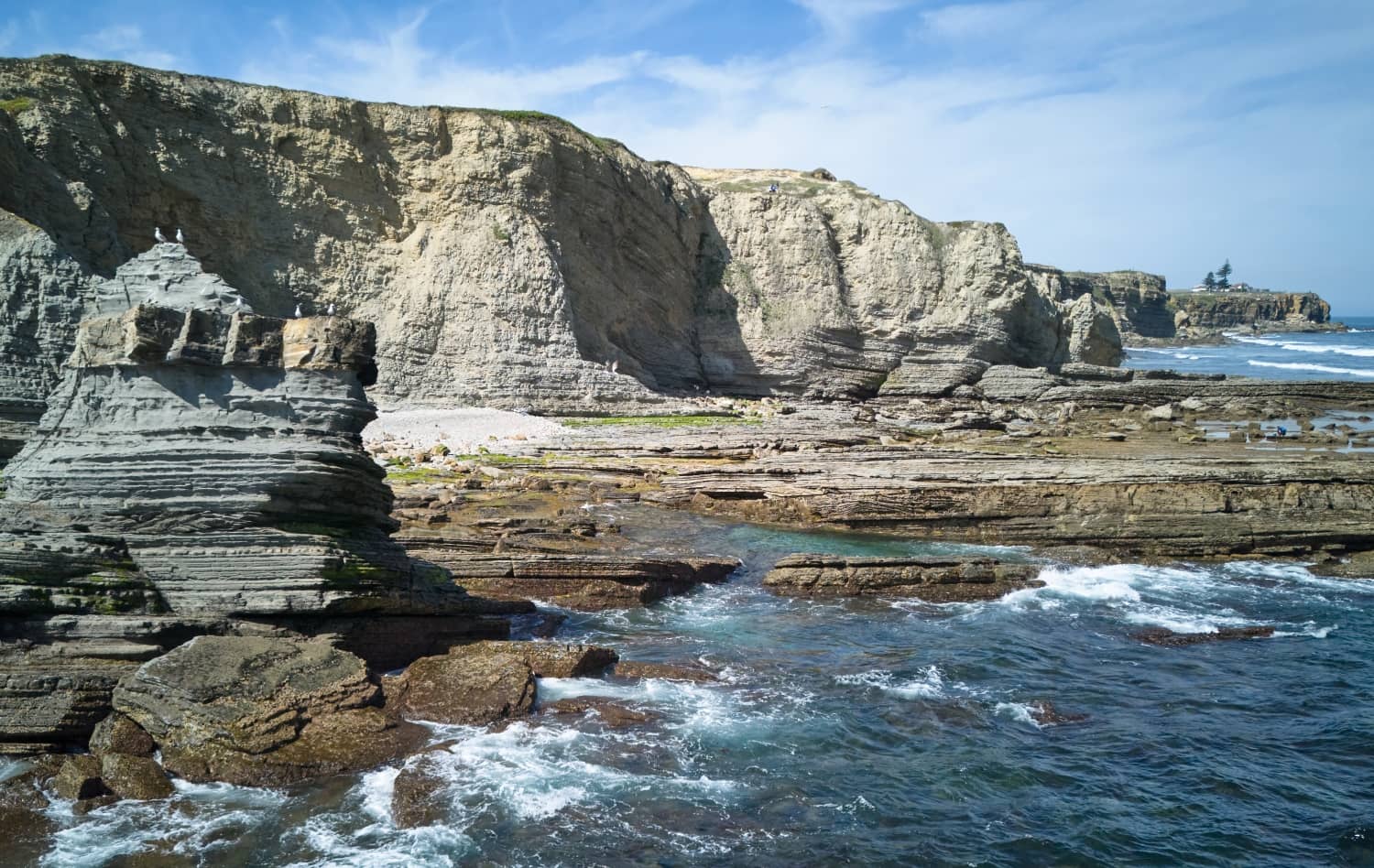
The uppermost lower to middle Toarcian succession representing turbidites and hemipelagic marly limestones (Cabo Carvoeiro Formation).
Geological description
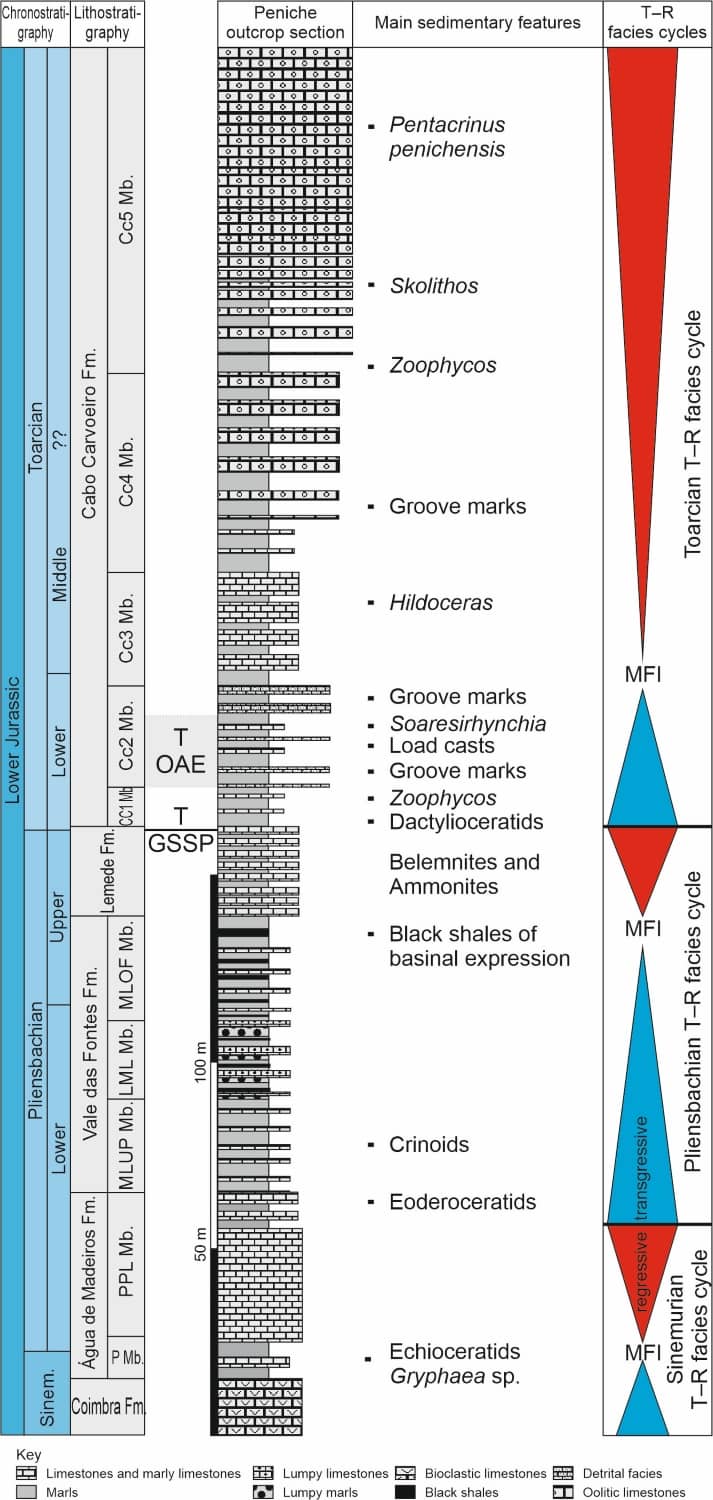
During the Early Jurassic, Peniche occupied a key palaeogeographic setting located between the Western Tethys and the pre-Atlantic realm. A continuous marine carbonate succession over 450 meters thick was deposited, spanning from the Sinemurian to the Aalenian (Middle Jurassic) and recording nearly 20 million years of Earth’s history. This succession is divided into five formations, predominantly consisting of marl-limestone alternations from the lower Pliensbachian to the middle Toarcian, including organic-rich deposits that characterize much of the Pliensbachian. These hemipelagic sediments, well-dated by ammonites, were deposited in a homoclinal carbonate ramp paleoenvironment. The upper part of the Peniche succession exhibits significant facies differentiation, ranging from siliciclastic turbidites to shallow-water carbonates, which accumulated in a highly variable depositional setting (e.g., Duarte 2007; Barata et al. 2021). Rich in benthic, nektonic, and planktonic fossils of both Tethyan and Boreal origin, the stratigraphic succession is of considerable importance for global correlation, including the formal definition of the Toarcian stratotype (Duarte et al. 2017). This section is also notable for its record of the Early Toarcian Oceanic Anoxic Event (T-OAE), also known as the Jenkyns Event (~183 Ma), reflected in various abiotic and biotic signatures (e.g., Hesselbo et al. 2007; Font et al. 2022).
Scientific research and tradition
This section has been a focus of stratigraphic analysis since the nineteenth century. However, the number of studies has significantly increased over the last twenty years, developed by various international research groups, resulting in dozens of publications, as well as by educational and scientific dissemination activities (Duarte et al.. 2017).
Stratigraphic chart of the Lower Jurassic succession at Peniche (adapted and modified from Duarte et al. 2017).
Reference
Barata, J., Duarte, L.V. and Azerêdo, A.C. (2021) “Facies types and depositional cyclicity of a Toarcian–Aalenian(?) carbonate-siliciclastic mixed succession (Cabo Carvoeiro Formation) in the Lusitanian Basin, Portugal,” Journal of Iberian Geology, 47(3), pp. 501–534. Available at: https://doi.org/10.1007/s41513-021-00163-2.
Duarte, L. (2007) “Lithostratigraphy, sequence stratigraphy and depositional setting of the Pliensbachian and Toarcian series in the Lusitanian Basin (Portugal),” Ciências da Terra, 16, pp. 17–23.
Duarte, L.V. et al. (2017) “The jurassic of the peniche peninsula (Portugal): Scientific, educational and science popularization relevance,” Revista de la Sociedad Geológica de España, 30(1), pp. 55–70.
Font, E. et al. (2022) “Rapid light carbon releases and increased aridity linked to Karoo-Ferrar magmatism during the early Toarcian oceanic anoxic event.,” Scientific reports, 12(1). Available at: https://doi.org/10.1038/s41598-022-08269-y.
Hesselbo, S.P. et al. (2007) “Carbon-isotope record of the Early Jurassic (Toarcian) Oceanic Anoxic Event from fossil wood and marine carbonate (Lusitanian Basin, Portugal),” Earth and Planetary Science Letters, 253(3), pp. 455–470. Available at: https://doi.org/10.1016/j.epsl.2006.11.009.
Reolid, M. et al. (2020) “The Toarcian Oceanic Anoxic Event and the Jenkyns Event (IGCP-655 final report),” Episodes Journal of International Geoscience, 43(2), pp. 833–844. Available at: https://doi.org/10.18814/epiiugs/2020/020051.
Author(s)
Luís Vítor Duarte University of Coimbra
José Brilha University of Minho, Portugal
Susana Machado Laboratório Nacional de Energia e Geologia, Portuguese Geological Survey
João Matos Laboratório Nacional de Energia e Geologia, Portuguese Geological Survey