Mio-Quaternary continental geoarchive of Guadix-Baza
Spain
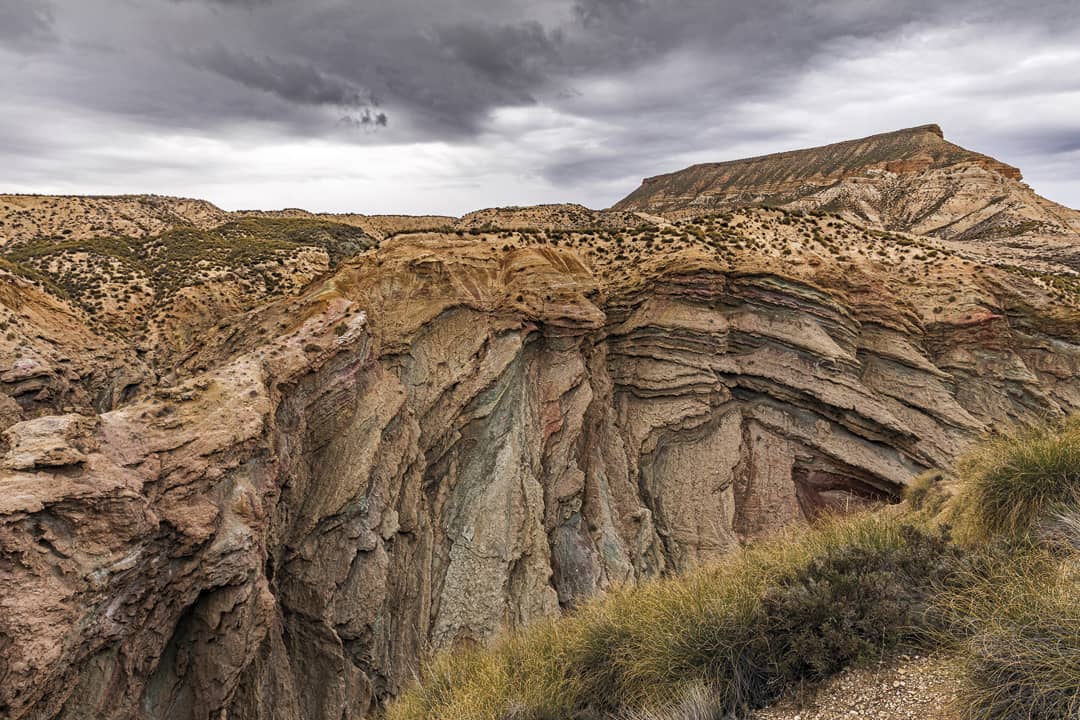
Unconformity between the undeformed continental infilling of the Basin and the mesozoic folded basement (Photo: J. Olivares)
Geological Period
Neogene (Miocene) to Quaternary (Holocene)
Main geological interest
Stratigraphy and sedimentology
Paleontology
Location
Andalusia, Spain
37°50’00” N, 3°8’00” W
Unconformity between the undeformed continental infilling of the Basin and the mesozoic folded basement (Photo: J. Olivares)
The most complete european continental archive demonstrating mammal interchange between Africa and Eurasia including the first hominids in Europe.
This basin (Granada UNESCO Global Geopark since 2020) stands out internationally for its exceptional geological value, demonstrated by its uniqueness and importance in aspects such as:
Interaction Stratigraphy–Tectonics–Paleoclimate: These three elements appear extraordinarily well combined and exposed.
Palaeontology and human evolution: It holds the keys to early mammal migration and biogeographic interchange between Africa and Eurasia, as well as the appearance of the first hominins in Europe.
Geobiology and astrobiological implications: The lacustrine microbialites and their biosignatures offer a terrestrial analogue for the early Earth and for the search for life on Mars.
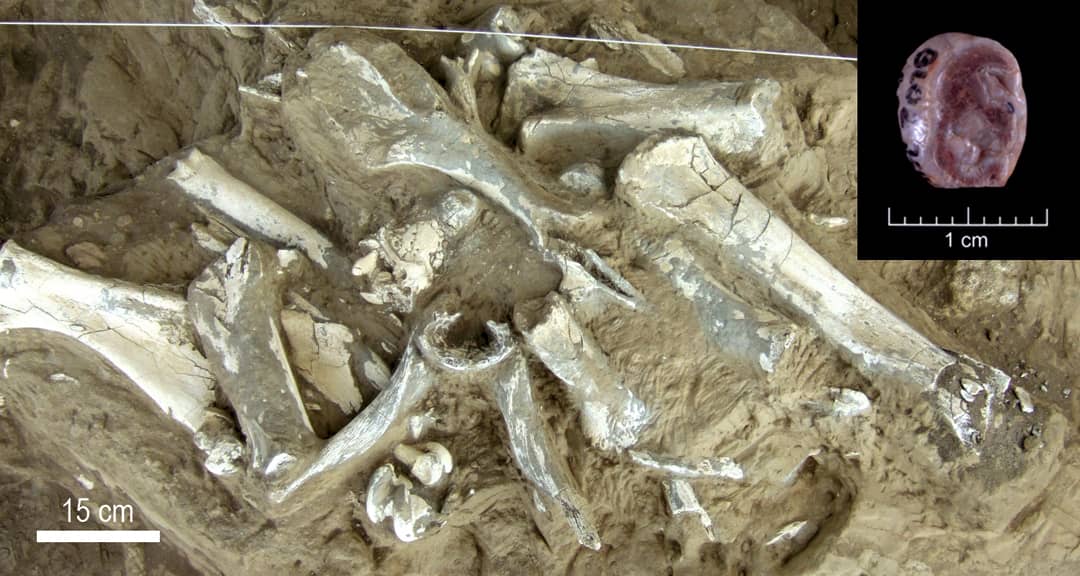
Accumulation of mammal bones in the Fonelas P-1 site (2 Ma). Top rigth: fossil hominid tooth (1.4 Ma) from the site of Barranco Leon (Toro-Moyano et al., 2013).
Geological description
Guadix-Baza is a unique basin in the European continent that has continuously recorded the last 7 million years in a context of collision between Europe and Africa. Its backarc alpine tectonic framework, together with the climatic evolution and the highest reliefs of the Iberian Peninsula, has allowed the transformation of a savannah with endorheic drainage into a semi-desert (Viseras et al., 2006; Medina Cascales et al., 2020).
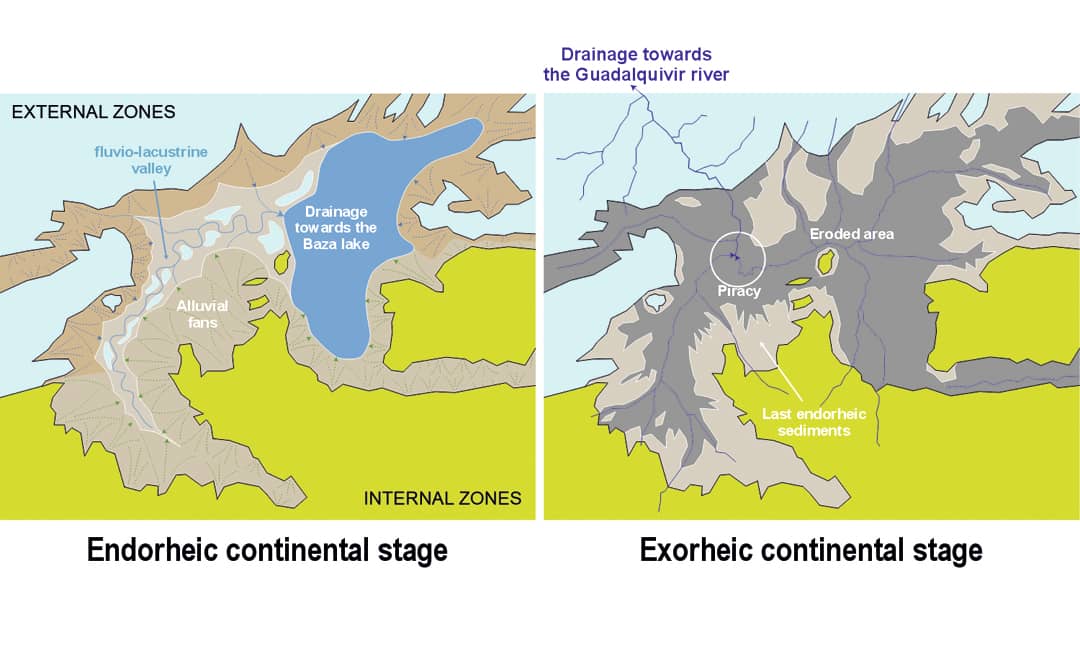
No place like this records the complete history of a sedimentary basin from its structuring as an endorheic area, with a complex architecture of fluvial and lacustrine systems, to its geomorphological inversion due to a process of fluvial pyracy (Calvache and Viseras, 1997).
The numerous well-studied vertebrate palaeontological sites in the region (7 are internationally recognised as Geosites) and the preservation of low-temperature biogeochemical processes, including microbial mineralisation, demonstrate that this may have been the perfect habitat for the beginning of human colonisation of the European continent (Arribas et al., 2009; Toro-Moyano et al., 2013; Álvarez-Posada et al., 2017).
The severe entrenchment of the present-day fluvial network on the sediments it was itself accommodating allows detailed stratigraphic reconstruction with precise time control and continuous palaeoenvironmental reconstruction.
Scientific research and tradition
Important multidisciplinary geological research results in this basin have invited the Granada University, Spanish Geological and Mining Institute (IGME) and the Diputacion de Granada to propose here initiatives to valorise several scientifically documented geosites for field schools, teacher-training programs and public education initiatives making it a living classroom for geosciences.
Palaeogeographic reconstruction of the ancient endorheic basin (left) and the current fluvial network (right). A fluvial piracy phenomenon transformed the savannah into desert (Calvache and Viseras, 1997).
Reference
Álvarez-Posada, C. et al. (2017) “New magnetostratigraphic evidence for the age of Acheulean tools at the archaeo-palaeontological site ‘Solana del Zamborino’ (Guadix – Baza Basin, S Spain),” Scientific Reports, 7(1), p. 13495. Available at: https://doi.org/10.1038/s41598-017-14024-5.
Arribas, A. et al. (2009) “A Mammalian Lost World in Southwest Europe during the Late Pliocene,” PLoS ONE, 4(9), p. e7127. Available at: https://doi.org/10.1371/journal.pone.0007127.
Medina Cascales, I. et al. (2020) “Geometry and kinematics of the Baza Fault (central Betic Cordillera, South Spain): insights into its seismic potential,” Geologica acta: an international earth science journal, 18(1), p. 10.
Toro-Moyano, I. et al. (2013) “The oldest human fossil in Europe, from Orce (Spain),” Journal of Human Evolution, 65(1), pp. 1–9. Available at: https://doi.org/10.1016/j.jhevol.2013.01.012.
Viseras, C. et al. (2006) “A large-mammal site in a meandering fluvial context (Fonelas P-1, Late Pliocene, Guadix Basin, Spain): Sedimentological keys for its paleoenvironmental reconstruction,” Palaeogeography, Palaeoclimatology, Palaeoecology, 242(3), pp. 139–168. Available at: https://doi.org/10.1016/j.palaeo.2006.05.013.
Author(s)
César Viseras.
University of Granada, Spain/ Coordinator of the Scientific Committee of the Granada Geopark
Mónica Sánchez.
University of Granada, Spain/Scientific Committee of the Granada Geopark
Daniel Ariztegui.
International Association of Sedimentologists/University of Geneva, Switzerland