Pleistocene volcanic tube La Corona-La Atlántida

Spain

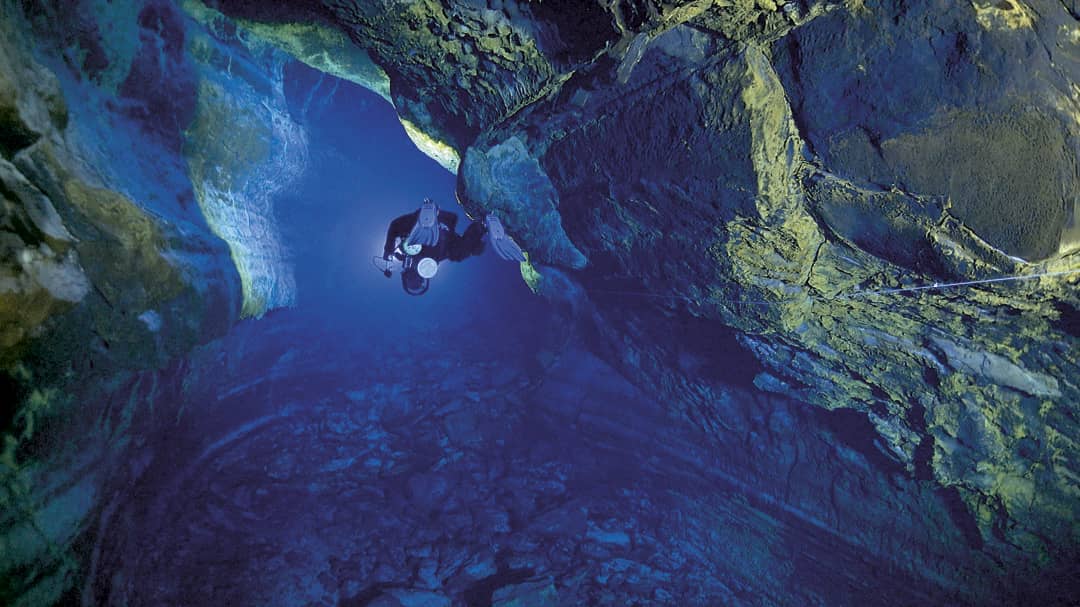
Túnel de la Atlántida section with main geomorphological features related with the tube formation.

Geological Period

Quaternary (Pleistocene) to Quaternary (Holocene)

Main geological interest

Geomorphology and active geological processes
Volcanology

Location

Lanzarote, Canary Islands, Spain
29°9’50” N, 13°27’03” W

Túnel de la Atlántida section with main geomorphological features related with the tube formation.

World largest underwater lava tube.

The La Atlántida lava tube is the longest underwater lava tube in the world and hosts a unique anchialine system with more than 37 endemic species. The sediments and speleothems it contains have enabled palaeoenvironmental reconstruction since the Last Glacial Maximum. The tube is one of the best examples of geological analogues for lava tubes on Mars and the Moon and has been selected by ESA and NASA for planetary cave research. The La Corona–La Atlántida lava tube can be freely visited in several sections, and two sectors (Cueva de los Verdes and Jameos del Agua) are developed as show caves.

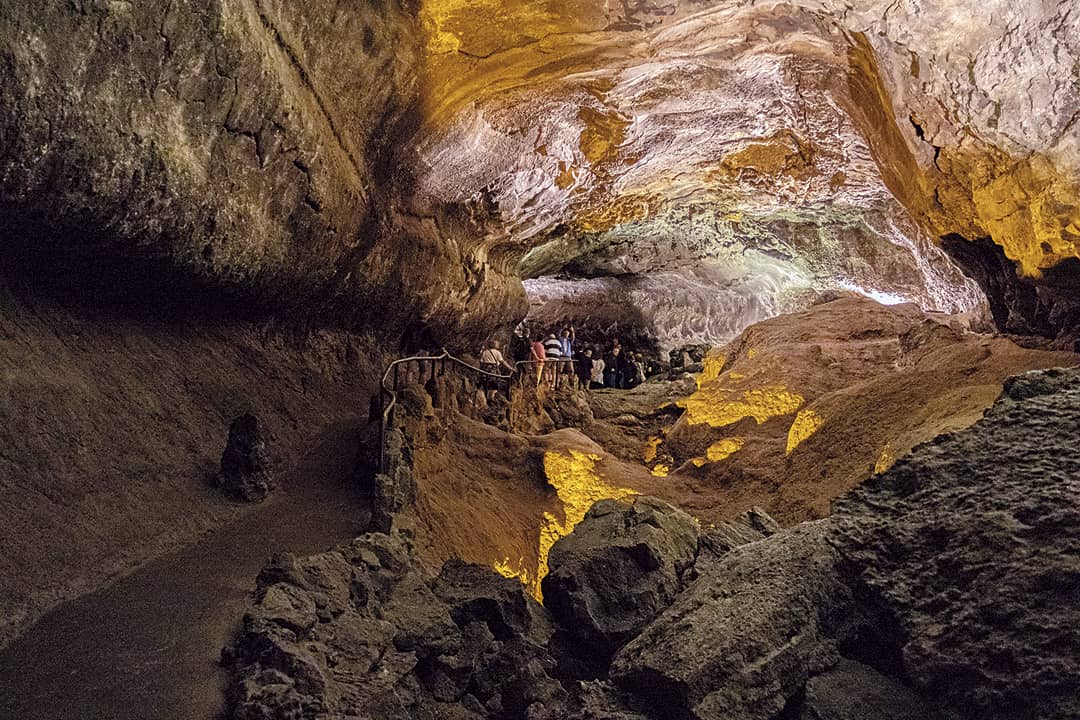
Upper gallery of Los Verdes show cave, part of the La Corona-La Atlántida lava tube.

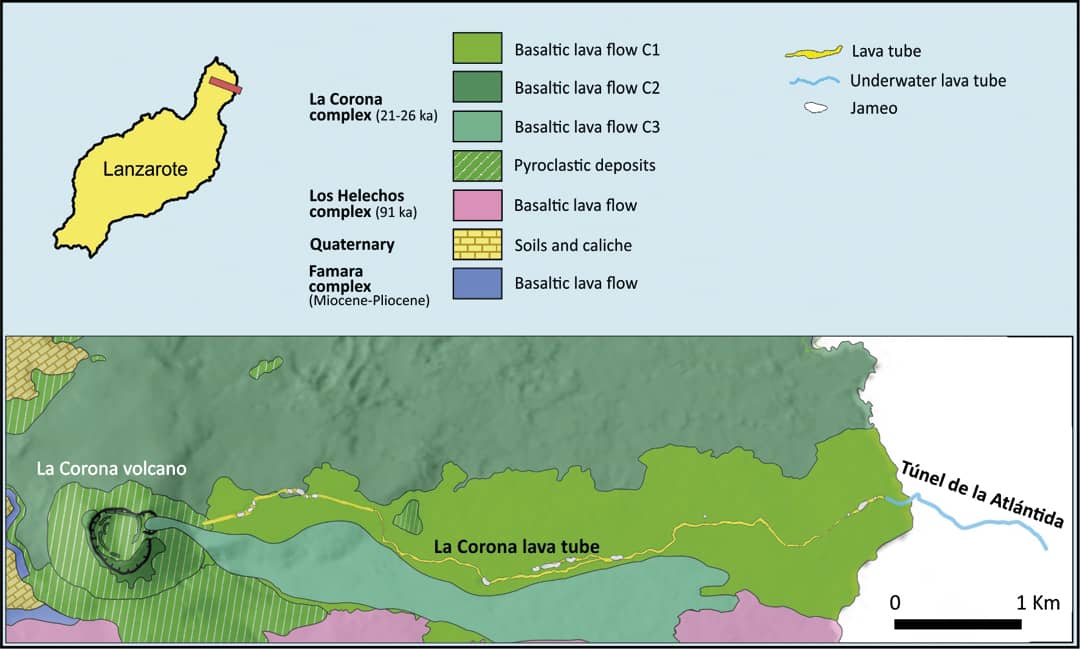
The La Corona-La Atlántida lava tube was formed during the eruption of La Corona volcano approximately 26-21 ka ago. The materials from this eruption overlie other Late Pleistocene volcanic complexes (91 ka). The submerged sector (Túnel de la Atlántida) is the longest submerged lava tube in the world and hosts a unique anchialine system (a subtype of coastal aquifer). It forms part of the La Corona tube and, with a length of 10 kilometers, is one of the largest lava-tube systems and one of the best observable examples of an inception-type lava tube in the world. The tube formed under subaerial conditions when sea level was 120 meters lower, and the La Atlántida sector was progressively flooded after the Last Glacial Maximum. The lava tube displays multiple examples of morphologies associated with its formation. There is also an abundance of secondary speleothems (carbonates and sulphates), as well as singular minerals. In addition, the tube hosts continental and marine deposits that, like the speleothems, have been dated by Th/U and radiocarbon methods, allowing palaeoenvironmental reconstruction and reconstruction of sea-level rise over the last 21 ka. It should be noted that the Younger Dryas and the 8.2 ka events have been recorded. Spanish Inventory of Geological Sites of Interest, code IC-1011.

This site has been investigated since 1909. It is an international reference site for volcanic-cave geomorphology and anchialine aquifers in volcanic rocks, and also a global reference as an analogue for planetary caves, having been used by ESA and NASA as a research laboratory. In recent years, it has hosted international conferences on volcanic and planetary caves.

Geological diagram of La Corona-La Atlántida lava tube.

Carracedo, J.C. et al. (2003) “La erupción y el tubo volcánico del Volcán Corona (Lanzarote, Islas Canarias),” Estudios Geológicos, 59(5–6), pp. 277–302. Available at: https://doi.org/10.3989/egeol.03595-6104.

Lario, J. et al. (2022) “El Túnel de la Atlántida (Lanzarote): un patrimonio geológico sumergido de interés mundial,” in J.M. Calaforra and J.J. Durán (eds.) Minas y Cuevas: Patrimonio Geológico y Turístico. VIII Congreso Español sobre Cuevas y Minas Turísticas_Cuevatur, Pulpí, Almería, pp. 287–298. Available at: https://www.researchgate.net/publication/364622136_El_Tunel_de_la_Atlantida_Lanzarote_un_patrimonio_geologico_sumergido_de_interes_mundial.

Lario, J. et al. (2026) “The Túnel de la Atlántida (Lanzarote, Canary Islands): reconstructing Late Pleistocene-Holocene sea-level and paleoenvironments changes inside the world largest underwater lava tube,” Geologica Acta, 24, pp. 1–26. Available at: https://doi.org/10.1344/GeologicaActa2026.24.12.

Sauro, F. et al. (2019) “Volcanic Caves of Lanzarote: A Natural Laboratory for Understanding Volcano-Speleogenetic Processes and Planetary Caves,” in E. Mateo, J. Martínez-Frías, and J. Vegas (eds.) Lanzarote and Chinijo Islands Geopark: From Earth to Space. Cham: Springer International Publishing (Geoheritage, Geoparks and Geotourism), pp. 125–142. Available at: https://doi.org/10.1007/978-3-030-13130-2_9.

Sauro, F. et al. (2020) “Lava tubes on Earth, Moon and Mars: A review on their size and morphology revealed by comparative planetology,” Earth-Science Reviews, 209, p. 103288. Available at: https://doi.org/10.1016/j.earscirev.2020.103288.

Tomasi, I. et al. (2022) “Inception and Evolution of La Corona Lava Tube System (Lanzarote, Canary Islands, Spain),” Journal of Geophysical Research: Solid Earth, 127(6), p. e2022JB024056. Available at: https://doi.org/10.1029/2022JB024056.

Wilkens, H. et al. (2009) “The Corona lava tube, Lanzarote: geology, habitat diversity and biogeography,” Marine Biodiversity, 39(3), pp. 155–167. Available at: https://doi.org/10.1007/s12526-009-0019-2.

Javier Lario.
Universidad Nacional de Educación a Distancia (UNED, Spain)

The Third 100 IUGS Geological Heritage Sites have been officially announced!
Privacy overview

This website uses cookies so that we can offer you the best possible user experience. Cookie information is stored in your browser and performs functions such as recognizing you when you return to our website or helping our team to understand which sections of the website you find most interesting and useful.