Panoramic view of Taupo Volcano from the south, showing rhyolitic lava domes and preserved ignimbrite plateaus along the eastern and western margins.
Geological Period
Quaternary (Pleistocene) to Quaternary (Holocene)
Main geological interest
Volcanology
Geomorphology and active geological processes
Location
Central North Island, New Zealand
38°47’60” S, 175°54’08” E
Panoramic view of Taupo Volcano from the south, showing rhyolitic lava domes and preserved ignimbrite plateaus along the eastern and western margins.
A prolific source of large silicic eruptions, including Earth’s youngest known supereruption about 25,400 years ago.
The Taupo Volcanic System represents one of the world’s most active silicic volcanic systems and preserves a diverse eruptive history over the past ~25 kyr. More than 30 eruptions, ranging from small hydrovolcanic events to large caldera-forming eruptions, have produced a wide variety of volcanic landforms and deposits (Barker et al., 2021). The 25.4 ka Oruanui and ~1.8 ka Taupo caldera-forming eruptions provide globally significant examples of the sedimentary and geomorphic impacts of large explosive eruptions (e.g., Manville et al., 1999). In addition, the young ignimbrite-dominated landscapes surrounding Taupo provide valuable insights into post-eruptive landscape evolution and volcanic geomorphology.
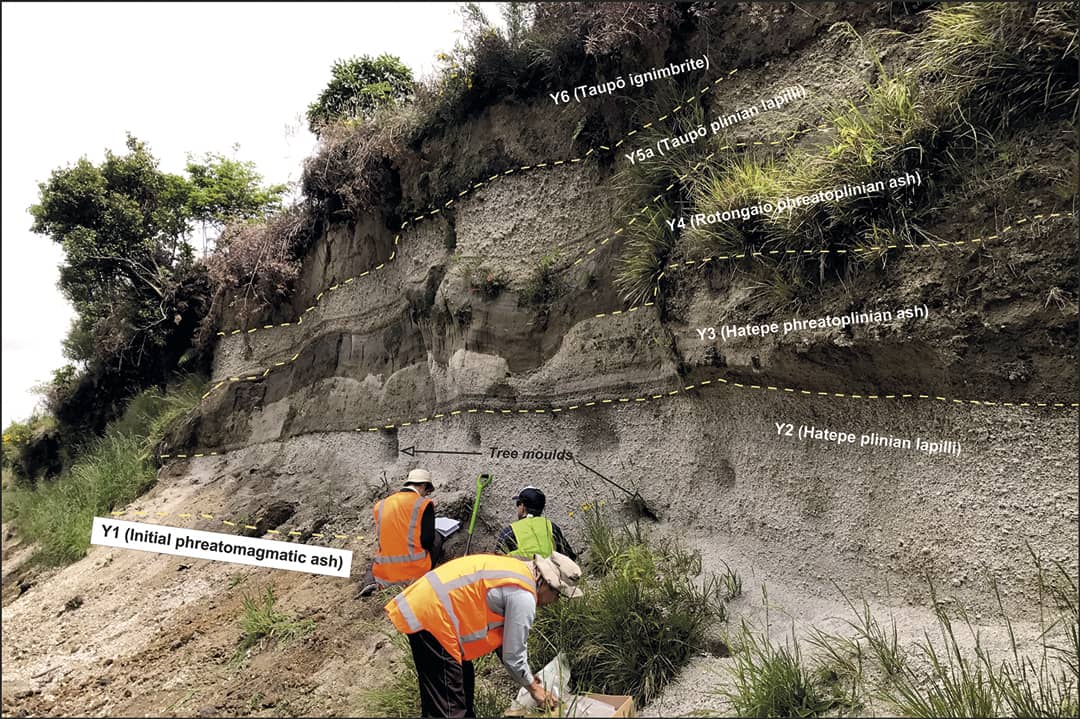
Stratigraphy of the ~232 CE Taupo eruption sequence, showing Plinian fall deposits (Units 2 and 5) and phreatoplinian successions (Units 3–4).
Geological description
Taupo Volcanic System is dominated by a nested caldera complex, currently occupied by Lake Taupo, that was the source of the 25.4 ka Oruanui and ~1.8 ka Taupo caldera-forming eruptions (Wilson and Walker, 1985; Wilson, 2001). However, the full extent of the volcanic system remains poorly defined because Taupo also generated numerous smaller explosive and effusive eruptions from vents located beyond the recognised collapse structures (e.g., Barker et al., 2021). Taupo magmas display considerable geochemical diversity, reflecting both temporal evolution of the magmatic system and variations in the depth and location of magma extraction from the underlying reservoir. The volcanic system is situated along the axis of the actively extending Taupo Rift, a tectonic depression that has hosted long-lived lakes throughout much of the past ~350 kyr. Interaction between volcanism and surface water strongly influenced eruptive processes in which hydrovolcanic activity produced features such as tuff rings and tuff cones (e.g., Kósik et al., 2021), as well as unusually fine-grained ignimbrites including the Oruanui Formation (Wilson, 2021). Present-day geothermal activity, frequent seismic swarms, and episodes of ground deformation demonstrate that the Taupo magmatic system remains active, although the timing, location, and style of future eruptions remain highly uncertain.
Scientific research and tradition
Taupo has been a major focus of caldera research since the early 1980s. Continuous lake-levelling surveys since 1979 provide one of the world’s longest volcanic deformation records. In addition, the exceptionally preserved ignimbrites and tephra deposits associated with caldera-forming eruptions provide unique insights into the dynamics of large-scale phreatoplinian volcanism.
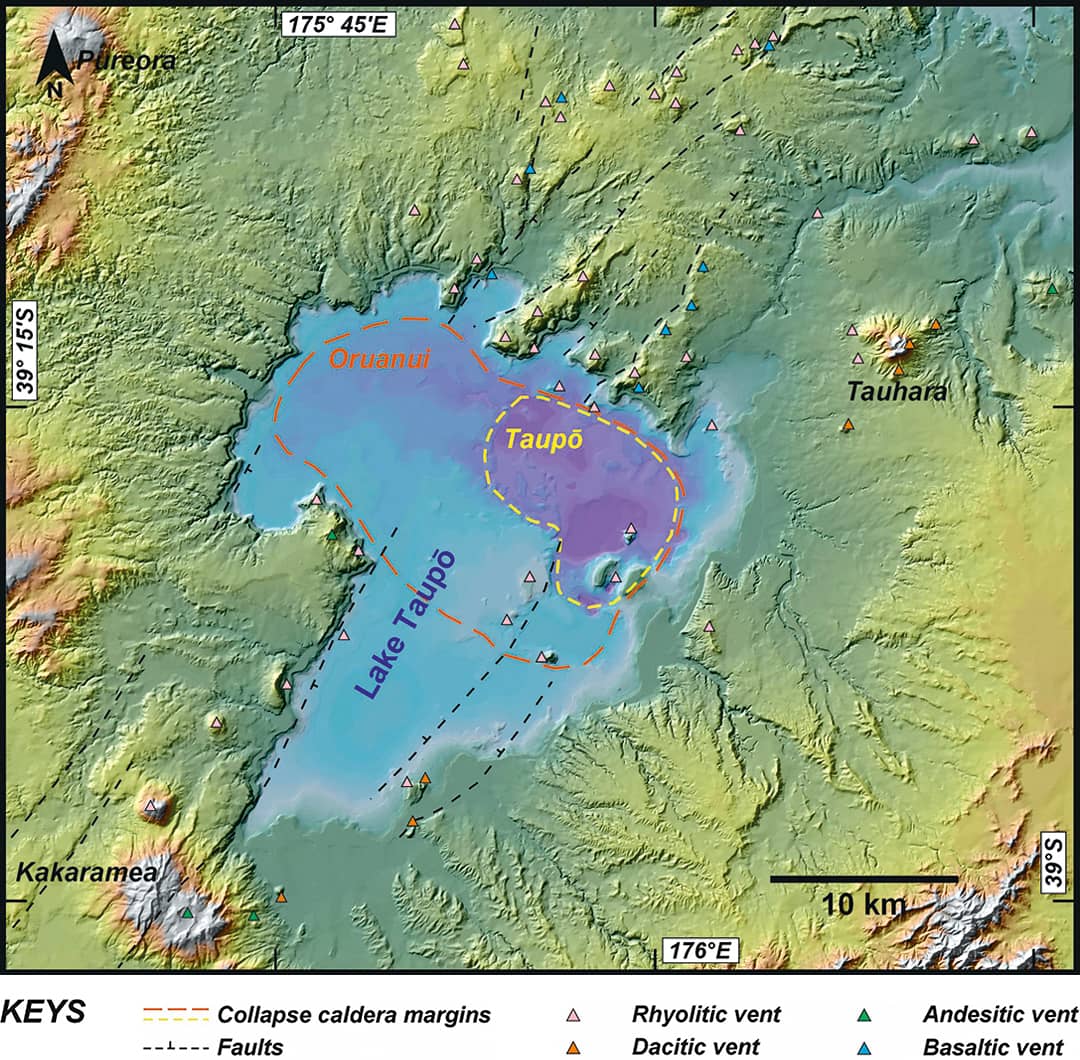
Ignimbrite-dominated landscape of the Taupo Volcanic System, showing dispersed vents associated with lava-dominated volcanic edifices surrounding Lake Taupo, which occupies the Oruanui collapse structure.
Reference
Barker, S. et al. (2021) “Taupō: an overview of New Zealand’s youngest supervolcano,” New Zealand Journal of Geology and Geophysics, 64(2–3), pp. 320–346. Available at: https://doi.org/10.1080/00288306.2020.1792515.
Kósik, S. et al. (2021) “Shallow subaqueous to emergent intra-caldera silicic volcanism of the Motuoapa Peninsula, Taupo Volcanic Zone, New Zealand – New constraints from geologic mapping, sedimentology and zircon geochronology,” Journal of Volcanology and Geothermal Research, 411, p. 107180. Available at: https://doi.org/10.1016/j.jvolgeores.2021.107180.
Wilson, C.J.N. (2001) “The 26.5ka Oruanui eruption, New Zealand: an introduction and overview,” Journal of Volcanology and Geothermal Research, 112(1), pp. 133–174. Available at: https://doi.org/10.1016/S0377-0273(01)00239-6.
Wilson, C.J.N. and Walker, G.P.L. (1985) “The Taupo Eruption, New Zealand I. General Aspects,” Philosophical Transactions of the Royal Society of London. Series A, Mathematical and Physical Sciences, 314(1529), pp. 199–228.
Author(s)
Szabolcs Kósik.
Horizons Regional Council
Károly Németh.
Saudi Geological Survey, Kingdom of Saudi Arabia