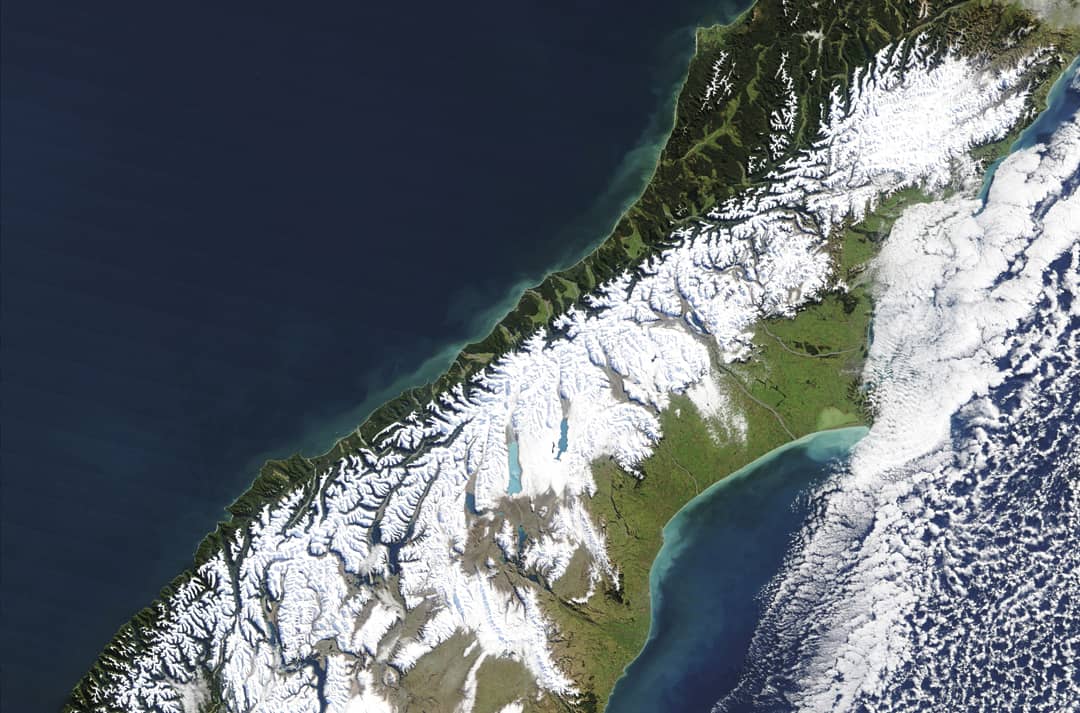
Satellite image of New Zealand’s South Island showing the straight Alpine Fault with the snow-capped Southern Alps uplifted on the east side. (Photo: NASA).
Geological Period
Neogene (Miocene) to Quaternary (Holocene)
Main geological interest
Tectonics
History of geosciences
Location
South Island, New Zealand
44°7’47” S, 168°33’40” E
Satellite image of New Zealand’s South Island showing the straight Alpine Fault with the snow-capped Southern Alps uplifted on the east side. (Photo: NASA).
One of the world's largest on-land transform faults and longest straight-line land feature on Earth.
The 600-kilometer-long Alpine Fault is one of the world’s largest on-land transform faults and arguably has the greatest lateral displacement (480 kilometer). The fault includes the longest (400 kilometer) straight-line land feature on Earth. It is the major driver of the geology, shape and topography of New Zealand’s South Island and is a major tectonic feature within the continent of Zealandia.
Recognition of the fault and its enormous displacement by Harold Wellman in the 1940s-50s predated general acceptance of lateral displacement across faults and contributed to the 1960s-70s global acceptance of the plate tectonics theory.
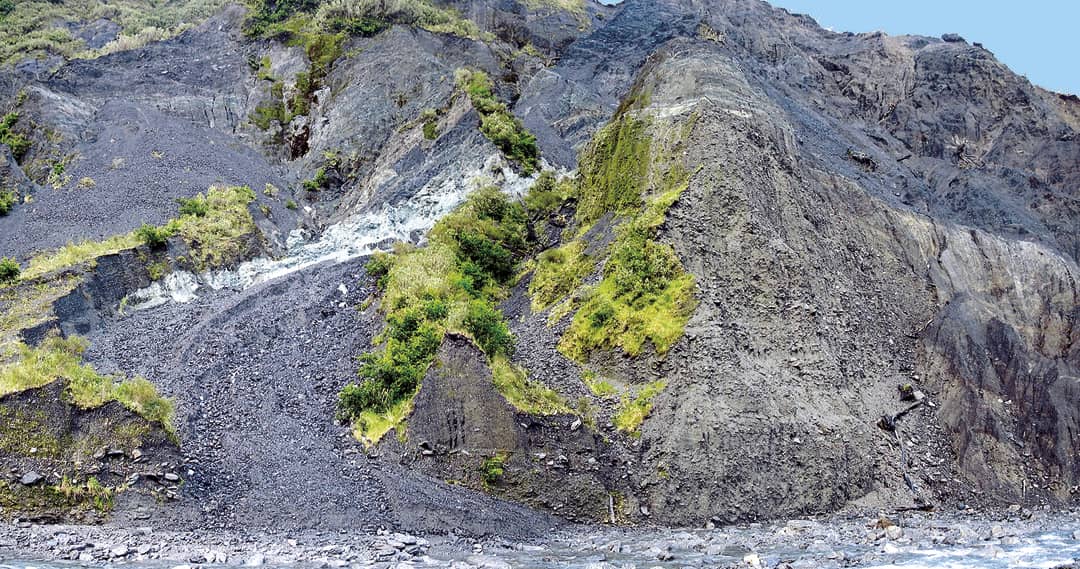
The Alpine Fault with sheared, schist-derived, hydrothermally-atered mylonite (light colour) of the Pacific Plate thrust over Holocene river gravels. Photo 20 meters across.
Geological description
The Alpine Fault through New Zealand’s South Island, is a vital part of the obliquely-convergent boundary between the Pacific and Indo-Australian plates. Uniquely, it links two sectors of subduction with opposite polarity. The straight, southern portion has dextral and vertical displacement components reflecting the oblique convergence. Lateral displacement of 480 kilometers began ~25 Ma and major vertical displacement began ~7 Ma; both became progressively faster through time. Deeply buried metamorphic rocks have been uplifted 20,000 meters on the eastern side and eroded down to form the 3000-4000-meter-high Southern Alps. In the north the fault bends east and splays into several, dominantly strike-slip faults parallel to plate convergence. The Wairau Fault is traditionally considered part of the Alpine Fault because most lateral displacement occurred along it, whereas the Hope Fault is now the most active splay.
Sediment in fault-adjacent lakes records ~25 major rupture events over the last 8000 yrs with a regular spacing of major earthquakes (>8 Mw) of ~290 yrs. The youngest rupture has been dated using dendrochronology of deformed trees at 1717 CE. The next earthquake rupture, of 200 kilometer length or more, is overdue. Coring has identified extreme hydrothermal temperatures in the sheared mylonitised fault zone.
Scientific research and tradition
Initial research (1940s-1970s) focussed on determining the amount, timing and components of displacement and later of the fault’s role in plate tectonic history of New Zealand and formulation of global fault rock classifications. Most recently research has been on the lateral extent and migration of rupture events with its geohazard implications.
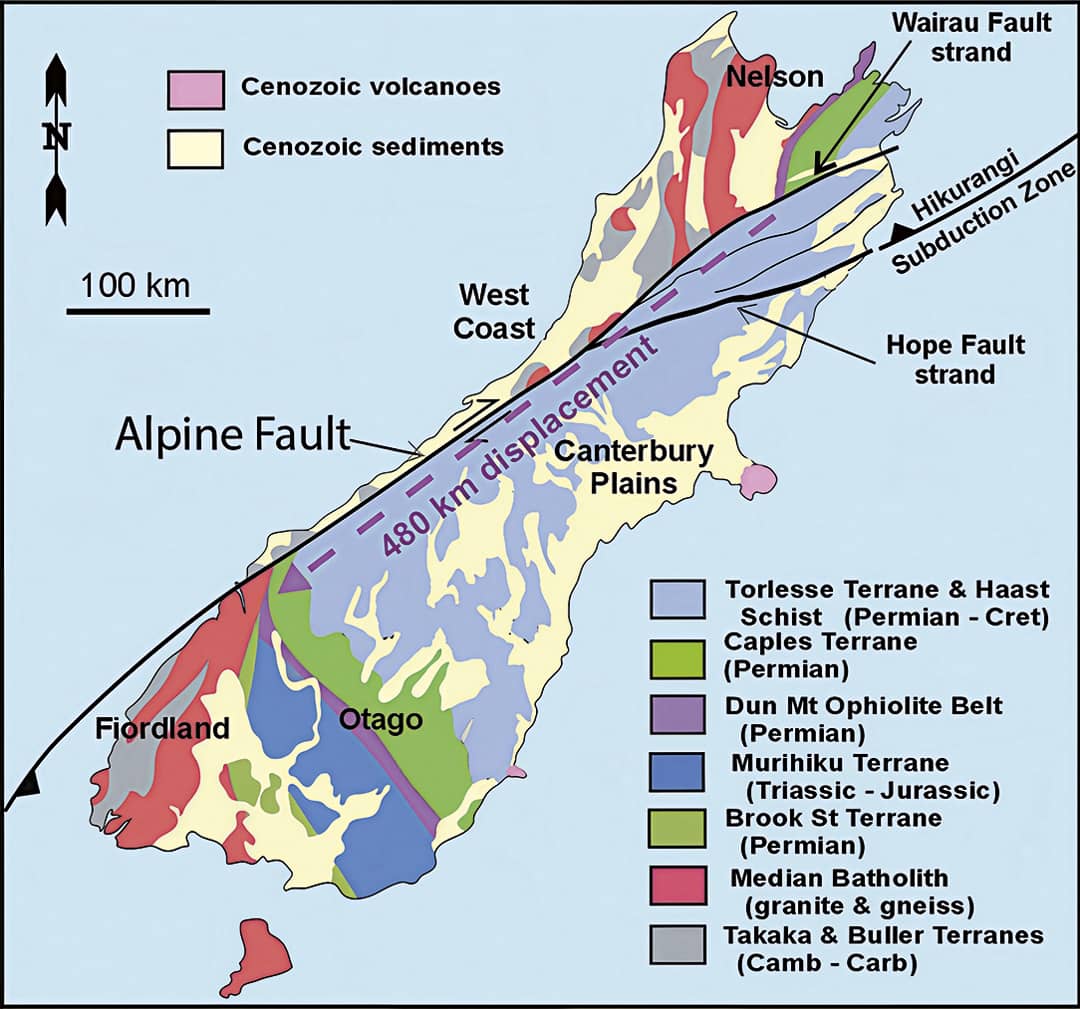
Simplified geological map of New Zealand’s South Island showing the 480 kilometer of lateral displacement of Paleozoic and Mesozoic rocks across the Alpine Fault.
Reference
Barth, N.C. et al. (2024) “Rupture direction of paleoearthquakes on the Alpine Fault, New Zealand, as recorded by curved slickenlines,” Geology, 52(12), pp. 917–921. Available at: https://doi.org/10.1130/G52543.1.
Berryman, K. et al. (2012) “Late Holocene Rupture History of the Alpine Fault in South Westland, New Zealand,” Bulletin of the Seismological Society of America, 102(2), pp. 620–638. Available at: https://doi.org/10.1785/0120110177.
Howarth, J.D. et al. (2021) “Spatiotemporal clustering of great earthquakes on a transform fault controlled by geometry,” Nature Geoscience, 14(5), pp. 314–320. Available at: https://doi.org/10.1038/s41561-021-00721-4.
Miller, M.S., Townend, J. and Lai, V.H. (2024) “The South Island Seismology at the Speed of Light Experiment (SISSLE): Distributed Acoustic Sensing Across and Along the Alpine Fault, South Westland, New Zealand,” Seismological Research Letters, 96(3), pp. 2065–2078. Available at: https://doi.org/10.1785/0220240322.
Sutherland, R. et al. (2017) “Extreme hydrothermal conditions at an active plate-bounding fault,” Nature, 546(7656), pp. 137–140. Available at: https://doi.org/10.1038/nature22355.
Author(s)
Bruce W Hayward.
Geoheritage Subcommittee, Geoscience Society of New Zealand