One of the best-established geological, chronological, and paleoenvironmental frameworks for Palaeolithic occupation in Europe.
The Quaternary fluvial terrace system of the River Somme valley currently constitutes one of the best established geological, chronological and palaeoenvironmental frameworks in Europe for the last million years. Its construction continues today as part of an interdisciplinary team responsible for the discovery of several new major Palaeolithic sites and Quaternary sequences over the last 20 years (Antoine et al., 2007; 2019). Finally, since 2007, 20 of the most representative Quaternary sequences of the area have been the subject of a global geological heritage protection policy with the aim of preserving them for future research projects and young scientists.
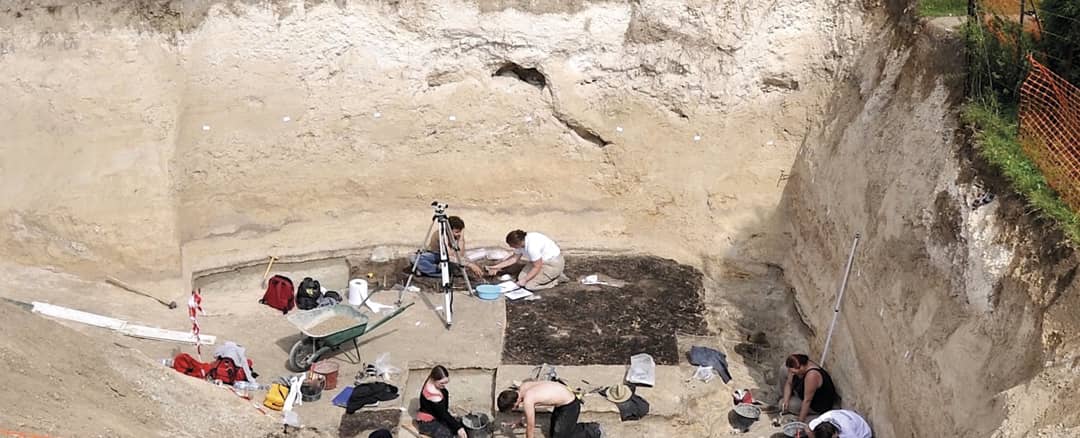
Caours 2008 Palaeolithic excavation: last interglacial calcareous tufa sequence (Eemian: 123 ka) and major Neanderthal site.
Geological description
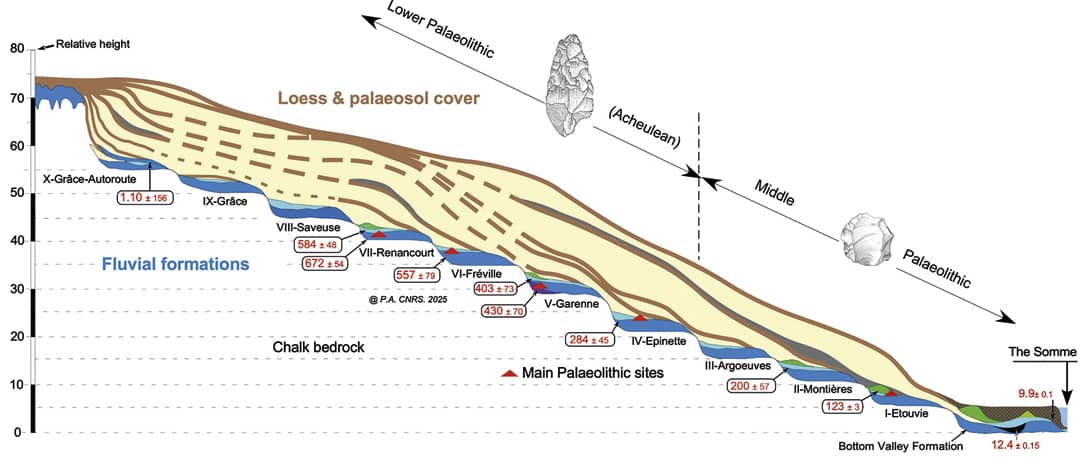
The Somme valley terraces system is made up of 10 alluvial formations incised over the last 1 Ma in the Upper Cretaceous chalk between +5/6 and +55 m above the bedrock of the present-day valley. Each alluvial formation corresponds to the morpho-sedimentary balance of a glacial-interglacial cycle. The typical cycle exhibits three main climatic and environmental phases: phase 1 (Early-glacial): temperate continental climate, boreal forest then steppe, humus-bearing soils, displacement of the valley then vertical incision in the chalk substratum (5 to 6 m), this dynamics leads to the evacuation of most of the sediments previously deposited and the formation of a new terrace; Phase 2 (Full-glacial): cold, arid climate, dust storms and permafrost, open environment with herbaceous vegetation to polar desert; extremely unstable slopes leading to an accumulation of flint and chalk gravels in a valley with multiple mobile channels, and Phase 3 (Interglacial): temperate oceanic climate, sedimentation fed by the flooding of a meandering river, slopes stabilised by vegetation and deep soils; context favourable for the formation of calcareous tufa deposits with encrusted vegetation in the valley. This system is covered by loess-palaeosols sequences up to ten metres thick, which have recorded glacial-interglacial dynamics since around 750 ka.
Scientific research and tradition
Since the mid-19th century, the Somme valley has been at the centre of scientific research into the earliest human settlements in Europe and Quaternary geology (Boucher de Perthes, 1847; Prestwich, 1859; Commont, 1909). It is the place where the antiquity of humankind was first recognised, leading to the emergence of prehistoric science and laying the foundations for the interdisciplinary approach combining geology and archaeology (Bourdier, 1974) that is still in use today.
The system of Quaternary alluvial terraces in the middle Somme valley: morpho-stratigraphic summary, dating and location of the main Palaeolithic sites (Antoine et al., 2007).
Reference
Antoine, P. et al. (2007) “Pleistocene fluvial terraces from northern France (Seine, Yonne, Somme): synthesis, and new results from interglacial deposits,” Quaternary Science Reviews, 26(22), pp. 2701–2723. Available at: https://doi.org/10.1016/j.quascirev.2006.01.036.
Antoine, P. et al. (2019) “The earliest evidence of Acheulian occupation in Northwest Europe and the rediscovery of the Moulin Quignon site, Somme valley, France,” Scientific Reports, 9(1), p. 13091. Available at: https://doi.org/10.1038/s41598-019-49400-w.
Boucher de Perthes, M. (Jacques) (1847) Antiquités celtiques et antédiluviennes. Mémoire sur l’industrie primitive et les arts à leur origine. Paris, Treuttel et Wurtz, Dumoulin & Didron. Available at: http://archive.org/details/antiquitsceltiq00pertgoog.
Bourdier, F. (ed.) (1974) ”Quaternaire et Paléolithique des bassins de la Somme et de la Basse-Seine”, Bulletin de l’Association Française pour l’Etude du Quaternaire, 11 (3-4), 103-273. Available at: https://www.persee.fr/issue/quate_0004-5500_1974_num_11_3.
Commont, V. (1909) Saint-Acheul et Montières: notes de géologie, de paléontologie et de préhistoire. Lille: Liégeois-Six Mémoires de la société Géologique du Nord – 6 (3), 1-68.
Prestwich, J. (1859) “Sur la découverte d’instruments en silex asso¬ciés à des restes de mammifères d’espèces perdues dans des couches non remaniées d’une formation géologique récente.,” Compte Rendus de l’Académie des Sciences, 49, pp. 634–636.
Author(s)
Pierre Antoine.
CNRS-Univ. Paris I & UPEC « Laboratoire de Géographie Physique, Environnements Quaternaires et Actuels » Thiais, France
Nicole Limondin-Lozouet.
CNRS-Univ. Paris I & UPEC « Laboratoire de Géographie Physique, Environnements Quaternaires et Actuels » Thiais, France
Julie Dabkowski.
CNRS-Univ. Paris I & UPEC « Laboratoire de Géographie Physique, Environnements Quaternaires et Actuels » Thiais, France
Jean-Luc Locht.
Institut National de la Recherche en Archéologie Préventive Nord-Picardie, Direction régionale Hauts-de-France, Glisy, France
Jean-Jacques Bahain.
Muséum National d’Histoire Naturelle-CNRS & UPVD « Histoire naturelle de l’Homme préhistorique » Paris, France
Pierre Voinchet.
Muséum National d’Histoire Naturelle-CNRS & UPVD « Histoire naturelle de l’Homme préhistorique » Paris, France
Marie-Hélène Moncel.
Muséum National d’Histoire Naturelle-CNRS & UPVD « Histoire naturelle de l’Homme préhistorique » Paris, France
Patrick Auguste.
CNRS & Univ. des Sciences et Techniques de Lille « Evo-Eco-Paléo » Villeneuve d’Ascq, France