Tsunamite deposits associated with the Chicxulub Impact in La Popa Basin
Mexico
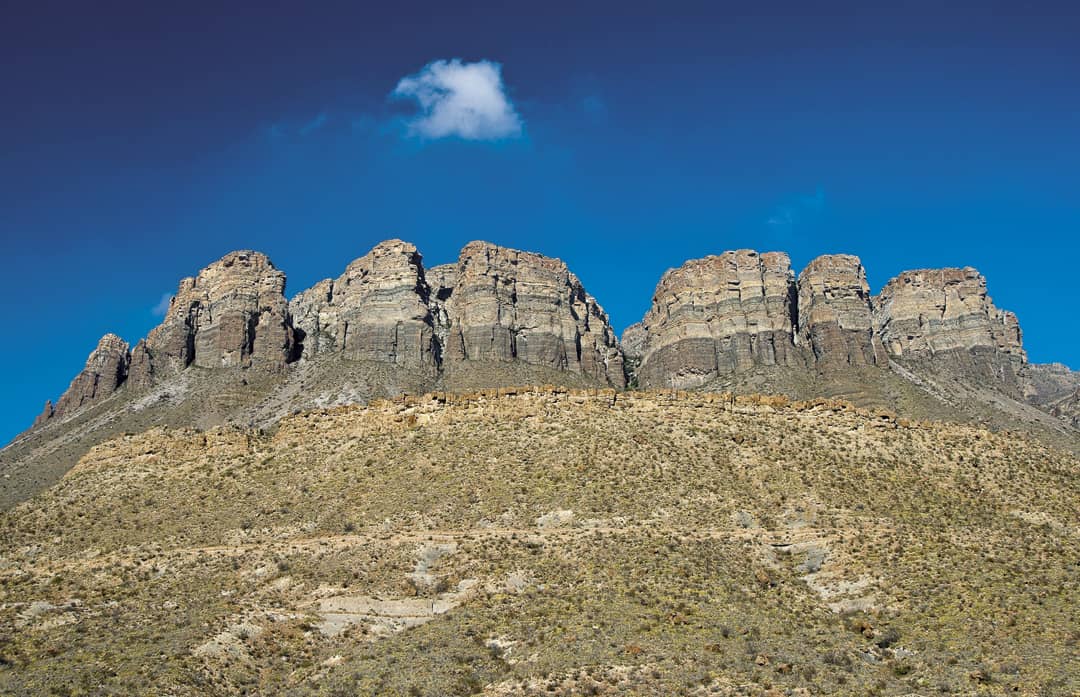
Delgado Sandstone Member, K-Pg boundary differentiated in dark ochre color by Maastrichtian siltstone and in light color by Paleocene shale and sandstone (Photo: Peter Schulte).
Geological Period
Cretaceous (Late Cretaceous) to Paleogene (Paleocene) boundary
Main geological interest
Stratigraphy and sedimentology
Impact structures and extraterrestrial rocks
Location
Monterrey, Nuevo León, Mexico
26°2’45” N, 100°43’13” W
Delgado Sandstone Member, K-Pg boundary differentiated in dark ochre color by Maastrichtian siltstone and in light color by Paleocene shale and sandstone (Photo: Peter Schulte).
The stratigraphic record of the tsunami created by the impact that caused the Cretaceous–Paleogene boundary mass extinction.
The La Popa Basin in northeastern Mexico preserves one of the most spectacular and best-exposed tsunami deposits generated by the Chicxulub impact. The site contains ejecta spherules, reworked fossil assemblages, and impact-related sedimentary structures that provide direct evidence of the catastrophic marine processes triggered immediately after the impact. Its exceptional preservation, accessibility, and scientific documentation makes it a key reference locality for understanding impact-generated tsunamis, post-impact sedimentation, and the environmental changes associated with the Cretaceous–Paleogene mass extinction.
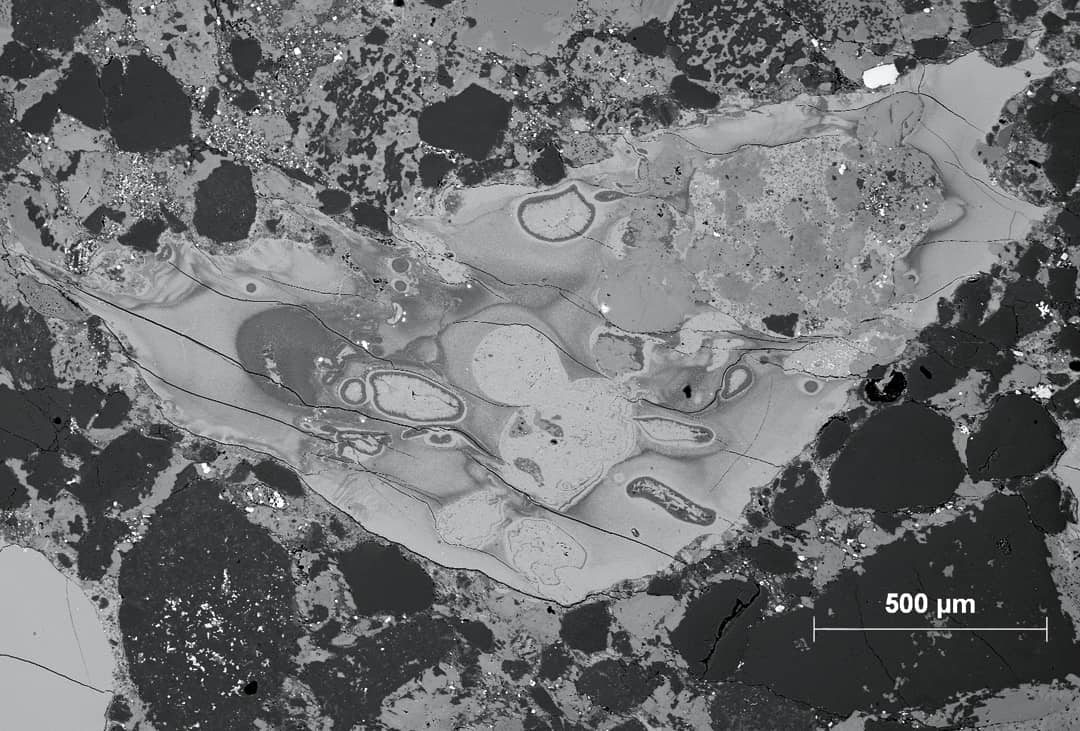
Back-scattered electron image of a typical spherule from the Cretaceous-Paleogene boundary event bed. Note that the spherule is rich in iron and magnesium, appearing as brighter areas. (Photo: Dr. Peter Schulte).
Geological description
Mexico contains several sites of exceptional scientific importance that document the Cretaceous–Paleogene (K–Pg) boundary associated with the Chicxulub asteroid impact approximately 66 million years ago. Among them, the La Popa Basin in northeastern Mexico, about 40 km northwest of Monterrey, stands out for preserving remarkable tsunamite deposits generated by the tsunami triggered immediately after the impact (Prost, 2020). The site complements other K–Pg boundary sections in northeastern Mexico, including El Mimbral and El Mulato, which document the Chicxulub impact and associated tsunami deposits (Lawton et al., 2005; Schulte et al., 2010).
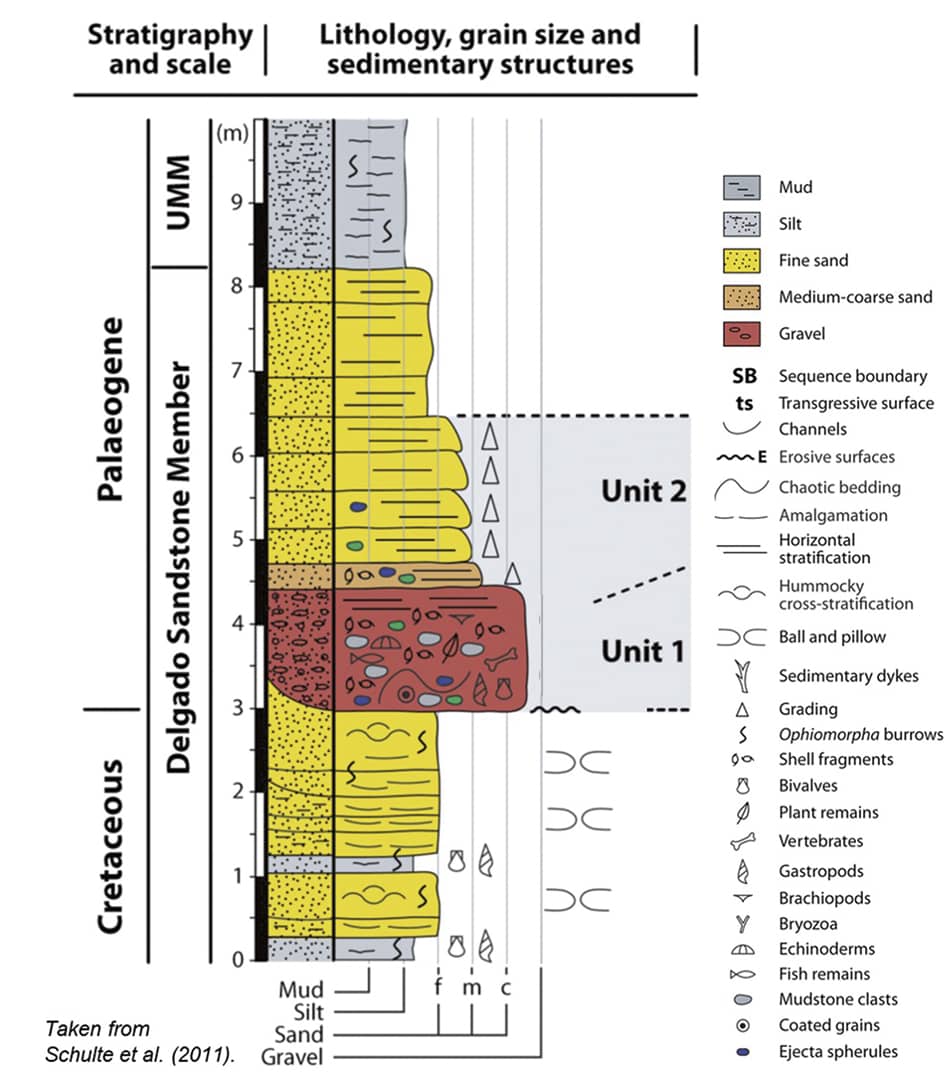
The site is located within the Difunta Group, specifically the Delgado Sandstone Member of the Potrerillos Formation, and comprises two sedimentary units. The lower unit is a conglomerate containing reworked fossils and impact ejecta spherules within a calcareous matrix. The upper unit consists of conglomeratic sandstone enriched in ejecta spherules and fossil material, overlying parallel-laminated sandstone.
These tsunami-related deposits are exceptionally preserved due to the influence of the El Papalote diapir. Their preservation provides an outstanding record of impact-related marine sedimentation and valuable insights into post-impact processes and environmental changes associated with the mass extinction (Schulte et al., 2012).
Scientific research and tradition
The site has been extensively investigated for more than two decades through sedimentological, paleontological, geochemical, and stratigraphic studies. Its impact ejecta, tsunami deposits, and fossil assemblages have made it a key reference locality for understanding the immediate aftermath of the Chicxulub impact and the Cretaceous–Paleogene mass extinction.
Stratigraphy of the K-Pg boundary in La Popa Basin. Taken from Schulte et al. (2012).
Reference
Amezcua, N. and Schulte, P. (2024) “Tsunamita del Chicxulub y el límite cretácico-paleógeno. La gran ola, el meteorito y el adiós de los dinosaurios,” in L. Carcavilla Urquí et al. (eds.) Sitios de interés geológico de Iberoamérica. Asociación de Servicios de Geología y Minería Iberoamericanos, pp. 341–345. Available at: https://digital.csic.es/handle/10261/384423.
Lawton, T.F., Giles, K.A. and Vega, F.J. (2005) “Basinward transport of Chicxulub ejecta by tsunami-induced backflow, La Popa basin, NE Mexico: Comment and Reply: REPLY,” Geology, 33(1), pp. e88–e89. Available at: https://doi.org/10.1130/0091-7613-33.1.e89.
Prost, G.L. (2020) “La Popa Basin and Sierra Madre Oriental: Monterrey-Saltillo-Linares Loop, Nuevo León and Coahuila, Mexico,” North America’s Natural Wonders. CRC Press, p. 74. Available at: https://doi.org/10.1201/9781003015468.
Schulte, P. et al. (2010) “The Chicxulub Asteroid Impact and Mass Extinction at the Cretaceous-Paleogene Boundary,” Science, 327(5970), pp. 1214–1218. Available at: https://doi.org/10.1126/science.1177265.
Schulte, P. et al. (2012) “Tsunami backwash deposits with Chicxulub impact ejecta and dinosaur remains from the Cretaceous–Palaeogene boundary in the La Popa Basin, Mexico,” Sedimentology, 59(3), pp. 737–765. Available at: https://doi.org/10.1111/j.1365-3091.2011.01274.x.
Shanmugam, G. (2006) “The Tsunamite Problem,” Journal of Sedimentary Research, 76(5), pp. 718–730. Available at: https://doi.org/10.2110/jsr.2006.073.
Author(s)
Natalia Amezcua Torres.
Mexican Geological Survey
Peter Schulte.
Consulting geologist
Flor de María Harp Iturribarría.
Mexican Geological Survey
Sofía del Pilar Mendoza Castillo.
Mexican Geological Survey