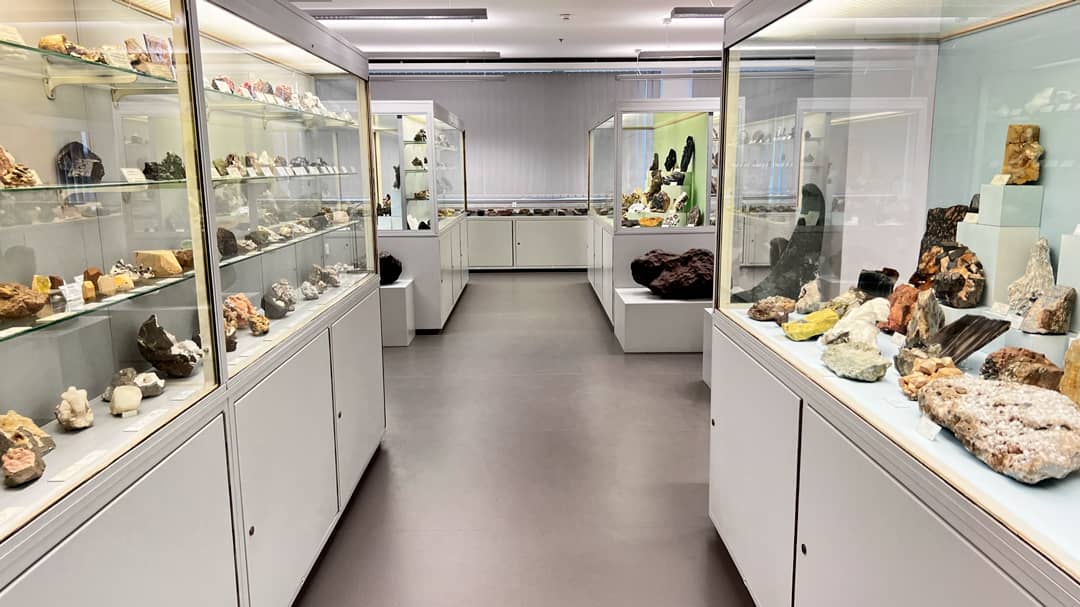
The Mineralogical Collections exhibit ~2000 Minerals in 8 central showcases (arranged according to mineral systematics after Strunz) and circular aligned cabinets showing further topics.
The Mineralogical Collections exhibit ~2000 Minerals in 8 central showcases (arranged according to mineral systematics after Strunz) and circular aligned cabinets showing further topics.
The Mineralogical Collections are an important witness of geo-scientific history and the nucleus of modern mineral systematics.
Geo-collection description
The mineralogical collections are part of the Institute of Applied Geoscience of the TUB and are involved in active student training and research (see detailed publication list of the mineralogical collections following the link in the reference list). Out of the collection’s ca. 200.000 objects, our museum exhibits ca. 2000 selected mineral specimens, plus selected rocks. In principle, the collections represent a compilation of different geo-collections with a focus on minerals. This compilation includes a mineral systematic collection (~ 95.000 objects), a mineralogical archive (~80.000 objects for research purpose), a lecture and exercise collection (~5.000 objects), one of the world’s biggest crystal model collections (~3.500 models), a rock and ore collection (~3000 objects) and a small paleontological collection (~1000 selected objects).
While the origin of the collections goes principally back to the founding (1770) of the Mining Academy of Berlin (founded by King Frederic (II.) the Great; predecessor institution of TU Berlin), the Royal Mineral Cabinet was officially founded in 1781. During the last ~250 years famous scientists (of global importance) have shape the collections (Strunz, 1970): e.g., Christian S. Weiss, Gustav Rose, Carl Rammelsberg, Paul Ramdohr, Hugo Strunz and Christel Tennyson.
Geo-collection value
We are one of Germany’s oldest and largest mineral collections. The museum shows the largest in Germany exhibited iron meteorite (550 kg, Gibeon, Namibia), and numerous outstanding mineral specimens (type and exotic minerals from now inaccessible localities: e.g., Hagendorf, Germany and Tsumeb, Namibia). The focus, however, lies on the mineral systematic exhibition and typical specimens for various areas of mineral formation, plus changing special topics (currently crystal twinning/epitaxy). Historically, the collections were used to develop the specific fields of expertise of several important scientists. One of the most important examples are certainly Hugo Strunz and Christel Tennyson, who developed the modern mineral systematics, which represents the official IMA verified classification of minerals (Strunz & Nickel, 2001). Until today, the exhibition is organized according to the original exhibition concept of Strunz. Both, national and international student classes, and German school classes visit the museum (and use our workshops about different mineralogical topics) for teaching purposes. Furthermore, the TUB currently builds a new additional exhibition building (as part of the collections), which aim to highlight the origin, application, and importance of minerals in our past, present and future society through a modern exhibition.
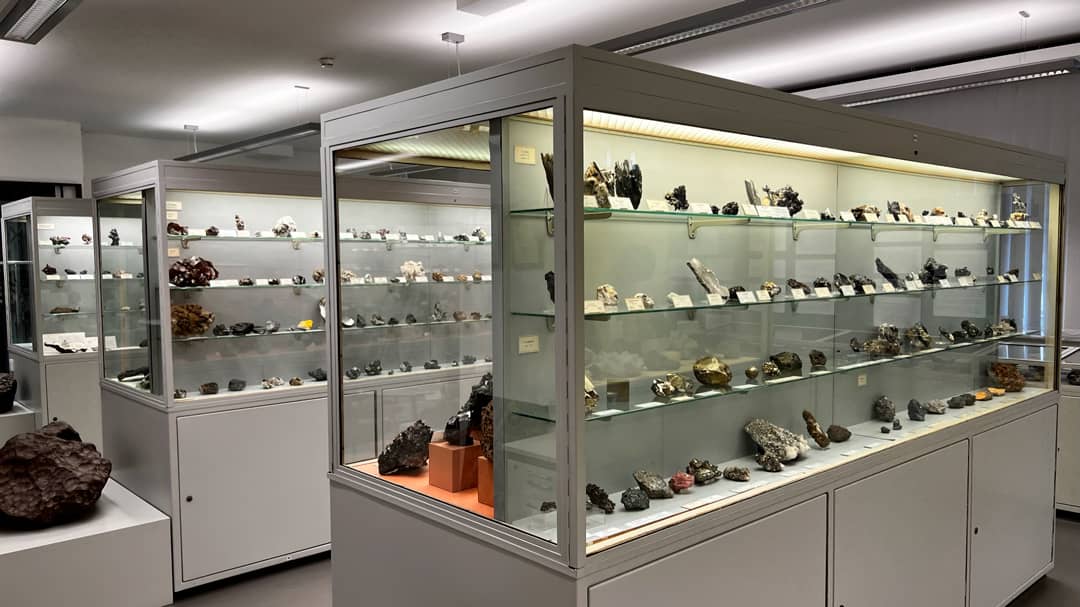
View from behind. While the front part of the showcases display exceptionally aesthetic specimens, the rear part reveals the diversity of the different mineral classes.
Reference
Strunz, H. & Nickel, E. (2001): Strunz Mineralogical Tables. Chemical Structural Mineral Classification System, 9th ed. 870 pp. Stuttgart: E. Schweizerbart’sche Verlagsbuchhandlung. Numerous reprints and translations.
Strunz, H. (1970): Von der Bergakademie zur Technischen Universität Berlin: 1770 – 1970. 151 pp. Berlin: Technische Universität Berlin. Please find an English abstract of the publication at the vend of this file.
Lauterbach, M., Giebel, R.J., Mikloweit, S. (2025): Geoscientific Collections as Spaces of Sedimented Histories. In: S. Mikloweit (ed.), Transpositional Geologies. Berlin: Kerber. P 143- 151.