Three centuries of foraminiferal micropaleontology: the contribution of Beccari, Brady, d’Orbigny, Ellis, Fornasini, Hantken, Plancus, and Soldani to the collection of the Giovanni Capellini Museum.
Three centuries of foraminiferal micropaleontology: the contribution of Beccari, Brady, d’Orbigny, Ellis, Fornasini, Hantken, Plancus, and Soldani to the collection of the Giovanni Capellini Museum.
From Ammonite to Ammonia: three centuries of history of foraminiferal micropaleontology in the collection of the Giovanni Capellini Museum (Italy).
Geo-collection description
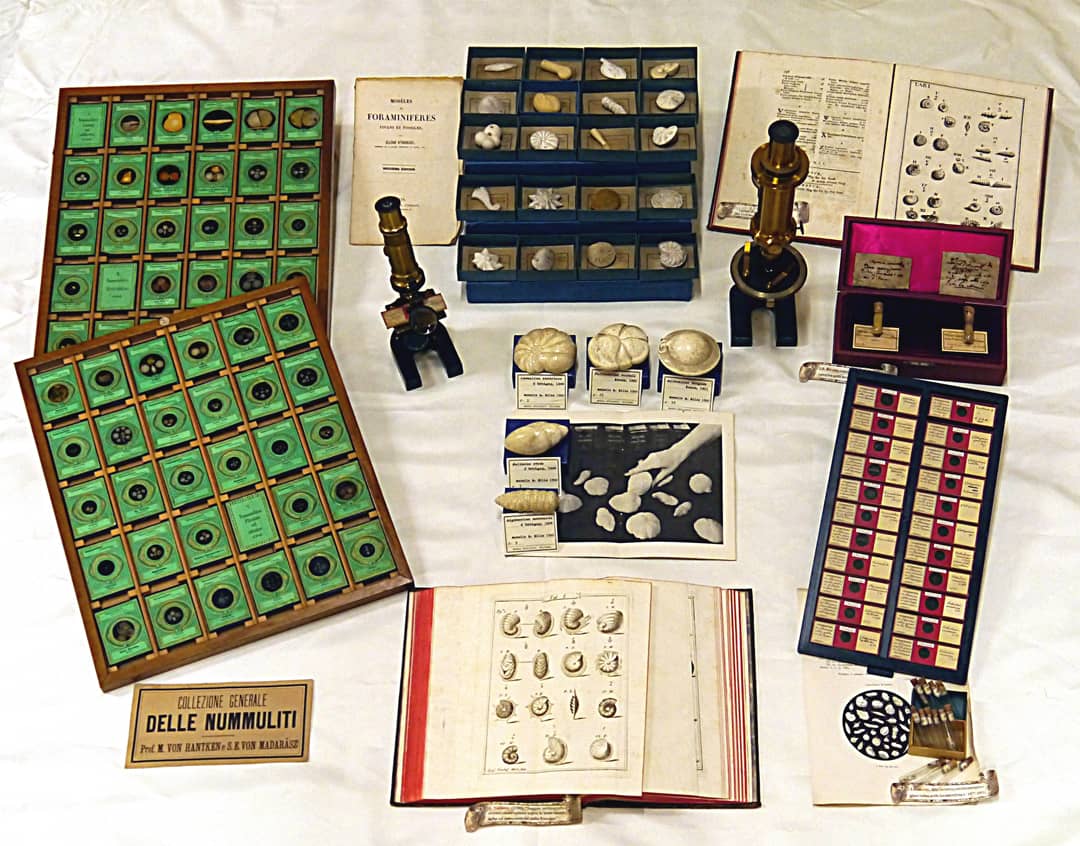
The Giovanni Capellini Museum (University of Bologna), the oldest paleontological museum in Italy, still occupies its original 19th-century galleries and houses one of Europe’s major fossil repositories. The foraminiferal collection assembled from the 18th century, comprises c. 10.000 specimens mounted on c. 1.000 slides or stored in glass tubes, c. 150 enlarged foraminifera models (19th-20th centuries), four historical microscopes (17th-20th centuries), and a specialized library (18th-20th centuries).
The oldest (18th-19th centuries) material was acquired by Giovanni Capellini (1833–1922) and Carlo Fornasini (1854–1931) through exchanges and donations – often documented in informative letters – and from the former Museum of the Institute of Sciences (founded in 1711). 20th-21st century holdings include foraminifera holo- and paratypes and an extensive set of planktonic topotypes collected by Raimondo Selli (1916–1983) through collaborations with the original authors (including Bermúdez, Bolli, Borsetti, Cita, Jenkins, Parker, Perconig, Saito and Todd). Since 2017, the collection has undergone systematic curation, resulting in several publications (Vaiani et al. 2019; Vaiani and Borsetti 2025) and a new permanent display of the most historically and scientifically significant material enhancing it heritage value (Vaiani et al. 2021).
Geo-collection value
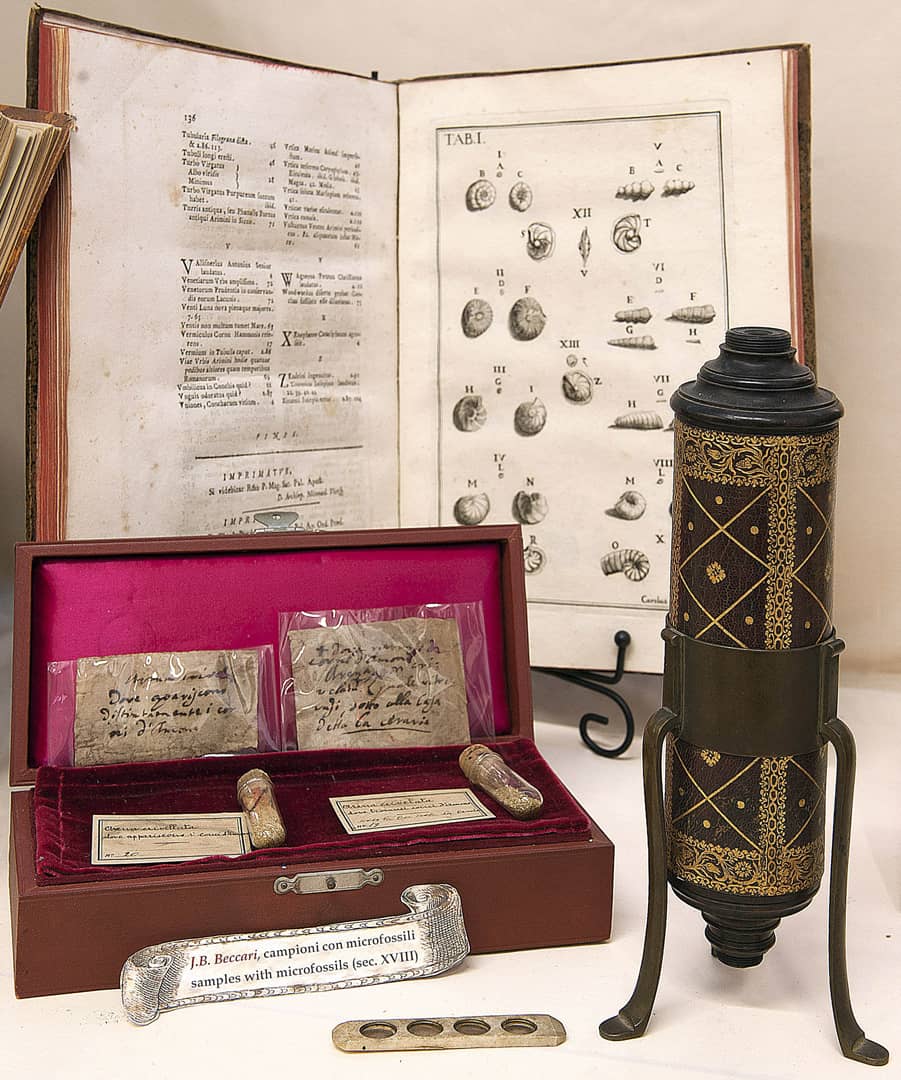
The collection’s significance lies in its breadth, assembled over three centuries, and the presence of unique items for the history of micropaleontology. Notable items include the Jacopo Bartolomeo Beccari’s (1682–1766) original samples, in which the first fossil foraminifera were studied accompanied by his 17th-century microscope, and the “Tableau Berthelin-Fornasini”, a handwritten copy of d’Orbigny’s Tableau méthodique. This manuscript, inherited by Carlo Fornasini, contains sketches of unpublished species by d’Orbigny, meticulously copied by Georges Berthelin at the end of the 19th century. Other highlights include 100 d’Orbigny foraminifera models and 114 of Hantken-Madarász’s prizewinning “green cassettes”, Nummulitidae slides awarded the gold medal at the 1873 Vienna Universal Exhibition (Seddighi et al. 2025). Complementary resources encompass volumes with foraminifera plates (among the oldest those by Plancus 1739, Gualtieri 1742, Soldani 1780, Walker and Boys 1784), major works by d’Orbigny and the Brady’s masterpiece (1884); slides and glass tubes, many bearing type material (Vaiani 2025), prepared by leading 19th– 20th-century micropaleontologists (e.g. Brady, Fornasini, Goës, Hantken, Heron-Allen, Karrer, Millett, Sherborn); research and teaching apparatus, such as microscopes, illuminators and enlarged foraminifera models, including those by Ellis (1950). Collectively, these assets constitute a unique heritage resource of exceptional scientific, historical and educational value.
Samples and microscope used by Jacopo Bartolomeo Beccari for the first micropaleontological analysis (1711). In the background the earliest illustration of Ammonia beccarii (Plancus, 1739).
Reference
Seddighi, M., Vaiani, S.C., Papazzoni, C.A., 2025. Revision of the Hantken-Madarász Nummulites collection (1881) at the Giovanni Capellini Geological Museum (Italy). Micropaleontology 71(3), 209–234.
Vaiani, S.C., 2025. Hantken’s type species of foraminifera from the ‘Clavulina Szabói beds’ preserved at the Giovanni Capellini Geological Museum (Italy). Micropaleontology 71, in press.
Vaiani, S.C., Vai, G.B., Borsetti, A.M., Sarti, C., 2019. From Ammonites to Ammonia, a tale on the early history of micropaleontology by Jacopo Bartolomeo Beccari (1682-1766). Micropaleontology 65(6), 551–560.
Vaiani, S.C., Sarti, C., Barbieri, R., 2021. Announcements – From Ammonite to Ammonia: The History of Foraminiferal Micropaleontology Through the Collections of the Giovanni Capellini Geological Museum (Bologna, Italy). Journal of Foraminiferal Research 51(3), 245–247.
Vaiani, S.C., Borsetti, A.M., 2025. Unilocular hyaline foraminifera of the “Fornasini Collection” at the Giovanni Capellini Geological Museum (Italy). Micropaleontology 71(1), 31–60.