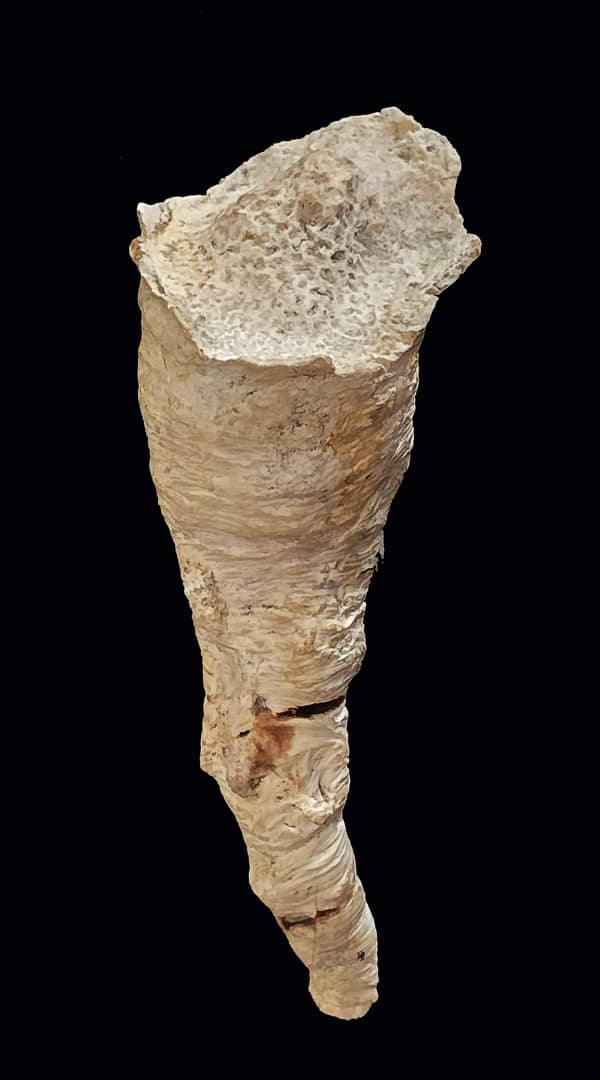
Brachiopoda. Coscinarina communis (Gemmellaro, 1894), Permian, Sosio Valley, Palazzo Adriano (Palermo, Sicily, Italy). Type specimen, MGUP-001.412.1; height 9 cm. Photo Carolina D’Arpa.
A unique snapshot of the latest Paleozoic framework of Permian seafloors and reefs in the Paleothetys realm.
Geo-collection description
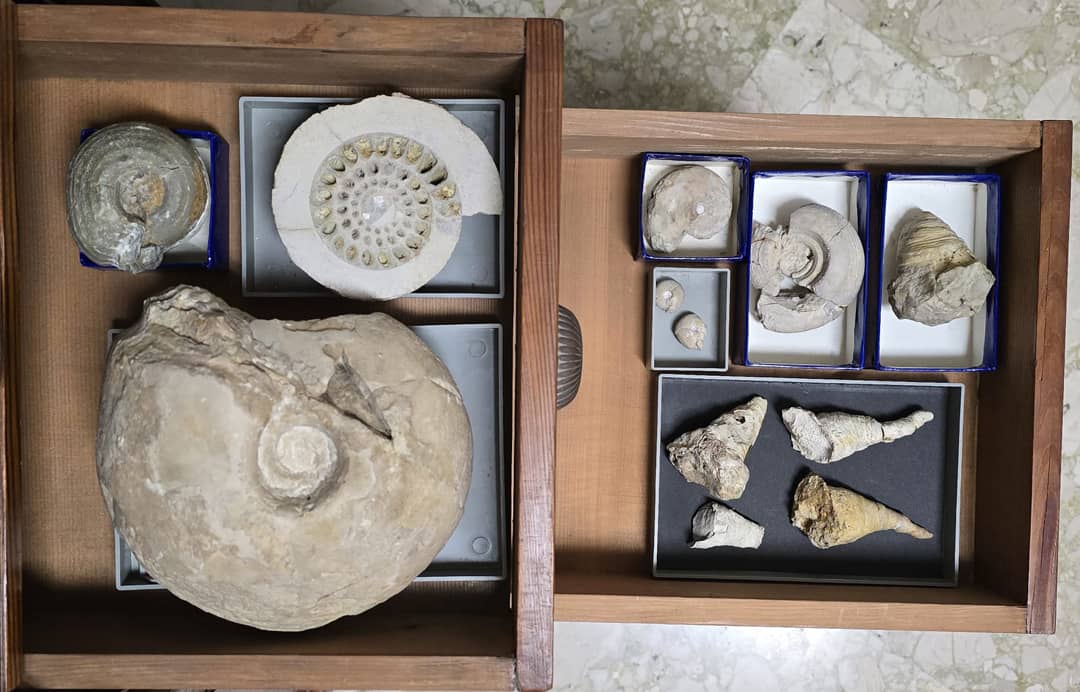
Late Permian invertebrate fossils from the Sosio Valley (Palazzo Adriano). The value of the collection lies in the extraordinary fossil content of the rock blocks, in terms of abundance, preservation, and diversity of the association. It represents a unique feature within the paleontological record of the Euro-Mediterranean region, where rocks of this age are typically either barren of fossils or yield only sparse and poorly preserved material. The exceptional preservation of brachiopods, mollusks, sponges, crinoids, serpulids, trilobites and corals within olistostromal blocks provide a unique snapshot of the latest Paleozoic pelagic and reef-associated communities in the Paleothetys realm, allowing the reconstruction of Permian benthic–pelagic interactions and depositional environments. Gemmellaro, 1899 established dozens of new species, still considered valid today, which were later recognized in sedimentary successions worldwide. New genera and species were also identified and established in the twentieth century (Yancey, 2024) and even today the collection on display, as well as that stored in the museum’s deposits, continues to attract specialists from all over the world.
Geo-collection value
The collection holds scientific, historical, cultural, and educational value. Its scientific value is underscored by the hundreds of type specimens of invertebrate species it contains, serving as a reference for specialists worldwide. Equally important is its paleoenvironmental significance, as an indicator and example of a Late Paleozoic Paleotethys seafloors and reef environment (Channell et al, 2022; Robertson et al. 2022; Korte et al., 2005). In attachment, a selection of bibliographic references that, since the late nineteenth century, deals with the Permian Sosio fauna (Attachment 1).
The historical value of the collection lies in the method of acquisition and cataloging of specimens in the second half of the nineteenth century, and how Gemmellaro made this known to European specialists. These methods intertwine with the naturalistic culture of the time, the history of the University of Palermo, and the Chair of Natural History and Geology.
The cultural value of the collection is determined by its museum placement and represents an important milestone in the Natural History of the island and the Mediterranean region.
The educational value of the collection is reflected in its use by a considerable number of visitors, approximately 30,000 per year of which students represent a significant portion. As part of the museum’s exhibition pathway, the collection serves as an educational tool for the knowledge, protection, and conservation of natural heritage.
The specimen cabinet for the collection “La fauna dei calcari con Fusulina della Valle del fiume Sosio”.
Reference
Channell, J.E.T., Muttoni, G., Kent, D.V. (2022): Adria in Mediterranean paleogeography, the origin of the Ionian Sea, and Permo-Triassic configurations of Pangea. Earth Science Reviews, 230, 104045.
Robertson, A.H.F. (2022): Palaeozoic-Early Mesozoic transition from Palaeotethys to Neotethys: Synthesis of data and interpretations from the northern periphery of Gondwana (central and western Anatolia, Aegean, Balkans and Sicily). Earth Science Reviews, 230, 799–804.
Korte, C., Jasper, T., Kozur, H.W., Veizer, J. (2005): δ18O and δ13C of Permian brachiopods: A record of seawater evolution and continental glaciation. Palaeogeography Palaeoclimatology Palaeoecology, 224(4), 333–351.
* Gemmellaro, G.G. (1899).:La fauna dei calcari con Fusulina della Valle del fiume Sosio nella provincia di Palermo. Editore Michele Amenta, Palermo. 2 vol., 1-375,1- 42 pl.
Yancey T.E. (2024): Revision of Late Paleozoic Pinnid Genera and North American Species of Bivalve Family Pinnidae. American Paleontology Bulletins, 410, 1-83.