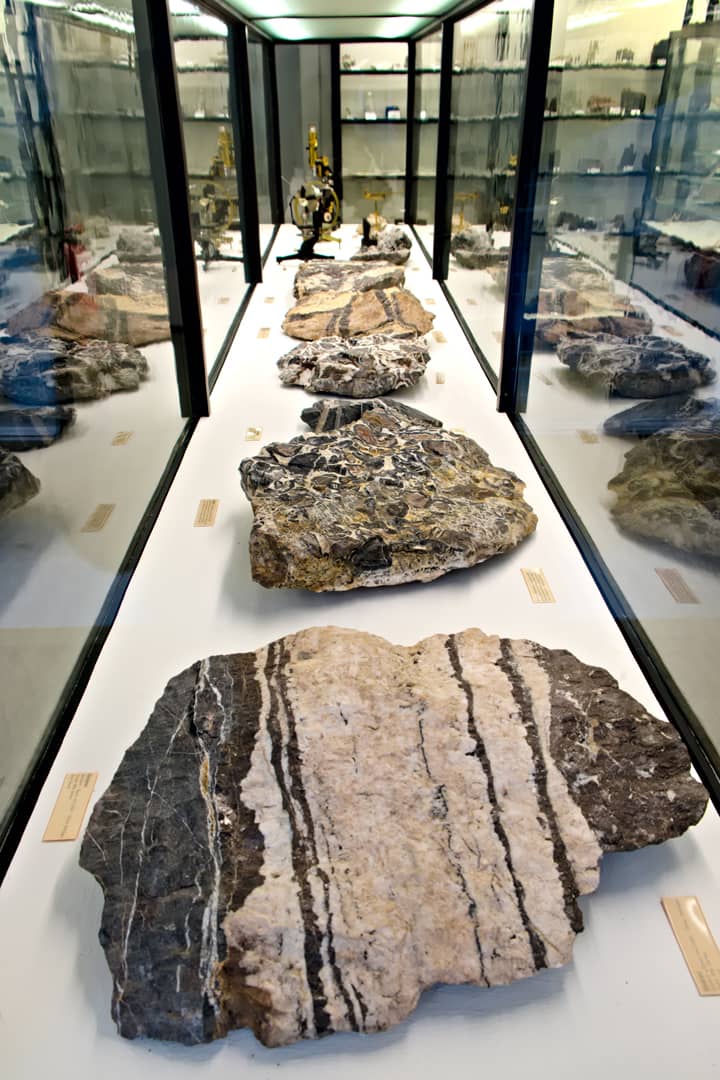
Samples from the Harz Mountain Pb-Zn-Cu ores, which are the unique selling point of the collection. No more samples of this kind can be retrieved.
No other collection exists with such unique Harz Mountain (ore) specimens, representing the significant cultural, historical, and geoscientific heritage.
Geo-collection description
The origin of the mineral collection goes back to the teaching collection, established in 1775 for the local miners’ education, which then became later a Bergakademie and ultimately the Clausthal University of Technology (TU Clausthal).
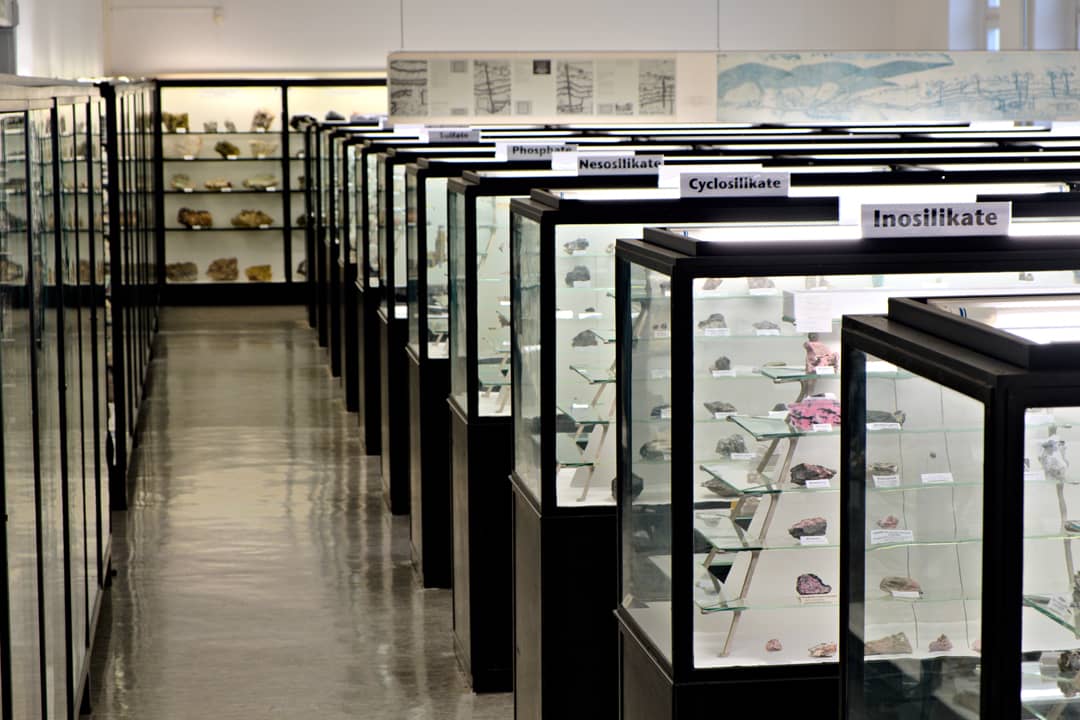
The collection encompasses over 120 000 specimens of minerals, rocks, fossils and meteorites, of which ~8 000 are exhibited. It is divided in different sections such as the evolution of life on Earth, mineral systematics (after Strunz), mineral resources (local and worldwide) and the ‘Harz collection’. The latter is worldwide unique, consisting of many ore samples and individual mineral specimen from the famous ore mines in the Harz Mountains in Germany that are no longer accessible. Focused largely on the W-Harz vein deposits, it contains unique specimens of silver, zinc, and copper ores, which were the backbone for the Middle age wealth of the kings and emperors in Germany. The collection is a witness of the historic mining in the Harz Mountains and the impact on culture and history of Central Europe. The collection also contains rare minerals such as Samsonite1 (Samson mine, St. Andreasberg) or the extremely rare Roterbärite2 (Roter Bär mine, St. Andreasberg), that are featured in scientific publications.
Geo-collection value
The Geosammlung at TU Clausthal has its focus on the educational and scientific part, however, due to its long existence it also has significant historical value. It started as a collection of reference samples for the education of miners and later for mineralogist and geoscientists. It was expanded and is still used in the education at the university and to raise awareness of the significance of minerals in our daily life. Together with the geological rock collection at TU Clausthal and the museum at UNESCO World Heritage mine site of the Rammelsberg it is unique in terms of ore deposits and the geology of the Harz Mountains. Prof. Ramdohr (1890-1985) was a pioneer in the study of opaque minerals. During his time at TU Clausthal he studied samples from the Rammelsberg mine and through his microscopy observations he defined a new type of sedimentary hosted Pb-Zn-Cu deposits. He wrote a textbook that still serves as the standard in ore microscopy3. Many of the locations from where samples in the collection are coming from are no longer accessible. These kinds of samples are of high scientific value in the study of rare minerals and the origin of mineralization in the region4.
Part of the mineral collection contains minerals from all over the world and makes up the systematic mineral collection that is also used for education.
Reference
Fraatz W.S., (1910) Samsonit, ein manganhaltiges Silbermineral von St. Andreasberg im Harz. Zentralblatt für Mineralogie, Geologie und Paläontologie, 1910, 331-335.
Vymazalová A, Cabral AR, Laufek F, Ließmann W, Stanley CJ, Lehmann B (2020) Roterbärite, PdCuBiSe3, a new mineral species from the Roter Bär mine, Harz Mountains, Germany. Mineralogy and Petrology, 114, 443-451.
Ramdohr, P. (1950) Die Erzmineralien und ihre Verwachsungen. Akademie-Verlag Berlin, 1950. pp. xvi + 827.
Cabral AR, van den Kerkhof AM, Sosa GM, Nolte N, Ließmann W, Lehmann B (2018) Clausthalite (PbSe) from the type locality: new observations and implications for metallogenesis in the Harz Mountains, Germany. Ore Geology Reviews, 102, 728-739.