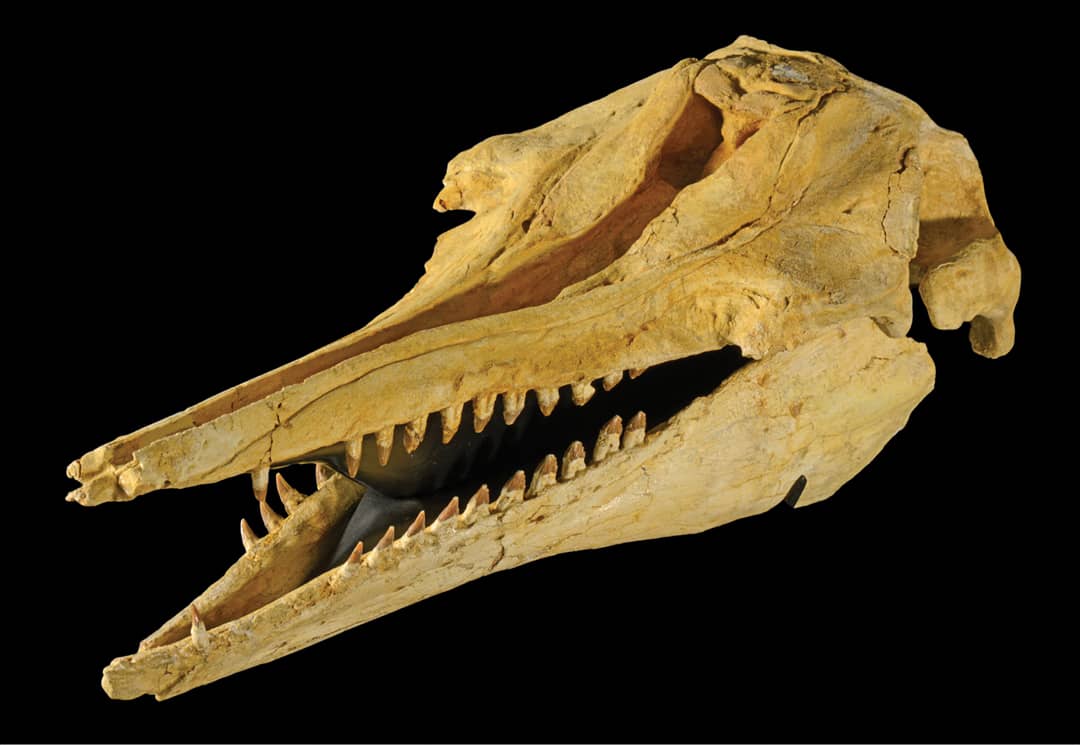
Holotype of Waipatia maerewhenua, a 26-million-year-old archaic dolphin that connects the Oligocene oceans of Zealandia with the endangered Ganges dolphin. Image credit: R Ewan Fordyce.
Housing institution
Department of Geology of the University
Location
Department of Geology, University of Otago, PO Box 56, Dunedin, New Zealand 9045
Holotype of Waipatia maerewhenua, a 26-million-year-old archaic dolphin that connects the Oligocene oceans of Zealandia with the endangered Ganges dolphin. Image credit: R Ewan Fordyce.
Geo-collection description
The University of Otago Geology Museum’s rock, mineral and fossil collections highlight the rich geological history and the evolution of marine and terrestrial biodiversity in Aotearoa New Zealand. Founded in 1869, the University of Otago is New Zealand’s oldest university, and collections date back to the 1870s when Geology and Paleontology were first taught. The Geology Museum has occupied its present site in the Geology Building since 1926 and is used for teaching, research and public engagement. The fossil collections are the pinnacle of the museum, comprising 60,000 catalogued specimens. Fossils of international significance include type specimens of endemic whales, dolphins, sharks, billfish, turtles and penguins (Robinson et al. 2024). Key freshwater animals include all of the world’s Galaxiidae fossils, the only Southern Hemisphere eel fossils, and fossil crayfish and mussels. Thousands of marine invertebrates ranging in age from Cambrian to Recent include holotypes of corals, brachiopods, clams, snails, ostracods, crabs, lobsters and sea urchins, mostly from the South Island of New Zealand. Notable additions include most of New Zealand’s fossils preserved in amber (Schmidt et al. 2018), and all plant and animal fossils, including a diverse array of insects, from the globally significant Foulden Maar (Lee et al. 2002).
Geo-collection value
Visitors to the Geology Museum can explore learning about the ancestors of species living today, including relatives of treasured taonga species with deep local significance, especially from Te Waipounamu, the South Island of New Zealand. The new eBook Fossil Treasures of the Geology Museum (Thomas et al. 2025) also enables readers from around the world to appreciate these renowned collections.
Spanning from the Cambrian period to the present, the collections document the evolution of the globally important marine life and ecosystems of the Southern Ocean. In addition to the treasures on display, the museum features a Fossil Preparation Research Laboratory, where visitors can observe the preparation of research specimens through viewing windows.
Students and scholars from around the world have travelled to Dunedin for more than 150 years to study the rocks and fossils housed within, and to collaborate with the expert staff who have helped to build the Geology Museum into the valuable collection it is today. Today, the Geology Museum serves as an essential earth sciences field trip destination for school groups, a hub for Geology, Zoology, Botany, and Marine Science undergraduates, and a centre for students, visiting researchers, academics, our local communities and wider public.
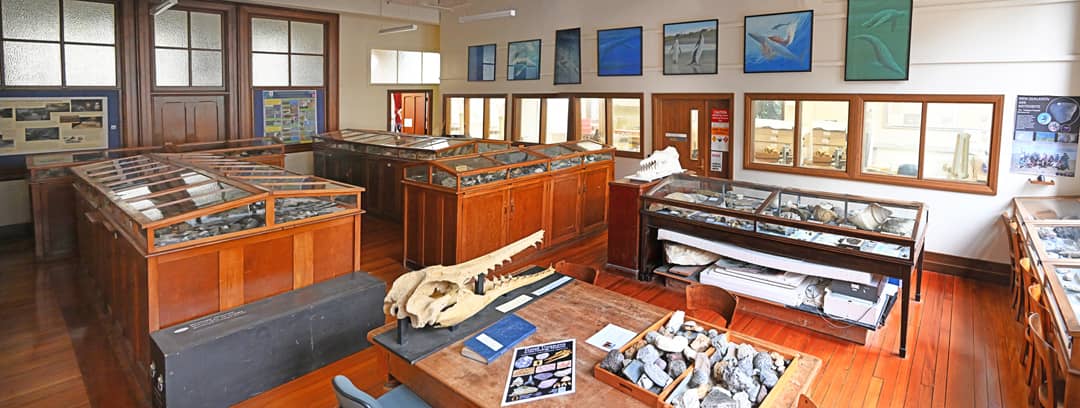
Traditional Victorian display cases and touch specimens in the Geology Museum, featuring the Fossil Preparation Laboratory. Image credit: Ian Thomson.
Robinson, J.H., Lee, D.E., Richards, M.D., White, S.E.M. and Fordyce, R.E. 2024. The fossil vertebrate primary type specimens in the collection of the University of Otago Department of Geology. Journal of the Royal Society of New Zealand, 54: 566–583. https://doi.org/10.1080/03036758.2024.2363436
Lee, D.E., Kaulfuss, U. and Conran, J.G. 2022. Fossil Treasures of Foulden Maar: A Window into Miocene Zealandia. Otago University Press, Dunedin New Zealand. 216 pp.
Slack, K.E., Jones, C.M., Ando, T., Harrison, G.L., Fordyce, R.E., Arnason, U. and Penny, D. 2006. Early penguin fossils, plus mitochondrial genomes, calibrate avian evolution. Molecular Biology and Evolution 23: 1144–1155. https://doi.org/10.1093/molbev/msj124
Schmidt, A.R., Kaulfuss, U., Bannister, J.M., Baranov, V., Beimforde, C., Bleile, N., Borkent, A., Busch, A., Conran, J.G., Engel, M.S., Harvey, M., Kennedy, E.M., Kerr, P.H., Kettunen, E., Kiecksee, A.P., Lengeling, F., Lindqvist, J.K., Maraun, M., Mildenhall, D.C., Perrichot, V., Rikkinen, J., Sadowski, E.-M., Seyfullah, L.J., Stebner, F., Szwedo, J., Ulbrich, P. and Lee, D.E. 2018. Amber inclusions from New Zealand. Gondwana Research 56: 135–146. https://doi.org/10.1016/j.gr.2017.12.003