A unique and comprehensive collection documenting the subsurface geology of the United Kingdom.
Geo-collection description
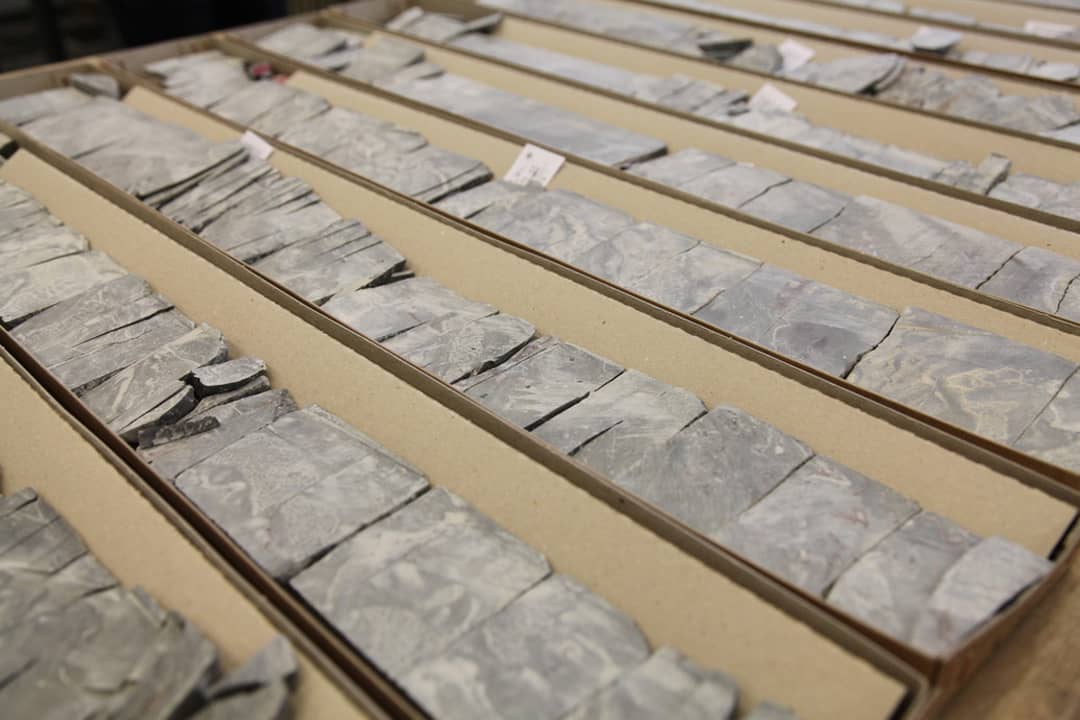
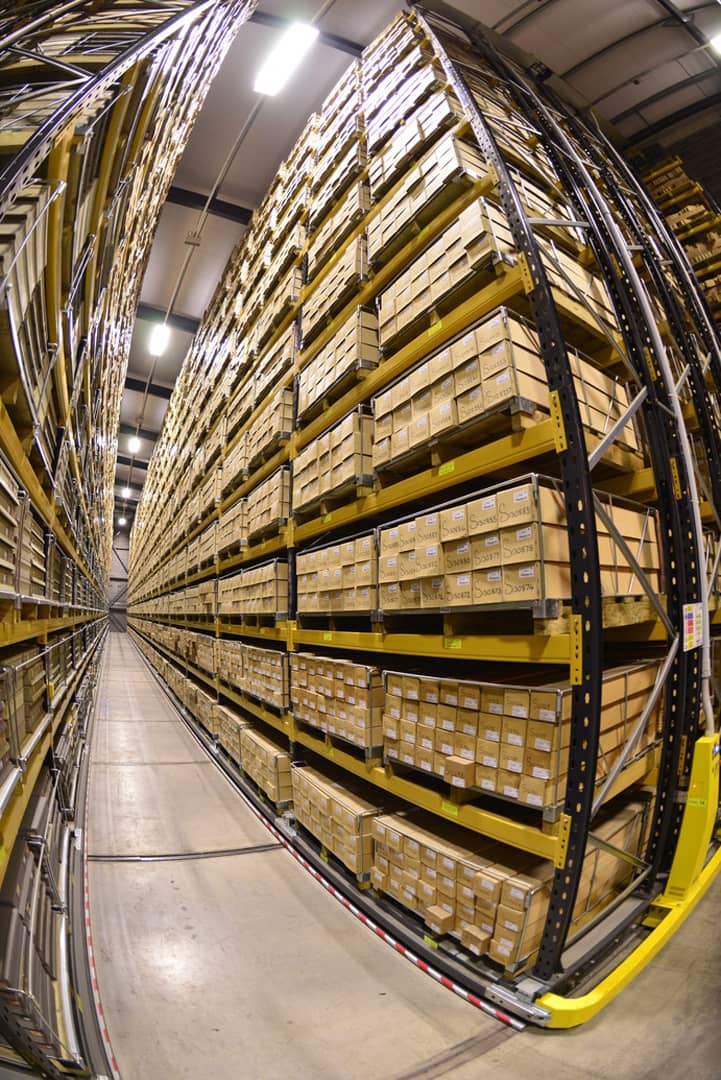
The BGS Collection of UK onshore borehole materials are unrivalled, both in scope and in volume. It consists of drillcore material from across the UK, usually as either continuous lengths or as hand samples extracted to show the fossils present in the core. Extensive characterisation has taken place on many of the samples. The collection is augmented by paper records, processed subsamples, (e.g. thin sections), and digital records.
12,500 individual boreholes represented
200km of continuous drillcore
1,000,000 hand specimens
Assembly of the collection formally began in the 1920’s, but smaller collections of borehole material were already in existence at the Survey, e.g. Portsmouth Harbour dated 1825.
Several pieces of UK legislation are applicable to the collection1, most notably the Geological Survey Act of 18452.
The entire collection is stored at BGS Keyworth, where it supports industry, academia and government policy. Despite developments in geoscience core remains the only direct observation of the subsurface and analysis is critical to the Energy Transition, for example for subsurface storage.
The collection is constantly evolving with UK policy and feeds into our 3D geological model3 of the UK and the nation’s geological survey mapping.
Geo-collection value
Without a collection such as this, our knowledge of the geology of the UK would be limited to surface exposures, natural sections (e.g. coastline) and only the occasional deep insight from mining. Having such a large, well organised collection in one place encourages and supports research activities.
The existence and continuity of the collection enables a huge variety of uses from understanding hydrocarbon prospectivity4 through to the climatic impact of the earth’s orbit5.
Today many uses of the collection are focused on the energy transition, specifically the suitability of UK geology to house a subsurface storage facility. In addition, the collection also informs infrastructure development (e.g. Crossrail London), exploration for critical minerals and identification of sites of interest for geothermal heating and energy.
Alongside this the collection has contributed significantly to UK research and training. The collection was used most recently for the annual meeting of the Tectonic Studies Group and has hosted many summer schools and training courses.
Whilst it is impossible to value to collection itself the cost to acquire the material has been estimated to be in excess of £100bn, notwithstanding the added value of the associated data.
Howe, M. P. A. (2023). The UK National Geological Repository: a case study in innovation. Geological Society, London, Special Publications, 527(1), 333–353. https://doi.org/10.1144/sp527-2022-266
Andrews, I.J. 2013. The Carboniferous Bowland Shale gas study: geology and resource estimation. British Geological Survey for Department of Energy and Climate Change, London, UK. – available at https://nora.nerc.ac.uk/id/eprint/503839/
Hesselbo, S. P., Al-Suwaidi, A., Baker, S. J., Ballabio, G., Belcher, C. M., Bond, A., Boomer, I., Bos, R., Bjerrum, C. J., Bogus, K., Boyle, R., Browning, J. V., Butcher, A. R., Condon, D. J., Copestake, P., Daines, S., Dalby, C., Damaschke, M., Damborenea, S. E., … Zhao, K. (2023). Initial results of coring at Prees, Cheshire Basin, UK (ICDP JET project): towards an integrated stratigraphy, timescale, and Earth system understanding for the Early Jurassic. Scientific Drilling, 32, 1–25. https://doi.org/10.5194/sd-32-1-2023