The Dun Mountain ophiolite belt

New Zealand

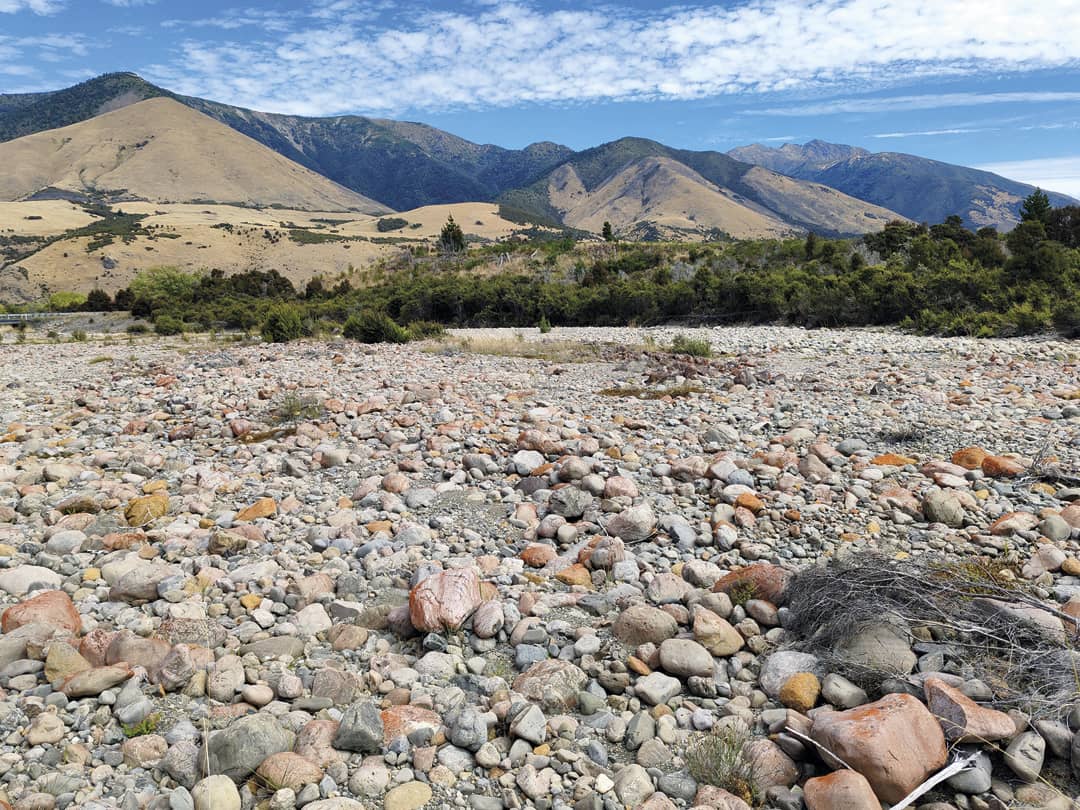
Dunite boulders in the Stoney Stream Wairau River confluence from the Red Hills Ridge (left flat hill) while the Dun Mountain Richmond Range forms the highest distal hill on the right far side of the view.

Geological Period

Permian to Triassic

Main geological interest

History of geosciences
Igneous and Metamorphic petrology

Location

South Island, New Zealand
41°20’32” S, 173°22’24” E

Dunite boulders in the Stoney Stream Wairau River confluence from the Red Hills Ridge (left flat hill) while the Dun Mountain Richmond Range forms the highest distal hill on the right far side of the view.

It exemplifies the full spectrum of mantle-origin olivine-bearing rocks, metasomatized intrusions, and mineralized regions.

The Dun Mountain ophiolite belt consists of a typical ophiolite sequence, featuring ultramafic rocks overlain by a plutonic then volcanic sequence, and finally by conglomerates and other sedimentary rocks of the Maitai Group. Dun Mountain is a narrow ophiolite belt that exposes a complete deep marine to oceanic basaltic crust sequence in narrow tectonic slices. The mountain belt has a reddish color, and the olivine-rich rocks are well exposed, revealing sections of dyke-deep marine sedimentary rock interactions, metasomatized zones of rodingites, and distinct serpentinite sections. Dun Mountain exemplifies the full spectrum of mantle-origin olivine-bearing rocks, metasomatized intrusions, and mineralized regions.

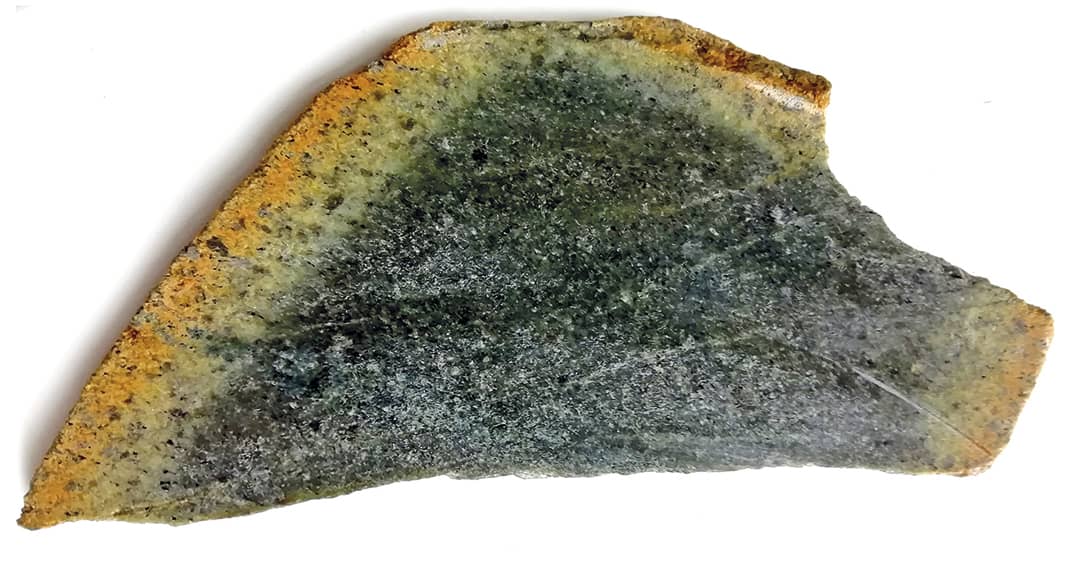
Original dunite from Dun Mountain with a fresh dark green olivine core surrounded by oxidized olivine (iddingsite). Base of image is 25 cm.

Dunite is an intrusive ultramafic rock with a coarse-grained texture, composed of over 90% olivine and minor amounts of pyroxene, chromite, magnetite, and pyrope. It forms part of the peridotite group of mantle-derived rocks. Named by Austrian geologist Ferdinand von Hochstetter in 1859 after Dun Mountain in New Zealand, dunite’s name reflects the dun color of weathered ultramafic rocks. Dunite and other peridotite rocks mainly make up the Earth’s mantle above 400 km depth. Rarely found in continental rocks, dunite typically appears at the base of ophiolite sequences where mantle rock slabs from subduction zones are thrust onto continental crust during collisions. Near the surface, dunite undergoes retrograde metamorphism, transforming into serpentinite and soapstone. The Dun Mountain–Maitai Terrane includes the Dun Mountain ophiolite belt, Maitai Group, and Patuki Mélange. The Dun Mountain Ophiolite is a Permian-age ophiolite in New Zealand’s South Island. In the late 1800s, the Dun Mountain ophiolite belt was surveyed to assess its economic potential. During this period, the rock types dunite and rodingite (named after Dun Mountain and the Roding River) were first identified. The discovery of economically viable chromite deposits near Nelson led to the construction of New Zealand’s first railway.

Dun Mountain is recognized as the origin of geological research in New Zealand. In the late 1800s, the discovery of valuable mineral resources within ophiolite-hosted mineral reserves significantly contributed to New Zealand’s economic prosperity. Consequently, Dun Mountain became a focal point for research in economic geology, structural geology, and stratigraphy.

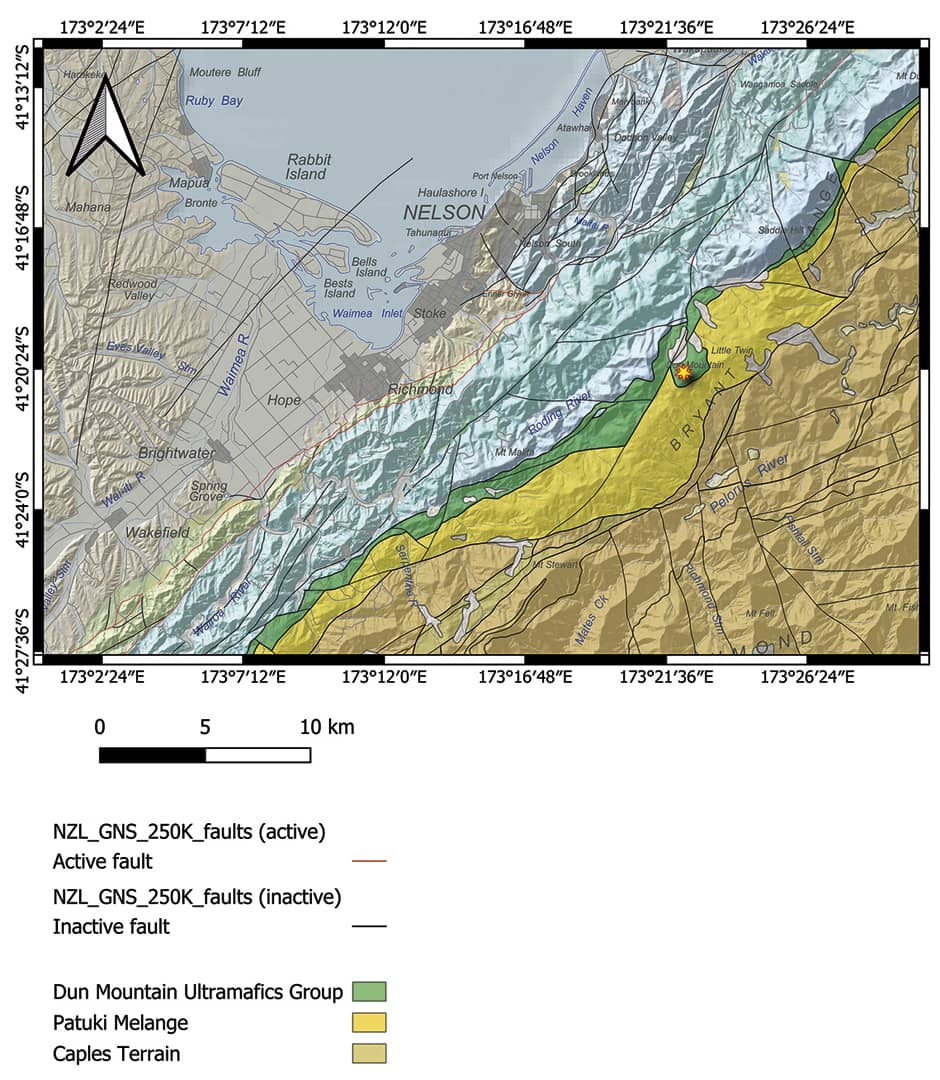
Geological map of the Dun Mountain. The dunite-/dominated ultramafics is in contact to a tectonic melange to Mesozoic greywacke terrains in the south-east.

Brathwaite, R.L., Christie, A.B. and Jongens, R. (2017) “Chromite, platinum group elements and nickel mineralisation in relation to the tectonic evolution of the Dun Mountain Ophiolite Belt, east Nelson, New Zealand,” New Zealand Journal of Geology and Geophysics, 60(3), pp. 255–269. Available at: https://doi.org/10.1080/00288306.2017.1313279.

Davis, T.E. et al. (1980) The Dun mountain ophiolite belt in East Nelson, New Zealand. (Ophiolites,).

Johnston, M.R. (2007) “Nineteenth-century observations of the Dun Mountain Ophiolite Belt, Nelson, New Zealand and trans-Tasman correlations,” Geological Society, London, Special Publications, 287(1), pp. 375–387. Available at: https://doi.org/10.1144/SP287.27.

Lauder, W.R. (1965) “The geology of Dun Mountain, Nelson, New Zealand: Part 2—The petrology, structure, and origin of the ultrabasic rocks,” New Zealand Journal of Geology and Geophysics, 8(3), pp. 475–504. Available at: https://doi.org/10.1080/00288306.1965.10426418.

Nemeth, K., Sagi, T. and Sandor, J. (2024) “Why the Pounamu? Low- to Medium Grade Metabasites and Metaultrabasites of New Zealand from a Geoheritage Perspective,” in Karoly Nemeth (ed.) Metamorphic Rocks as the Key to Understanding Geodynamic Processes. IntechOpen. Available at: https://doi.org/10.5772/intechopen.1000289.

Reed, J.J. (1959) “Chemical and modal composition of dunite from Dun Mountain, Nelson,” New Zealand Journal of Geology and Geophysics, 2(5), pp. 916–919. Available at: https://doi.org/10.1080/00288306.1959.10422757.

Károly Németh.
Saudi Geological Survey, Kingdom of Saudi Arabia

Heather Handley.
Museums Victoria Research Institute (MVRI), Melbourne, Australia

Tamas Sagi.
Eotvoes University, Budapest, Hungary

The Third 100 IUGS Geological Heritage Sites have been officially announced!
Privacy overview

This website uses cookies so that we can offer you the best possible user experience. Cookie information is stored in your browser and performs functions such as recognizing you when you return to our website or helping our team to understand which sections of the website you find most interesting and useful.