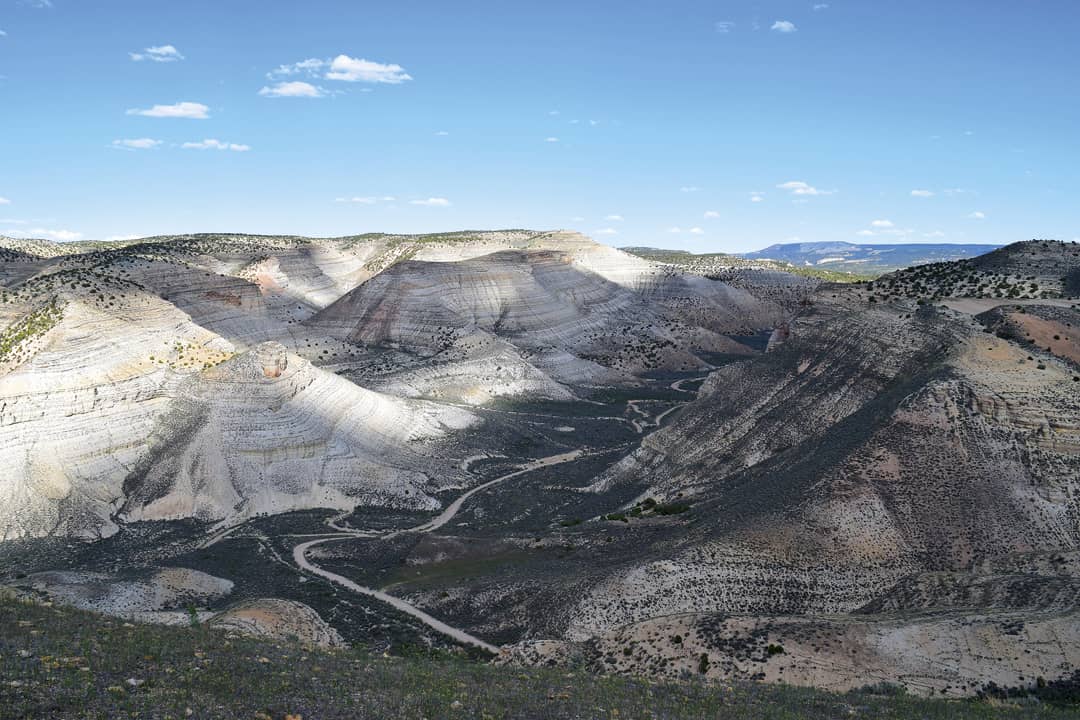
Outcrop showing continuity and lateral extent of profundal oil shale mudrocks in Hells Hole Canyon, Utah, immediately northwest of White Face Butte, Colorado.
Paleogene (Eocene)
Stratigraphy and sedimentology
Mineralogy
NE Utah and NW Colorado, Rocky Mountains, United States of America
39°45’09” N, 109°2’47” W
Outcrop showing continuity and lateral extent of profundal oil shale mudrocks in Hells Hole Canyon, Utah, immediately northwest of White Face Butte, Colorado.
Displays a world class section of the Green River Formation comprising littoral to profundal lacustrine environments deposited during the early-middle Eocene. A rich history of research exists by public geological surveys (Pitman, 1996), energy companies (Bohacs et al., 2000), and the Mars science teams. Multiple preserved tuffs allow age dating. Modern lithofacies, petrographic, and geochemical analyses, including stable isotopes, XRD mineralogy, and SEM imaging by researchers at multiple universities address the Early Eocene Climate Optimum (Smith and Carroll, 2015; Tänavsuu-Milkeviciene et al., 2017) making it a unique paleoclimatic record. Location is on protected public lands and accessible from nearby roads.
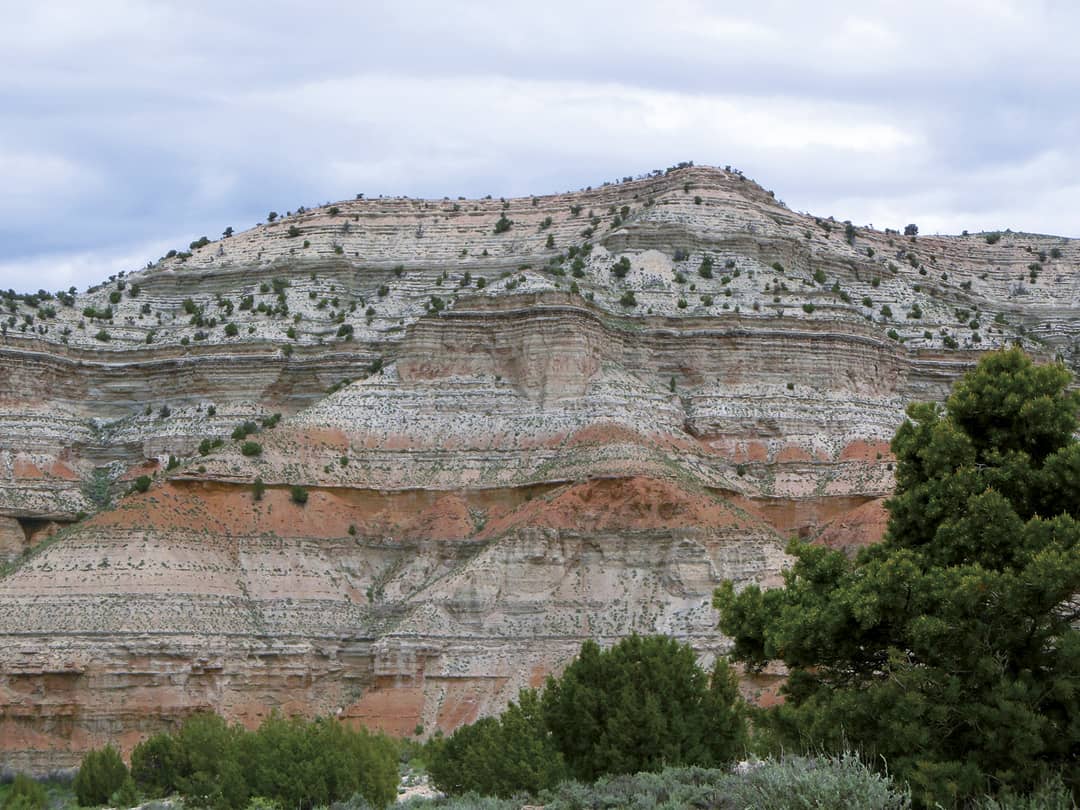
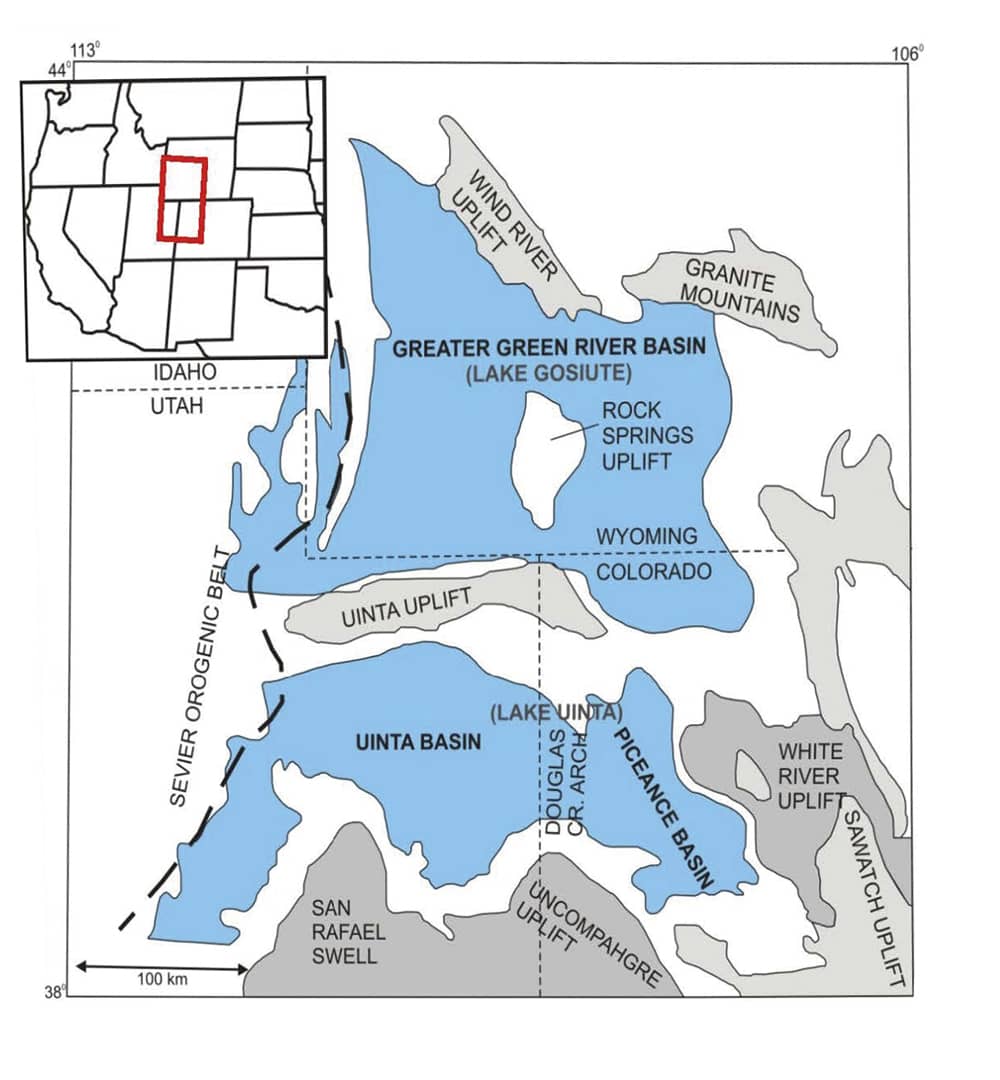
The Green River basins (see map below) formed as a post-orogenic, continental foreland basin in the western USA, ca 53-48 Ma, in early to middle Eocene. Kerogen-rich mudstones (clay and carbonate), occur over a wide area (see photo on the previous page), lakeward of littoral/sublittoral oolitic and microbial carbonates and wave-modified fluvial/deltaic sandstones that formed in a shallow to deep (tens of meters), stratified lake environment (Tänavsuu-Milkeviciene and Sarg, 2012; Smith and Carroll, 2015). The Green River contains world-class preserved flora and fauna unique to this Eocene lacustrine system. The location here is a 250 meter vertical outcrop (White Face Butte) that anchors multi-kilometer exposures in two adjacent canyons (see photo above) displaying a spectacularly preserved, accessible lacustrine system deposited during the Early Eocene Climate Optimum (Tänavsuu-Milkeviciene and Sarg, 2012; Tänavsuu-Milkeviciene et al., 2017). Stacked meter to decimeter thick depositional cycles form depositional sequences meters to tens of meters thick (see photo above). Depositional sequences record periods of low, rising, and high lake. The changing character of stratigraphic cycles record the evolution of this paleo-lake from an initial fresh lake to a saline alkaline lake, and a final mesosaline/alkaline lake system. This history reflects changing climatic conditions from humid to semiarid, and a return to humid conditions (Birgenheier et al., 2020).
The USA and Utah Geological Surveys have long studied the Green River for its oil shale (Pitman, 1996), and multiple universities have conducted modern research into Early Eocene Climate Optimum lacustrine sedimentary record (Bohacs et al., 2000; Tänavsuu-Milkeviciene and Sarg, 2012; Smith and Carroll, 2015; Tänavsuu-Milkeviciene et al., 2017; Birgenheier et al., 2020).
Birgenheier, L.P. et al. (2020) “Climate impact on fluvial-lake system evolution, Eocene Green River Formation, Uinta Basin, Utah, USA,” Geological Society of America, Bulletin, 132(3–4), pp. 562–587. Available at: https://doi.org/10.1130/b31808.1.
Bohacs, K.M. et al. (2000) “Lake-Basin Type, Source Potential, and Hydrocarbon Character: an Integrated Sequence-Stratigraphic–Geochemical Framework,” in E.H. Gierlowski-Kordesch and K.R. Kelts (eds.) Lake Basins Through Space and Time. American Association of Petroleum Geologists (AAPG Studies in Geology, 46), pp. 3–34. Available at: https://doi.org/10.1306/St46706C1.
Pitman, J.K. (1996) Origin of primary and diagenetic carbonates in the lacustrine Green River Formation (Eocene), Colorado and Utah. Report 2157. U.S. Geological Survey Bulletin, pp. iii, 17 p. ill. ;28 cm. Available at: https://doi.org/10.3133/b2157.
Smith, M.E. and Carroll, A.R. (eds.) (2015) Stratigraphy and Paleolimnology of the Green River Formation, Western USA. Dordrecht: Springer Netherlands (Syntheses in Limnogeology). Available at: https://doi.org/10.1007/978-94-017-9906-5.
Tänavsuu-Milkeviciene, K. and Sarg, J.F. (2012) “Evolution of an organic-rich lake basin – stratigraphy, climate and tectonics: Piceance Creek basin, Eocene Green River Formation,” Sedimentology, 59(6), pp. 1735–1768. Available at: https://doi.org/10.1111/j.1365-3091.2012.01324.x.
Tänavsuu-Milkeviciene, K., Sarg, J.F. and Bartov, Y. (2017) “Depositional Cycles and Sequences In An Organic-Rich Lake Basin: Eocene Green River Formation, Lake Uinta, Colorado and Utah, U.S.A.,” Journal of Sedimentary Research, 87(3), pp. 210–229. Available at: https://doi.org/10.2110/jsr.2017.11.
J. Frederick (Rick) Sarg.
Colorado School of Mines