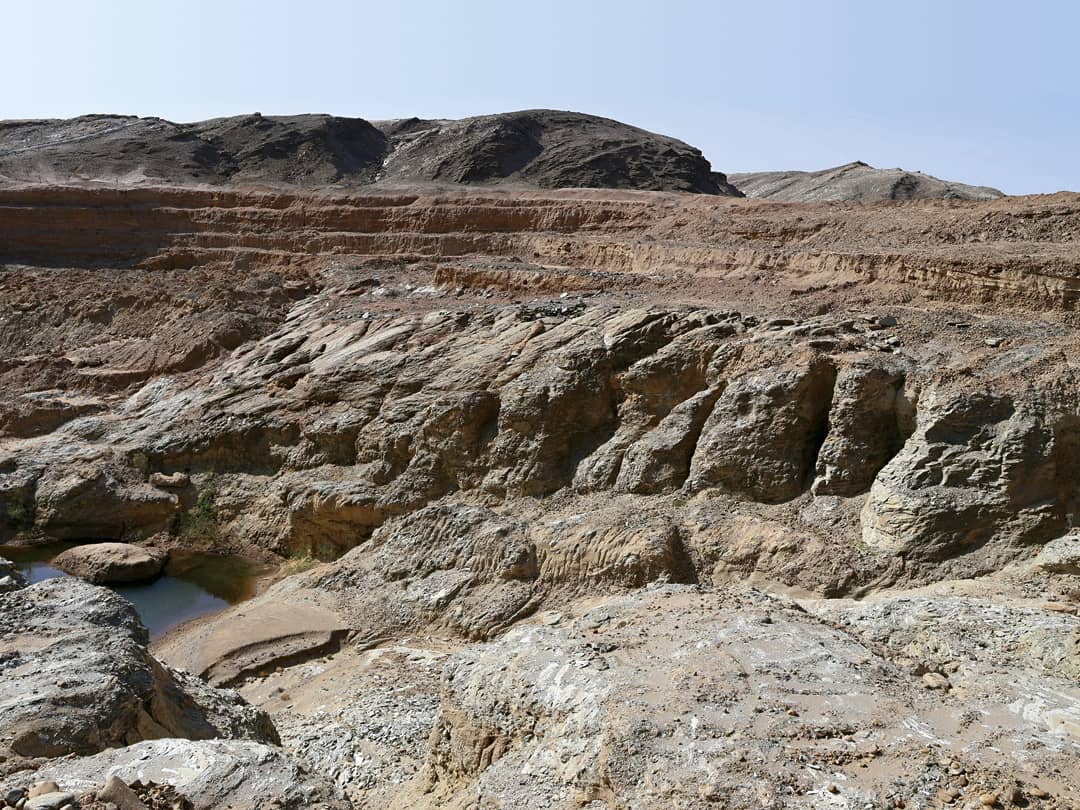
Large potholes preserved in a meander terraces are a perfect trap site for diamonds transported from the interior. (Photo: Roger Swart).
Geological Period
Paleogene (Eocene) to Quaternary (Holocene)
Main geological interest
Stratigraphy and sedimentology
Mineralogy
Location
Karas Region, Namibia
28°33’10” S, 16°25’40” E
Large potholes preserved in a meander terraces are a perfect trap site for diamonds transported from the interior. (Photo: Roger Swart).
Multi-process diamond mega-placer involving fluvial, marine and aeolian processes. This is the only placer of its kind globally.
The placer is unique in the world in terms of the combination of sedimentary and geomorphological processes that have been involved in its formation. The long distance conveyor which comprises the fluvial, marine and aeolian systems, has resulted in a deposit of >95% gem quality, far higher than other global diamond deposits. Additionally, mining has exposed a rich palaeontological heritage.
Mining has enhanced the visibility of these processes in that internal structures such as pot-holes, scours, sediment bars and gullies have been exposed and provide a visual record of these processes.
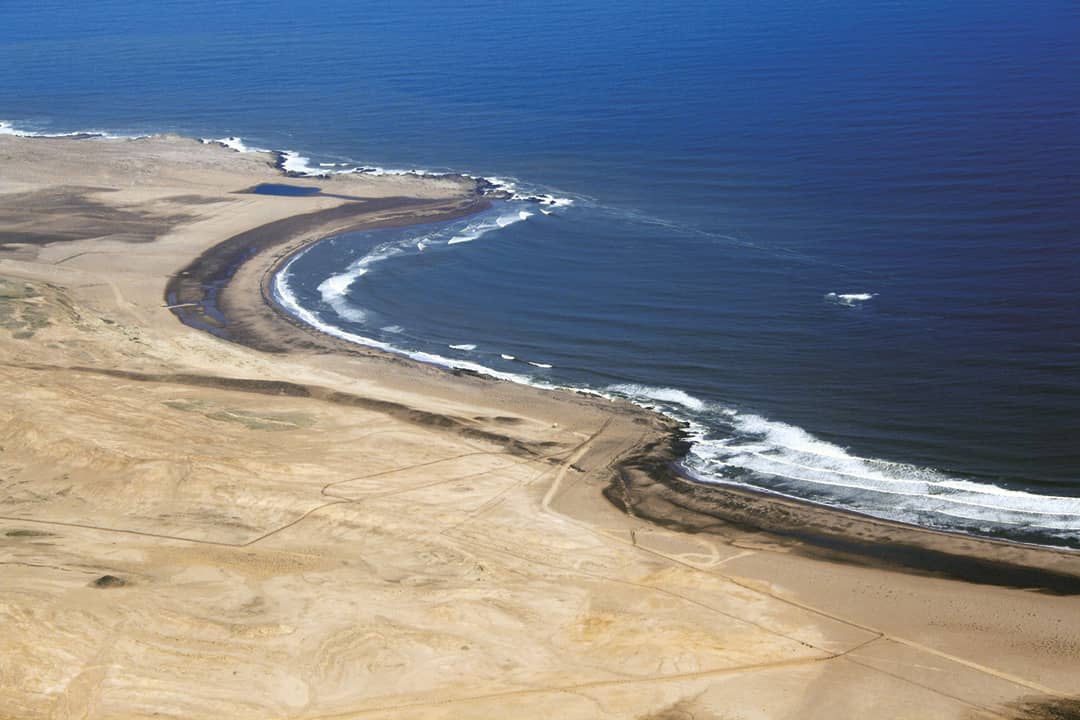
Log-spiral bays are trap sites for northward moving marine diamonds (photo: Roger Swart).
Geological description
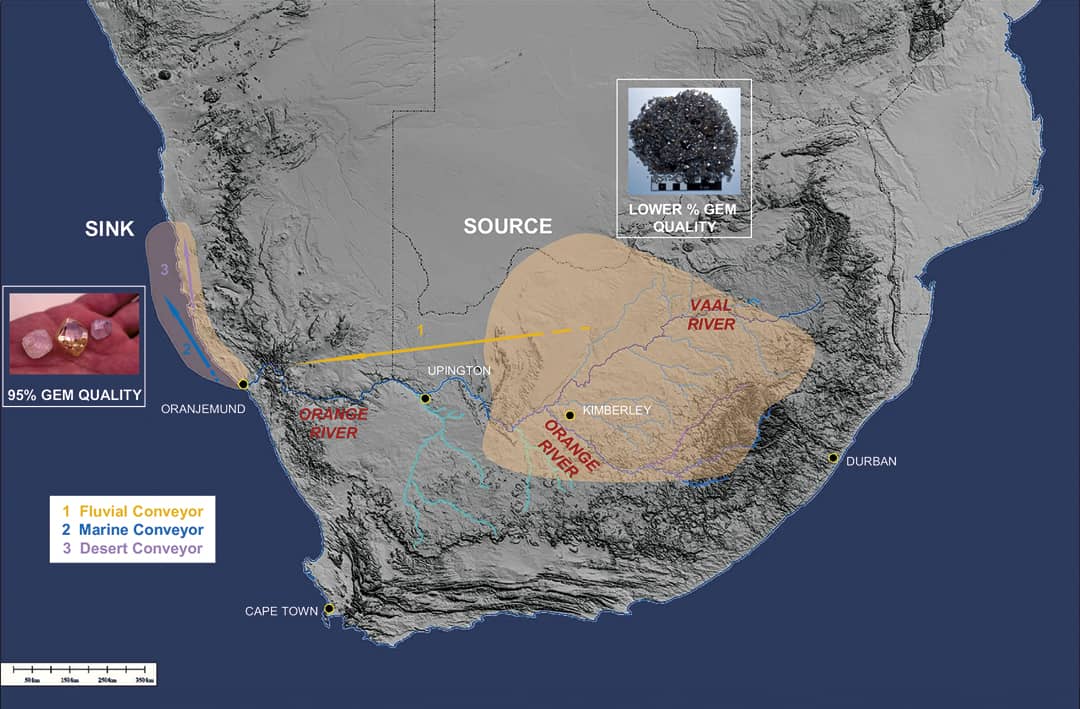
The Sperrgebiet diamond placer comprises a continuum of deposits, including fluvial, marine and aeolian. Diamonds, which are derived from kimberlite pipes in the interior of southern Africa, started entering the Orange-Vaal drainage system in the Eocene and the process has continued to the present day. The drainage basin of the Orange-Vaal is nearly 1 million square kilometers in size. The elements of the placer include river terraces, marine terraces of multiple ages found both below and above current sea level and aeolian deposits that have reworked the older marine gravels.
The physiography and climate of the region is ideal for accumulating a mega-placer. The large drainage area feeds onto a wide (170km) and relatively deep (400m at the shelf edge) continental shelf which trapped sediment and diamonds. Dominant winds are from the south to south west and these drive sediment deposited on the shelf back onshore and northwards. The structural
grain of the bedrock is sub-parallel to the margin and differential erosion of the
meta-sedimentary rocks helps to create trap sites for diamonds. This unique combination of features has allowed the development of a multi-dimensional placer which has produced over 95 million carats since its discovery in 1908.
Scientific research and tradition
Scientific interpretation of the deposits began immediately after their discovery. The interpretation of the deposits and their origins has constantly evolved with time with new understanding allowing for continued mining. Detailed mapping and logging from pre-World War 1 times is still used today to extend the understanding of the deposits.
Map showing the location and scale of the megaplacer, centered on the town of Oranjemund. Diamond quality increases downstream.
Reference
Bluck, B.J., Ward, J.D. and Wit, M.C.J.D. (2005) “Diamond mega-placers: southern Africa and the Kaapvaal craton in a global context,” in I. McDonald et al. (eds.) Mineral Deposits and Earth Evolution. Geological Society of London (Special Publications), pp. 213–245. Available at: https://doi.org/10.1144/GSL.SP.2005.248.01.12.
Helgren, D.M. (1979) Rivers of diamonds : an alluvial history of the Lower Vaal Basin, South Africa. Chicago : University of Chicago, Dept. of Geography (Research Paper, 185). Available at: http://archive.org/details/riversofdiamonds0000helg.
Jacob, R.J. (2005) The erosional and Cainozoic depositional history of the Lower Orange River, southwestern Africa. PhD. University of Glasgow. Available at: https://eleanor.lib.gla.ac.uk/record=b2296132.
Kaiser, E. (1926) Die Diamantenwuste Südewestafrikas. Berlin: Dietrick Reimer (Ernst Vohsen).
Pickford, M. and Senut, B. (2000) Geology and palaeobiology of the central and southern Namib Desert, Southwestern Africa. Windhoek, Namibia : Memoir of the Geological Survey of Namibia, 18.
de Wit, M.C.J. (2025) “Diamonds delivered to the West Coast of southern Africa from erosion of the Kaapvaal-based kimberlites and lamproites,” Mineralogy and Petrology, 119(3), pp. 433–448. Available at: https://doi.org/10.1007/s00710-025-00894-5.