Pleistocene to Holocene fluvio lacustrine deposits of Makgadikgadi Pans
Botswana
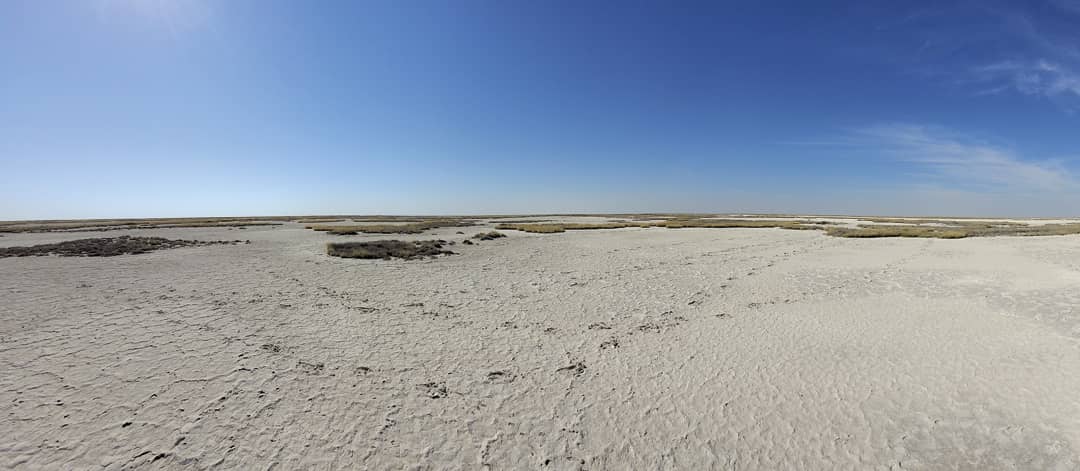
The vast expanse of the Makgadikgadi pans, view from the western margin of the Ntwetwe pan to the east (Photo credit: Asfawossen Asrat).
Geological Period
Quaternary (Pleistocene) to Quaternary (Holocene)
Main geological interest
Stratigraphy and sedimentology
Geomorphology and active geological processes
Location
Southern Africa, Botswana
20°45’00” S, 25°30’00” E
The vast expanse of the Makgadikgadi pans, view from the western margin of the Ntwetwe pan to the east (Photo credit: Asfawossen Asrat).
One of the largest evaporitic pans, showing striking similarities to playa deposits on Mars, located in the center of the Kalahari Desert.
The Makgadikgadi basin presents striking similarities with Mars playa deposits, and the layered mounds, relict fan deltas with inverted channels, polygonal structures and evaporitic crusts harboring communities of extremophiles present a unique setting for investigating extreme environments (Kahsay et al., 2024). These pans can serve as test beds for the physical and chemical characteristics of playa deposits on Mars. In addition, the Sua and Ntwetwe pans are biodiversity hotspots as they are major breeding areas for lesser and greater flamingo. The pans also serve as major sources of soda ash.
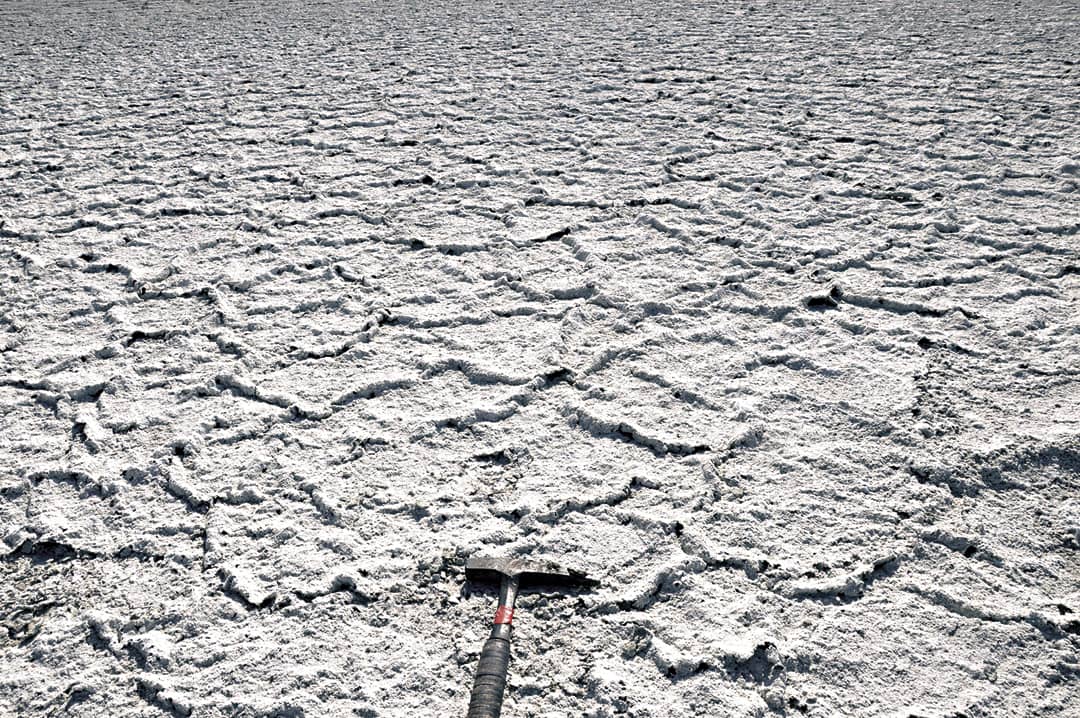
A polygonal teepee structure showing repeated cycle of evaporation and mineral precipitation on a playa environment (Photo: Fulvio Franchi).
Geological description
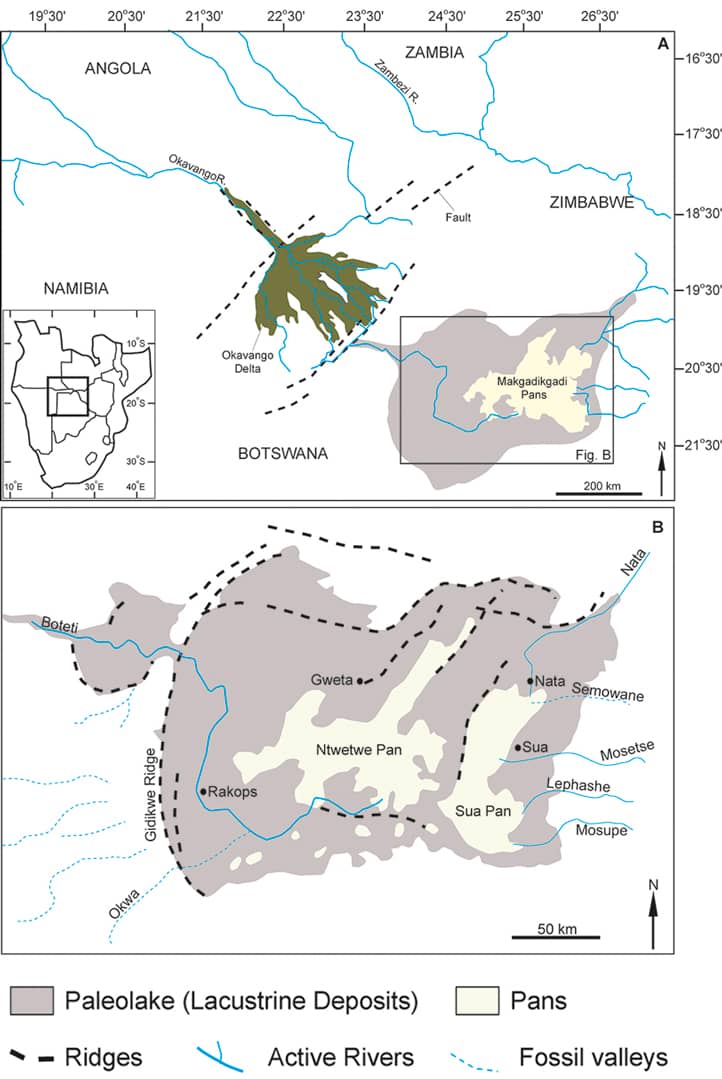
The Makgadikgadi basin is a fault-bounded intracratonic basin (Fig. 1) formed during the Early Pleistocene at the centre of the Kalahari Desert (Burrough et al., 2009; Moore et al., 2012). The basin comprises playa lake evaporite deposits underlain by fluvio-lacustrine Kalahari Group sediments, Carboniferous-Jurassic Karoo Supergroup sediments and volcanics and Archean-Neoproterozoic basement rocks (Franchi et al., 2022; Kahsay et al., 2024). The modern Makgadikgadi basin is a system of ~16.000 km2 playa or pan ephemeral lakes. The two largest pans in the complex – the Sua and Ntwetwe pans (Photos 1 and 2) have a total surface area of 8,409 km2. The pans are relict of 66,000 km2 large Pleistocene paleolake complex (Burrough et al., 2009; Riedel et al., 2014). The pan deposits are made up of unlithified sand, silt and clay sediments of 30–150 m thickness (Schmidt et al., 2023; Kahsay et al., 2024) with several interlayered calcretes and silcretes. The basin contains peculiar geomorphological features including concentric layered mounds, lakebed barchan dunes, deltaic landforms and fossil shorelines (e.g., Franchi et al., 2020; Kahsay et al., 2024). The pans are largely protected as part of them are within consrvation areas. They can be accessed by off-road tracks.
Scientific research and tradition
The Makgadikgadi pans have been investigated since the 1980s. Detailed and sustained study of the evolution of the paleolakes and the pans has been conducted since the 2000s. Since 2010, a number of studies of the unique geomorphic features of the basin have been used as analogues for Martian investigations.
The Makgadikgadi pans: (A) geological and structural context of the Makgadikgadi pans; and (B) Ntwetwe and Sua pans, ancient shore lines and active and fossil river valleys.
Reference
Burrough, S.L., Thomas, D.S.G. and Bailey, R.M. (2009) “Mega-Lake in the Kalahari: A Late Pleistocene record of the Palaeolake Makgadikgadi system,” Quaternary Science Reviews, 28(15), pp. 1392–1411. Available at: https://doi.org/10.1016/j.quascirev.2009.02.007.
Franchi, F. et al. (2022) “Late Pleistocene–Holocene Palaeoenvironmental Evolution of the Makgadikgadi Basin, Central Kalahari, Botswana: New Evidence From Shallow Sediments and Ostracod Fauna,” Frontiers in Ecology and Evolution, 10. Available at: https://doi.org/10.3389/fevo.2022.818417.
Kahsay, T.H., Asrat, A. and Franchi, F. (2024) “The astrobiological potential of the Makgadikgadi Basin, Botswana: Field analogue for planetary exploration,” Planetary and Space Science, 249, p. 105943. Available at: https://doi.org/10.1016/j.pss.2024.105943.
Moore, A.E., Cotterill, F.P.D. (Woody) and Eckardt, F.D. (2012) “The evolution and ages of Makgadikgadi paleo-lakes: consilient evidence from Kalahari drainage evolution south-central Africa,” South African Journal of Geology, 115, pp. 385–413. Available at: https://doi.org/10.2113/gssajg.115.3.385.
Riedel, F. et al. (2014) “Dynamics of a Kalahari long-lived mega-lake system: hydromorphological and limnological changes in the Makgadikgadi Basin (Botswana) during the terminal 50 ka,” Hydrobiologia, 739(1), pp. 25–53. Available at: https://doi.org/10.1007/s10750-013-1647-x.
Schmidt, G. et al. (2023) “Structural influences on groundwater circulation in the Makgadikgadi salt pans of Botswana? Implications for martian playa environments,” Frontiers in Astronomy and Space Sciences, 10. Available at: https://doi.org/10.3389/fspas.2023.1108386.
Author(s)
Asfawossen Asrat.
Botswana International University of Science and Technology, Palapye, Botswana; and Addis Ababa University, Ethiopia
Trhas Hadush Kahsay.
Botswana International University of Science and Technology, Botswana
Fulvio Franchi.
Università degli Studi di Bari – Aldo Moro, Italy