Clastic Microbial mats of the Mesoarchean Nhlazatse Section
South Africa
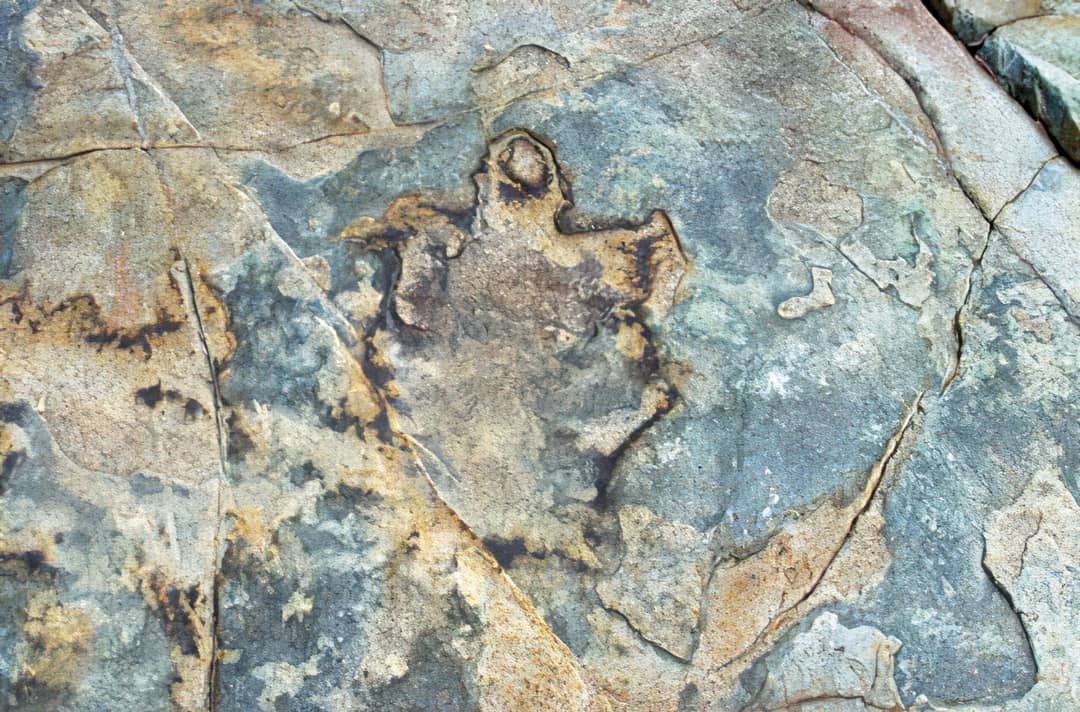
Example for exceptionally well preserved sedimentary structures produced by microbial mats in sandy tidal flats, Wit Mfolozi River Gorge, South Africa (Photo: Nora Noffke).
Geological Period
Meso-archean Era
Main geological interest
Paleontology
Stratigraphy and sedimentology
Location
Wit Mfolozi River Gorge, South Africa
28°10’00” S, 31°15’00” E
Example for exceptionally well preserved sedimentary structures produced by microbial mats in sandy tidal flats, Wit Mfolozi River Gorge, South Africa (Photo: Nora Noffke).
Worldwide unique outcrop of clastic microbial mat structures that recorded ancient climate zones in an Archean tidal flat.
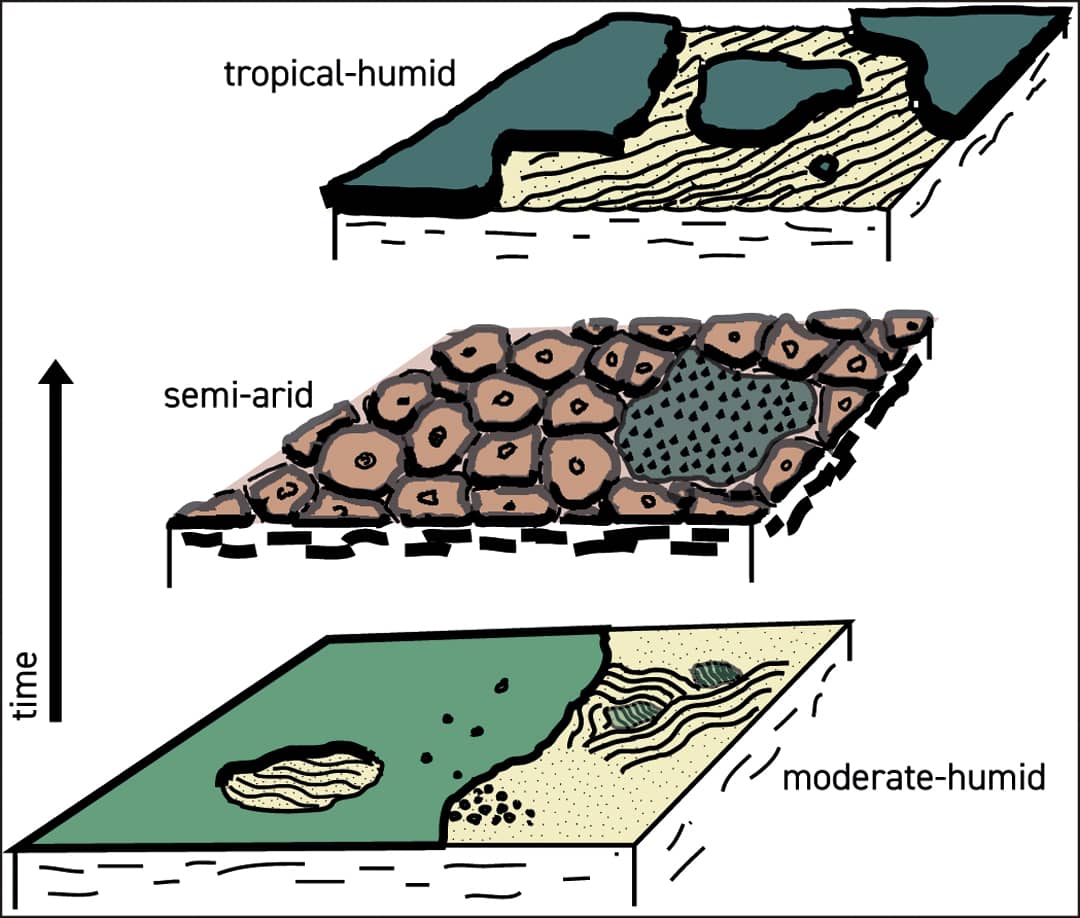
The enormous paleontological archive of Archean siliciclastic paleoenvironments has been unlocked only recently. In such settings, microbial mats are dominant testimony of life. With its rich content of exceptionally preserved fossil microbial mats, the Nhlazatse Section is a key site of global significance. Here, the morphological change of mat structures document that their paleoenvironment was once migrating through three climate zones (Noffke et al., 2008). The original paper has been cited more than 450 times and was highlighted by a Nature news article (Tice, 2008).
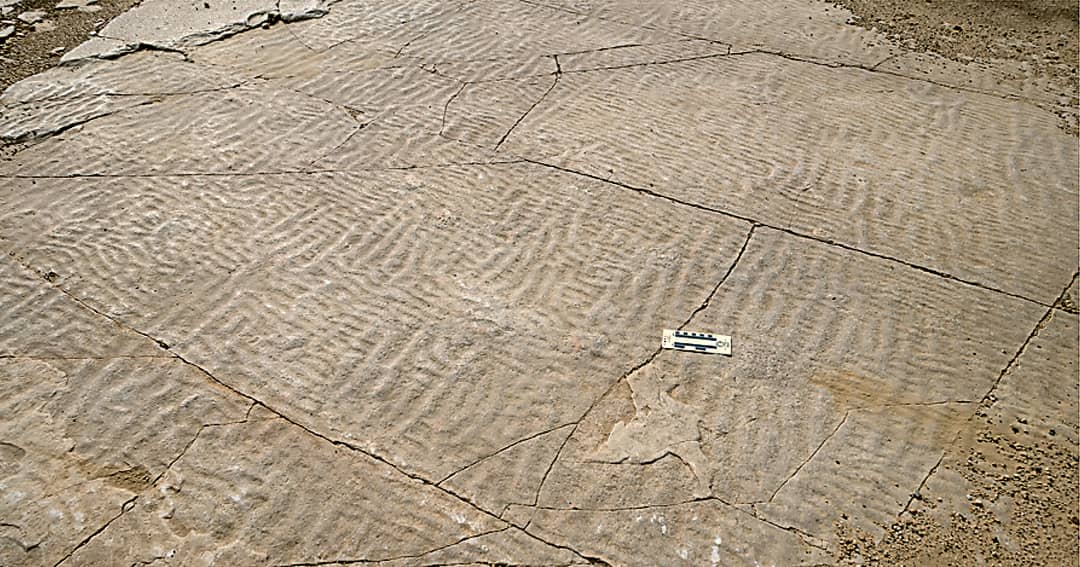
Sandstone surface in the Wit Mfolozi River Gorge covered by fossil microbial mats that once modified the ripple marks (Photo: Nora Noffke).
Geological description
The 46-meter-thick, clastic Nhlazatse Section is exposed in the picturesque Wit Mfolozi River Gorge, South Africa. It belongs to the 2.9 Ga Pongola Supergroup. The clastic succession harbors an exquisitely preserved suite of fossil microbial mats once colonizing the first shallow-marine sediments deposited across a substantial continent (Noffke et al., 2008). Interacting with physical sediment dynamics, the microbenthos formed characteristic microbially induced sedimentary structures that are known from modern coasts as well. The clastic structures differ in morphologies and formation greatly from carbonate stromatolites (Noffke and Awramik, 2013). The spectacular display of these structures in outcrop includes about 400 specimen of erosional remnants and pockets, gas domes, polygonal osciallation cracks, mat chips and many others. As is the case in modern settings, the distribution of these sedimentary structures reflects the ancient tidal flat geomorphology and tidal current dynamics. More so, the structures testify that the ancient setting migrated from a seasonal, temperate to a tropical semi-arid climate zone. The top of the section even includes structures typical for a full tropical climate. This pristine lagerstätte of Mesoarchean life and paleoclimate is worldwide unique and rightfully a critical reference location for Archean geoscience.
Scientific research and tradition
The stratigraphic section has been the basis for the first textbook on microbially induced sedimentary structures (Noffke, 2010). They are described in the volume “Prokaryota” of the Treatise of Invertebrate Paleontology (2023). In 2008, a BBC documentary was produced in this outcrop documenting the structures and paleoclimate in which they flourished.
The microbial structures in the Wit Mfolozi River Gorge document a migration of the ancient coastal setting from a moderate to a tropical climate zone.
Reference
Ausich, W.I. and Selden, P.A. (eds.) (2023) Treatise on Invertebrate Paleontology. Part B. Prokaryota. Bacteria and Archaea. The University of Kansas Paleontological Institute. Lawrence, Kansas. Available at: https://journals.ku.edu/InvertebratePaleo/article/view/25168/22385.
Noffke, N. et al. (2008) “An actualistic perspective into Archean worlds – (cyano-)bacterially induced sedimentary structures in the siliciclastic Nhlazatse Section, 2.9 Ga Pongola Supergroup, South Africa,” Geobiology, 6(1), pp. 5–20. Available at: https://doi.org/10.1111/j.1472-4669.2007.00118.x.
Noffke, N. (2010) Geobiology: Microbial Mats in Sandy Deposits from the Archean Era to Today. Berlin, Heidelberg: Springer. Available at: https://doi.org/10.1007/978-3-642-12772-4.
Noffke, N. and Awramik, S.M. (2013) “Stromatolites and MISS—Differences between relatives,” GSA Today, 23(9), pp. 4–9. Available at: https://doi.org/10.1130/gsatg187a.1.
Tice, M.M. (2008) “Modern life in ancient mats,” Nature, 452(7183), pp. 40–41. Available at: https://doi.org/10.1038/452040a.
Author(s)
Nora Noffke.
Old Dominion University, Norfolk, Virginia 23529, USA
Noah Nhleko.
Geological Survey and Mines Department, Mbabane, Swaziland
Albertus Smith.
Department of Geology, University of Johannesburg, South Africa