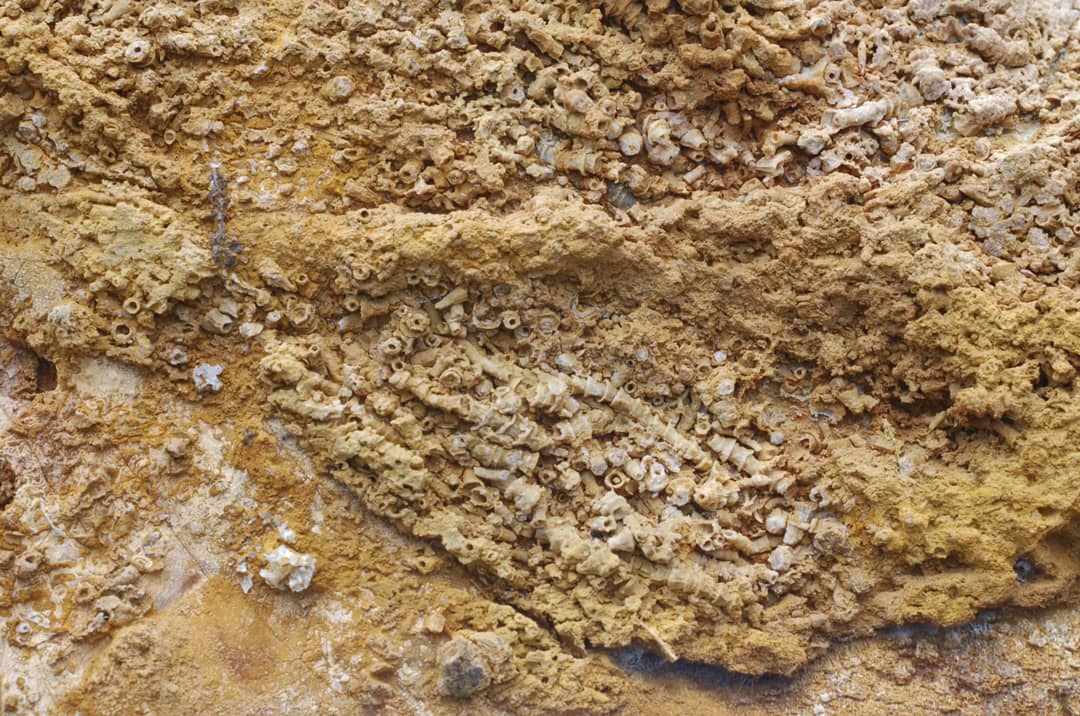
Detail of the ‘Cloudina carinata’ accumulation in the limestone block displayed in the Visitors Reception Centre of the Villuercas-Ibores-Jara UNESCO Global Geopark. (Approximate frame width: 13 cm).
Geological Period
Ediacaran
Main geological interest
Paleontology
History of geosciences
Location
Central East of Extremadura region, central Spain, Spain
39°22’48” N, 5°23’21” W
Detail of the ‘Cloudina carinata’ accumulation in the limestone block displayed in the Visitors Reception Centre of the Villuercas-Ibores-Jara UNESCO Global Geopark. (Approximate frame width: 13 cm).
One of the best and biggest concentration of Cloudina, the oldest animal skeletons, accessible to everyone.
Late Ediacaran (550–538 Ma) outcrops in Extremadura with the tubular fossils Cloudina offer an exceptional view of a crucial period in the evolution of life on our planet: the origin of the first biomineralized skeletons, igniting the Cambrian explosion and the Great Ordovician Biodiversification Event.
The presence of Cloudina in a variety of styles of preservation, including specimens in spectacular three-dimensions, makes this an exceptional area in which to explore the origin of skeletons.
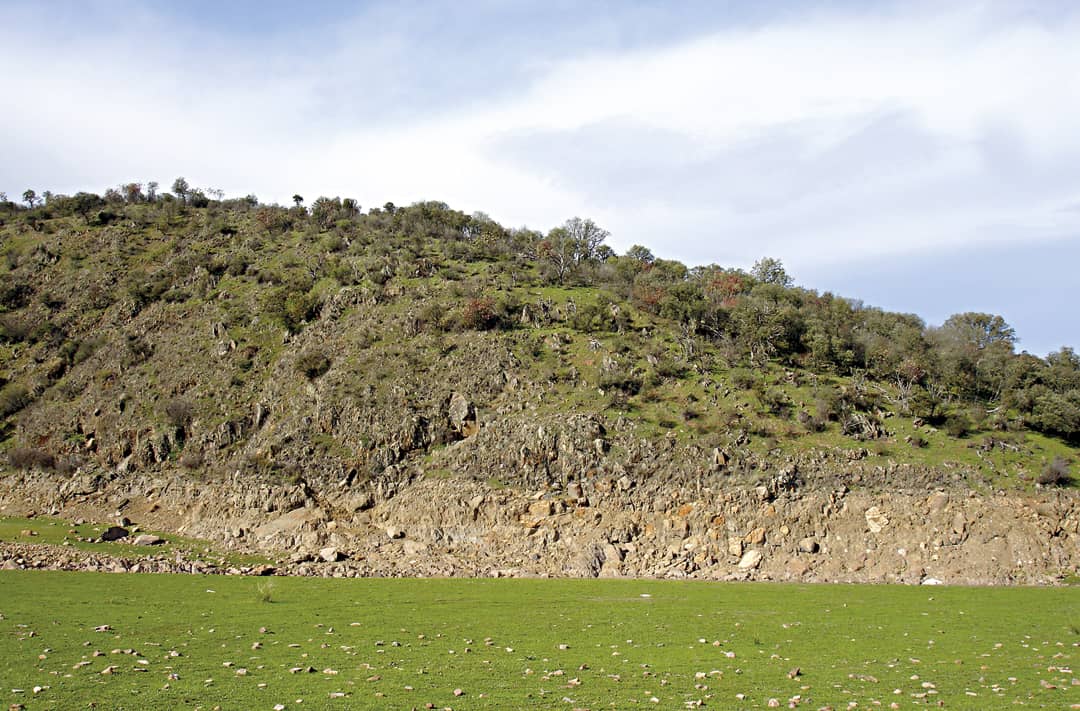
Outcrop at the type locality of ‘Cloudina carinata’ at El Membrillar, eastern Extremadura. The ‘C. carinata’ holotype block displayed in the Visitor Centre (see previous page), is the same type of limestone olistolith as those visible in this outcrop.
Geological description
The Cloudina-bearing outcrops are located in east Extremadura and belong to the Central Iberian Zone of the Iberian Massif. Lithospheric convergence along western Gondwana during the Cadomian orogeny (ca. 630–550 Ma) resulted in the formation of an orogenic belt flanked by fore- and retro-arc basins (Álvaro et al., 2020).
In the retro-arc basin, reefs with the first skeletonized animals developed of which the tubular fossil Cloudina is the best known and most abundant. The study of these fossils is essential for understanding the origin of skeletons and their role in animal diversification.
These outcrops include various types of sedimentary structures: in situ reefs, carbonate rocks formed by accumulations of shells, olistostromes and siliciclastic materials. Cloudina is found in a great diversity of preservation types, including internal and external moulds, phosphatisation, silicification and pyritisation.
Fossils, including three-dimensional specimens, are exceptionally preserved and display the biodiversity of late Ediacaran seas. They include two different species of Cloudina, including Cloudina carinata first described here (Cortijo et al., 2010). These are associated with other skeletonized fossils such as Sinotubulites and Protolagena (Cortijo et al., 2015a).
These deposits in Extremadura arguably constitute one of the best sites worldwide to study these organisms.
Scientific research and tradition
This area includes the first outcrop with Cloudina in Europe (Grant, 1990). Fossils from these sites allowed the description of the oldest ontogeny and asexual reproduction (Cortijo et al., 2015b). Some of these sites are included in a UNESCO Global Geopark and a Biosphere Reserve, being an important part of their conservation and education strategies.
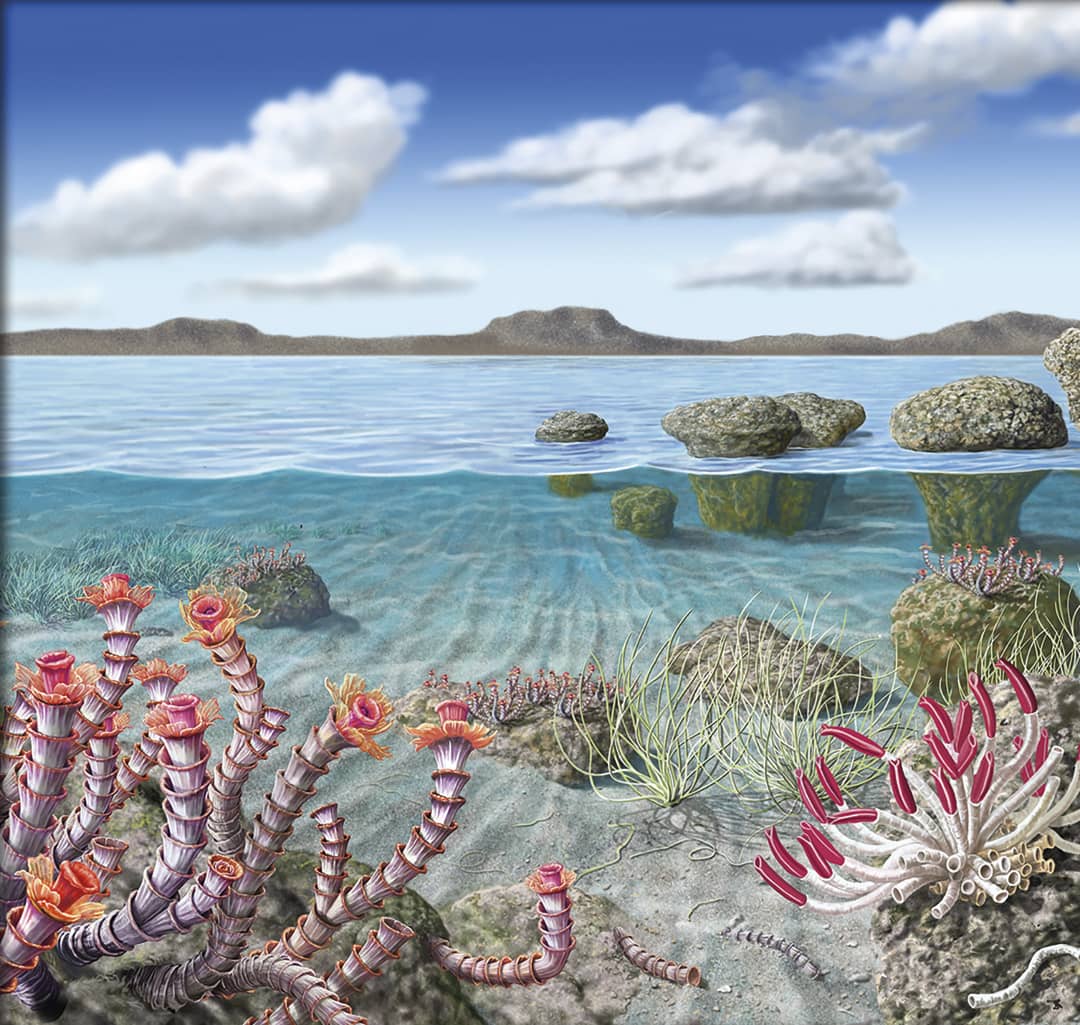
Reconstruction of the paleoenvironment in the late Ediacaran with ‘Cloudina carinata’ (left) and other organisms (by Antonio Grajera).
Reference
Álvaro, J.J. et al. (2020) “Cloudina-microbial reef resilience to substrate instability in a Cadomian retro-arc basin of the Iberian Peninsula,” Precambrian Research, 336, p. 105479. Available at: https://doi.org/10.1016/j.precamres.2019.105479.
Cortijo, I. et al. (2010) “A new species of Cloudina from the terminal Ediacaran of Spain,” Precambrian Research, 176, pp. 1–10. Available at: https://doi.org/10.1016/j.precamres.2009.10.010.
Cortijo, I., et al. (2015) “Late Ediacaran skeletal body fossil assemblage from the Navalpino anticline, central Spain,” Precambrian Research, 267, pp. 186–195. Available at: https://doi.org/10.1016/j.precamres.2015.06.013.
Cortijo, I., et al. (2015) “Life history and autecology of an Ediacaran index fossil: Development and dispersal of Cloudina,” Gondwana Research, 28, pp. 419–424. Available at: https://doi.org/10.1016/j.gr.2014.05.001.
Grant, S.W. (1990) “Shell structure and distribution of Cloudina, a potential index fossil for the terminal Proterozoic,” American Journal of Science, 290-A, pp. 261–294.
Author(s)
Iván Cortijo Sánchez.
Villuercas-Ibores-Jara UNESCO Global Geopark (Cáceres, Spain)
Sören Jensen.
University of Extremadura (Badajoz, Spain)
Mónica Martí Mus.
University of Extremadura (Badajoz, Spain)
José María Barrera Martín-Merás.
Villuercas-Ibores-Jara UNESCO Global Geopark (Cáceres, Spain)
Teodoro Palacios Medrano.
University of Extremadura (Badajoz, Spain)